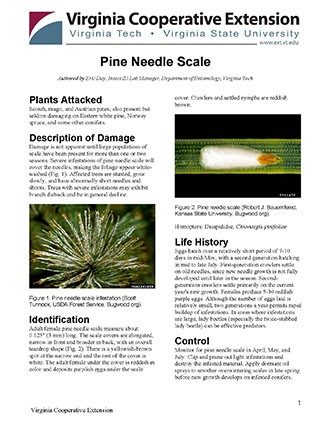
Pine Needle Scale
ID
2907-1400 (ENTO-371NP)
Plants Attacked
Scotch, mugo, and Austrian pines; also present but seldom damaging on Eastern white pine, Norway spruce, and some other conifers.
Description of Damage
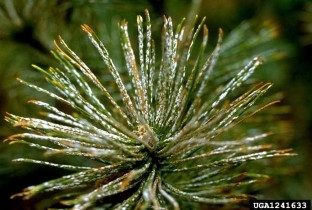
Damage is not apparent until large populations of scale have been present for more than one or two seasons. Severe infestations of pine needle scale will cover the needles, making the foliage appear white- washed (Fig. 1). Affected trees are stunted, grow slowly, and have abnormally short needles and shoots. Trees with severe infestations may exhibit branch dieback and be in general decline.
Identification
Adult female pine needle scale measure about 0.125" (3 mm) long. The scale covers are elongated, narrow in front and broader in back, with an overall teardrop shape (Fig. 2). There is a yellowish-brown spot at the narrow end and the rest of the cover is white. The adult female under the cover is reddish in color and deposits purplish eggs under the scale cover. Crawlers and settled nymphs are reddish brown.
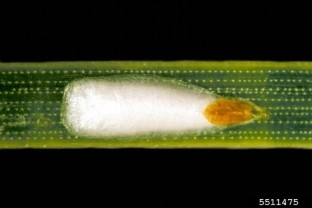
Homoptera: Diaspididae, Chionaspis pinifoliae
Life History
Eggs hatch over a relatively short period of 7-10 days in mid-May, with a second generation hatching in mid to late July. First-generation crawlers settle on old needles, since new needle growth is not fully developed until later in the season. Second- generation crawlers settle primarily on the current year's new growth. Females produce 5-30 reddish purple eggs. Although the number of eggs laid is relatively small, two generations a year permits rapid buildup of infestations. In areas where infestations are large, lady beetles (especially the twice-stabbed lady beetle) can be effective predators.
Control
Monitor for pine needle scale in April, May, and July. Clip and prune out light infestations and destroy the infested material. Apply dormant oil sprays to smother overwintering scales in late spring before new growth develops on infested conifers. Insecticidal sprays are effective if applied after most eggs have hatched. Control should be applied between May 5-20 for the first generation OR between July 10-20 for the second generation. Experience has shown that treatments for the summer generation may be more effective than the first. See the Virginia Pest Management Guide for Home Grounds and Animals (VCE 456-018) for a list of approved insecticides recommended for pine needle scale.
Remarks
Pine needle scale can be a serious pest of Christmas trees as well as ornamental trees and shrubs. Crawlers are blown by the wind and can be carried on birds.
Revision
Theresa A. Dellinger, March 19, 2020.
Virginia Cooperative Extension materials are available for public use, reprint, or citation without further permission, provided the use includes credit to the author and to Virginia Cooperative Extension, Virginia Tech, and Virginia State University.
Virginia Cooperative Extension is a partnership of Virginia Tech, Virginia State University, the U.S. Department of Agriculture, and local governments. Its programs and employment are open to all, regardless of age, color, disability, sex (including pregnancy), gender, gender identity, gender expression, national origin, political affiliation, race, religion, sexual orientation, genetic information, military status, or any other basis protected by law
Publication Date
May 1, 2020