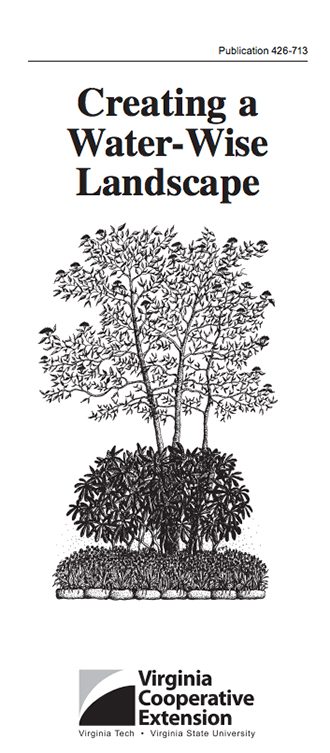
Creating a Water-Wise Landscape
ID
426-713 (HORT-200P)
 EXPERT REVIEWED
What is Water-Wise Landscaping?
Water-wise landscape design and management focus on working with nature and natural forces (such as rainfall) to create an aesthetically pleasing, livable landscape, while using less water from the local supply.
Minimizing the need for watering in your landscape requires careful observation, planning, and common sense. Several principles for water-wise landscaping include choosing the best design and plants, preparing soils, and watering properly for efficient water use.
Water-wise landscaping is also known as xeriscaping, a word trademarked by the National Xeriscape Council. The word is a combination of the prefix xero- or xer- meaning dry or dryness and the suffix-scape meaning scene or view.
Plan Your Landscape
The first step in any successful landscape is a good plan. Observe the site and take notes on the current use of different areas or their desired use. Indicate high-use areas, desirable views, environmental concerns (such as wind direction, slopes, dense shade), and traffic flow through the yard. Sketch the property, including any permanent structures, trees, and shrubs that you plan to leave, grass areas, driveways, and sidewalks.
Based on your notes, develop a plan that meets your needs for use, appearance, and budget. Consider maintenance and water requirements in making your decisions. For example, maintaining a high-quality lawn area for entertaining will require frequent fertilizing and mowing, as well as high water use. A more maintenance-free choice for get-togethers is a deck or patio, but don’t overdo the use of wood or concrete on your land. Leave plenty of vegetative surface for rain to reach the soil and soak in; otherwise, runoff and erosion problems are created. Whatever plan you develop, the cost can be distributed over a period of time if you implement your design over several years.
Prepare Soil Adequately
Good soil is the basis for healthy plants and optimum use of water. The key to good soil is the addition of organic matter, such as compost. Sandy soil will hold water and nutrients better if organic matter is incorporated. Clay will absorb water faster, reducing runoff and erosion, if it is loosened with organic matter. Incorporate approximately 2 to 3 inches of compost, shredded leaves, or other fine organic material into the soil annually.
In locations with established trees and shrubs, it is difficult to incorporate organic matter, but applying and maintaining a 2- to 3-inch layer of an organic mulch (coarse leaves, shredded bark, pine needles, or wood chips) will gradually improve the soil as the humic acid formed by the decomposing material leaches into the ground.

Select Plants Wisely
Decide on the trees, shrubs, and ground covers for your water-wise landscape based on their natural ability to grow well in your area. Select plants that do well with little or no addition of water. Consider native plants as well as introduced species for residential landscapes. Your local Extension agent and nursery personnel can help you identify suitable plants for your location. Limit plants with high water demands to small areas that can be watered efficiently. Grouping plants by water requirements is one way to guard against overwatering some plants and underwatering others.
In general, ground covers require less water than turfgrass, so replacing some of your lawn with a ground cover will conserve water. If you have large deciduous trees in your yard and want to reduce work and water, go natural - allow leaves to accumulate as they would in nature. Plant a few understory shrubs (such as azaleas and rhododendrons), a few understory trees (such as dogwood), and quit raking!
Mulch Your Gardens
Use mulch to conserve soil moisture. Organic mulches help retain moisture so there is less need to water. They also recycle plant materials that might otherwise end up in the landfill. In addition, mulches control annual weeds that compete with desired plants for water. Organic mulches improve soil structure as they decompose and moderate the soil temperature, two factors that also help plants use water efficiently.
Use Optimum Cultural Practices
Proper mowing and fertilizing of the lawn help conserve moisture. Mowing at the proper height (do not remove more than one third of the grass at any one mowing) allows the grass to develop deeper roots that are more efficient in using soil moisture, and reduces annual weeds. Fertilizing at the proper time (your Extension agent or local nursery experts can help you determine this) encourages healthier turf that needs less watering.
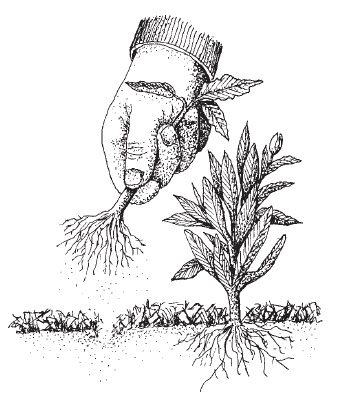
Leaving shrubs in their natural forms reduces stress to the plants and, therefore, lessens their need for water.
Keeping weeds, insects, and diseases under control reduces the competition and stress to plants that increase their water demands.
These principles minimize the water demands in your landscape, help you save money and time, and reduce your impact on the local water supply.
Use Turfgrass Appropriately
Limit the amount of turfgrass you use in the landscape to areas in which grass provides a functional benefit (i.e., a play area for children) that exceeds the benefit of other ground covers or surfacing materials. Select turfgrass suitable to your climate and site.
Design the grass area to make watering easier. Long narrow areas and small, odd shapes are hard to water efficiently. Avoid turf in the strip between the sidewalk and the road; most irrigation water will land on the paved surfaces and run off.
Use the Best Watering Method
While soils vary greatly in their ability to hold water, your garden and lawn should receive enough water to wet the soil to the bottom of the root zone each time you water, generally 1 inch per week. Determine this by digging a hole 5 to 6 inches deep in the watered area the day after watering so the water has a chance to seep in. Adjust weekly watering to your soil needs.
Avoid watering by hand. It often wastes water as there is excess runoff, and water does not penetrate beyond the top 1 inch of soil. This irrigation practice harms plants by forcing root growth too close to the surface. If you must water by hand, place a 5-gallon bucket with a few holes in the bottom next to the plant and fill it with water; when it is has drained, move it to the next plant and refill.
Properly used sprinkler systems can deliver a large quantity of water in a short time. They have the disadvantage, however, of excessive evaporation, both during watering and from the plant and soil surface. Early morning watering minimizes water loss. However, sprinkler systems that deliver the water from overhead are the most effective means of watering turfgrass. Be sure to position sprinklers to shower areas of vegetation, not driveways, streets, or patios. Water until the soil is moist 6 inches deep, usually 1 inch per week applied at one time.
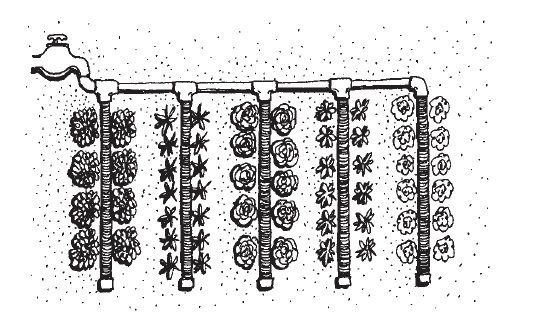
Trickle or drip irrigation systems and ooze hoses are very efficient, slowly applying water to vegetable and ornamental gardens. Soil moisture can be maintained at a level most suitable to plant uptake. If properly installed and maintained, little water is lost to evaporation or runoff and water use can be reduced by up to 50 percent. For many situations, the expense of installing a good trickle irrigation system will be compensated by reduced water usage, less replacement of plant materials, and less work. On any irrigation system, replace leaky parts promptly.
Measure the Quantity of Water
To measure the amount of water – whether from a sprinkler or rain – use a rain gauge or a tin can set in the lawn or garden areas to be measured. The soil has received an inch of water when the water in the container is an inch deep.

For more information on selection, planting, cultural practices, and environmental quality, contact your local Virginia Cooperative Extension Office. If you want to learn more about horticulture through training and volunteer work, ask your Extension agent about becoming an Extension Master Gardener. Horticultural information is also now available on the Internet by connecting with Virginia Cooperative Extension’s server at http://www.ext.vt.edu.
The original development of this series was funded by ESUSDA Smith Lever 3(d) National Water Quality Initiative Funds and the Virginia Department of Conservation and Recreation, Division of Soil and Water Conservation.
Revised by Joyce Latimer, Extension Specialist, Virginia Tech
Reviewed by Alex Niemiera, Extension Specialist, Horticulture
Virginia Cooperative Extension materials are available for public use, reprint, or citation without further permission, provided the use includes credit to the author and to Virginia Cooperative Extension, Virginia Tech, and Virginia State University.
Virginia Cooperative Extension is a partnership of Virginia Tech, Virginia State University, the U.S. Department of Agriculture (USDA), and local governments, and is an equal opportunity employer. For the full non-discrimination statement, please visit ext.vt.edu/accessibility.
Publication Date
February 2, 2021