Machinery Safety on the Farm
ID
442-092 (BSE-324P)
Machines; no farm or ranch can function without them. They save valuable time and are essential to agricultural productivity. They also represent an ever-present danger to the people who operate them. There are a host of hazards that makes agricultural machinery the leading cause of injury and death.
This fact sheet summarizes the hazards associated with operating farm machines and presents information about how farmers and farm workers can protect themselves from injury or death when working around agricultural machinery.
Safe machinery operation primarily depends on how you operate the machine. Machines are inanimate objects; they cannot think, reason, or adapt to meet the needs of people. The responsibility for machinery safety rests with you. Just as we are told to drive defensively when operating an automobile, machine operators should always be thinking ahead and anticipating potential hazards.
Common Machinery Hazards
Machines are designed to use power, torque, motion, and energy to perform work. They may be powered by power takeoff drivelines, hydraulic oil pressure, electrical motors, internal combustion engines, or ground traction. Regardless of how machines are powered, they present a number of hazards to those working around them.
There are several dangerous areas that can cause injury, dismemberment, and/or the death of the operator. Below are machinery related hazard areas.
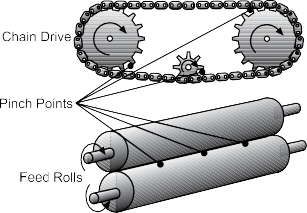
Pinch points are areas where two or more parts move together with at least one part moving in a circle. The areas where drive belts contact pulleys or sprockets mesh with chains are prime examples of pinch points (Figure 1).
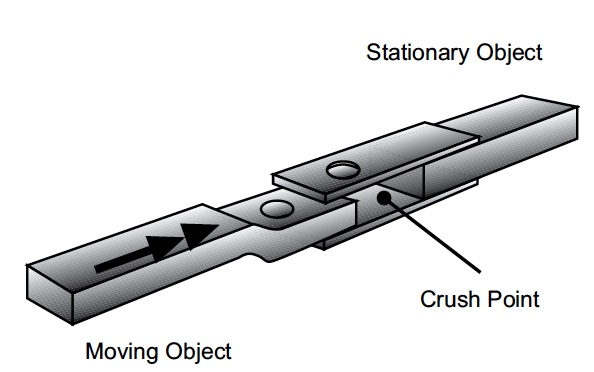
Crush points are hazards involving two components moving toward each other (Figure 2). Examples of crush-point hazards are the raising and lowering equipment with a three-point hitch, components that are moved by hydraulic cylinders, and the areas between the tractor and machinery when hitching or turning.
Wrap (entanglement) point hazards pertain to any exposed rotating component. Wrap-point hazards include any type of rotating shaft or driveline. PTO drivelines are prime examples of wrapping or entan- glement hazards (Figure 3).
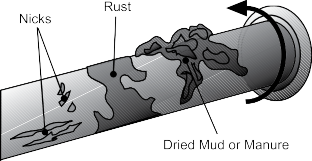
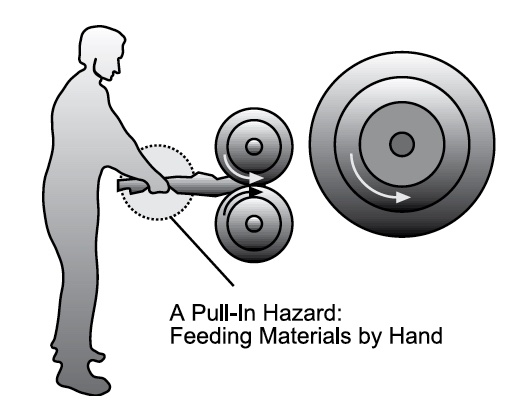
Pull-in point hazards involve mechanisms designed to take in crops or other materials for processing. They include combine headers, windrow pickups, forage chopper headers, and grinders (Figure 4).
Shear and cutting point hazards are areas where two parts move across one another or one moves across a stationary object. Windrower cutter bars and grain augers are examples of cutting and shear points.
Thrown objects present another type of machine hazard. Metal, glass, wire, sticks, or other materials may be picked up by a machine and propelled with extreme force. Rotary mowers are good examples of machines capable of throwing objects.
Burn point hazards are associated with tractors and self-propelled and pull-type machinery. Hot mufflers, engine blocks, pipes, and hot fluids are examples of burn points.
- Stored energy hazards are present in pressurized systems such as hydraulics, compressed air, and springs. The sudden or unsuspected pressurization or depressurization of these systems can result in crushing and other types of accidents, depending on the use of the system. High-pressure leaks are also forms of stored energy hazards.
Become a Safe Machinery Operator
Safe machinery operators respect machines for the work they perform and the dangers they present. In order to become a safe machinery operator:
Learn to operate your machinery properly. Use the operator’s manual as a guide.
Learn the hazards involved with machinery operation; be proactive and anticipate dangerous situations.
Be alert at all times when operating machinery. Take breaks and get sufficient food and rest to stay alert.
Always follow recommended safe practices for operating machinery.
- Use appropriate personal protective equipment (PPE).
Safety Guards and Warning Signs
Modern farm machinery is factory equipped with a variety of safety features, including guards, shields, and warning signs designed to reduce injuries. Needless injuries and deaths occur because safety guards are removed, broken, or torn off during operation. Take the time to inspect your machinery for missing or damaged safety guards and signs. If guards or signs are missing or damaged, repair or replace them before using the machine. Never operate a machine with missing guards.
Repairs and Adjustments
Repairs and adjustments are frequently necessary to ensure optimum machinery performance and efficiency. Numerous accidents occur because operators attempt to make repairs or adjustments while a machine was running. Others have been injured or killed by being crushed when equipment fell while they were working underneath it. Protect yourself. Before making any repair or adjustment, no matter how minor, be sure to turn off the machine, turn off the tractor, and take the key. Do not depend on the hydraulic system to keep the implement or attachments in the raised position; prevent them from falling by placing blocks beneath them. Only then can needed adjustments or repairs be made safely.
Power Take Off (PTO) Drivelines
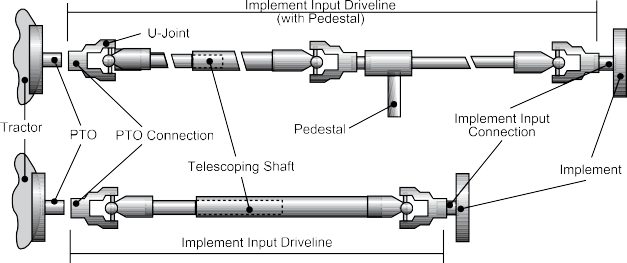
Power takeoff drivelines (shafts) are among the oldest and most common machinery hazards (Figure 5). Exposed bolts, universal joints, burrs, or other projections on rotating components can grab clothing, resulting in instant entanglement. Do your part to reduce PTO injuries and deaths:
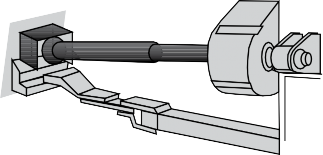
Ensure PTO drivelines are fully shielded (Figure 6).
Never attempt to step over rotating PTO drivelines, no matter how slowly they may be turning.
Never attempt to operate tractor controls from the rear of the tractor.
Never wear loose, baggy clothing around PTO drivelines.
Keep long hair pulled back to avoid entanglement.
- Stay well clear of rotating PTO drivelines.
Plugged Machinery
Combines, hay balers, and other harvesting machines are prone to plug-ups. Normally, these plugs-ups occur at the point where material enters the machine and must be removed before harvesting can continue. Attempting to unplug materials from a running machine can easily result in death or dismemberment by being pulled into the machine. Remember, you cannot win a strength or speed contest with these machines. You can’t let go of the material quickly enough to keep from being pulled into the machine. If a machine is plugged, the mechanical components may be under pressure even when the power is turned off. When the plug is removed the components may begin to move. Make it your rule to turn off the machine and its power source before attempting to clear any plugged machine.
Protecting Others from Danger
You can be instrumental in protecting others from danger. Do your part to protect others from needless injuries while operating agricultural machinery by:
Training your employees and family members to operate machinery in the correct manner.
Teaching family members and employees about the hazards involved with agricultural machinery.
Keeping children away from agricultural machinery, whether it is running or idle.
References:
Safety and Health for Production Agriculture. ASAE Textbook Order Number M0792, American Society of Agricultural Engineers, St. Joseph, MO.
Fundamentals of Machine Operation - Agricultural Safety. Deere and Company, Moline, Ill.
Acknowledgement:
This information was adapted from an Extension fact sheet (F-1727) entitled Machinery Safety on the Farm by the Oklahoma State University Extension Service, Stillwater, OK. http://www.wcpolicy.com/loss_control/ag_safety/pdfs/machinery_safety.pdf
The author acknowledges the coauthors for their contributions of the previous version, Glen Hetzel, John Perumpral, Don Ohanehi, Kirk Ballin, and Bruce Stone.
The AgrAbility Virginia Program is funded by the AgrAbility Project, USDA National Institute of Food and Agriculture (NIFA), Special Project 2019-41590- 30127. Administered by Virginia Tech, Virginia State University, and Easter Seals UCP North Carolina & Virginia, Inc. www.agrabilityvirginia.org. The authors that developed this publication is solely responsible for its content, and it does not necessarily reflect the views of the USDA/ NIFA.
Virginia Cooperative Extension materials are available for public use, reprint, or citation without further permission, provided the use includes credit to the author and to Virginia Cooperative Extension, Virginia Tech, and Virginia State University.
Virginia Cooperative Extension is a partnership of Virginia Tech, Virginia State University, the U.S. Department of Agriculture, and local governments. Its programs and employment are open to all, regardless of age, color, disability, sex (including pregnancy), gender, gender identity, gender expression, national origin, political affiliation, race, religion, sexual orientation, genetic information, military status, or any other basis protected by law
Publication Date
May 28, 2020