Black Vine Weevil
ID
444-210 (ENTO-354NP)
Plants Attacked
Adult black vine weevils feed on a wide variety of evergreen, deciduous, and herbaceous plants. The larval stage is destructive on yew (taxus), hemlock, rhododendron, cherry laurel, and other broad-leaved evergreens. Adults and larvae both will sometimes feed on strawberry, impatiens, hostas, and other ornamental plants.
Description
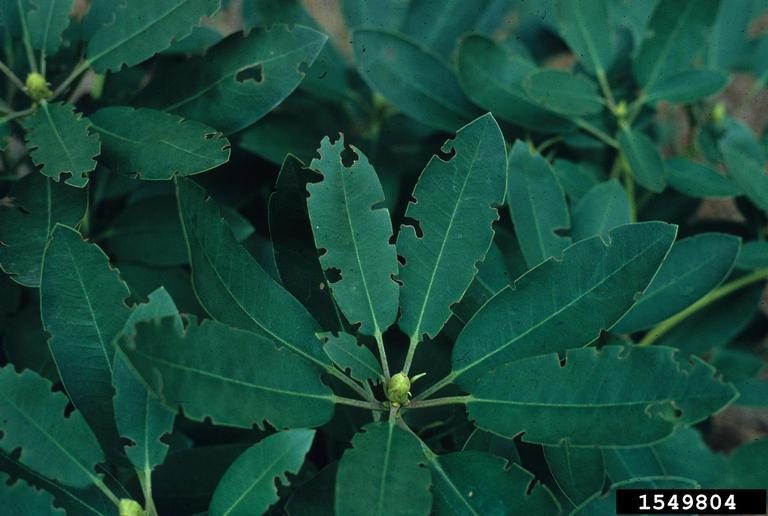
Adult weevils chew irregular notches along leaf margins, causing damage that is often confused with a disease or chemical injury (Fig. 1). These characteristic notches can be used as an early indicator of larval populations in nearby soil. Adults cut notches on the margins only; they never make holes in the center of the leaf. On yew, the needles closer to the main trunk and down inside of the shrub will show notching and feeding scars. Marginal leaf notching on broadleaved evergreens resembles damage caused by the two-banded Japanese weevil and Fullers rose beetle. Adult black vine weevils are largely nocturnal and may not been noticed on host plants.
Black vine weevil larvae feed on roots and are more destructive than the adults. When large numbers of larvae feed on the roots, the plants will wilt, turn brown, and die. Larval populations may go unrecognized because they are hidden in the soil, and plant decline may be mistaken for a plant disease rather than insect damage.
Coleoptera: Curculionidae, Otiorhynchus sulcatus (F.)
Identification
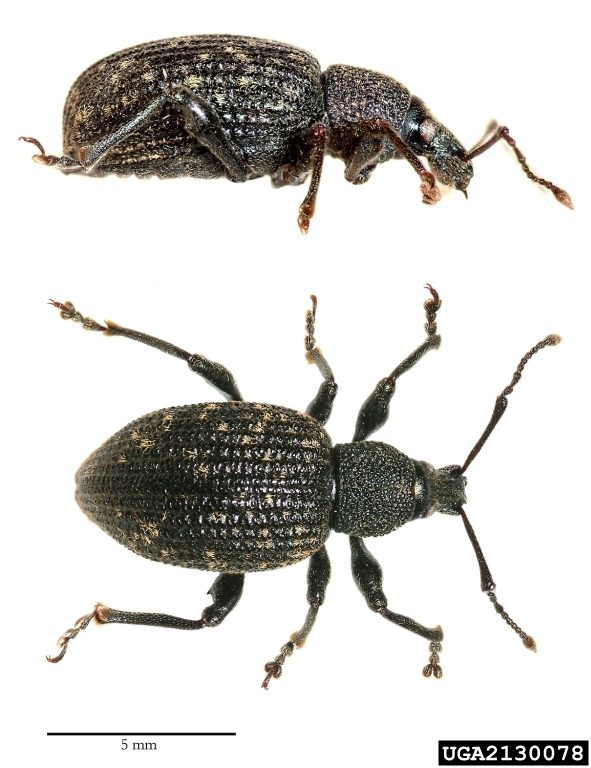
Black vine weevil adults are black, 0.25 inch (6 mm) long weevils with short, broad snouts (Fig. 2). The head is narrower than the rest of the body. The thorax is medium, rounded, and somewhat bumpy in appearance. The wing covers are broad, well rounded, and textured with corrugated ridges down the length of the back and scattered patches of yellow hairs. Sometimes soil on the body will make adult weevils appear grayish or reddish. Adults cannot fly because their wing covers are fused together. The larvae are white C-shaped grubs with well-developed brown heads and no legs.
Life History and Habits
Larvae spend the winter feeding on roots deep in the soil; they pupate in May. Adults dig their way out of the ground in mid-May and crawl up the host plants to feed. Feeding occurs mostly at night and adults hide in dark places on the plants or on the soil during the day. When disturbed, they quickly drop the ground. After one to two weeks of feeding, adults crawl or drop to the ground to lay eggs. They alternately feed and lay eggs over several months. Occasionally a few adults can be found in houses during the winter, but most adults die in the fall. There is only one generation per year.
Control
Scouting Monitor host plants for the distinctive leaf notches made by feeding adults. Examine yews by looking for signs of adult feeding on needles near the center of the plant, near the main trunk or stems. Adult weevils usually hide in the branch crotches under heavy clumps of needles. On other host plants, look for feeding adults on the foliage or on the soil surface under the plants using a flashlight at night. The best time of year to look is in May and June, when adults are active.
Cultural Control Purchase pest-free nursery stock whenever possible. Make sure leaves do not show any signs of leaf notching, which may indicate larval weevils are present in the container’s soil.
Nonchemical Control Beneficial nematodes in the soil work well for control of black vine weevil. Two species recommended for control are Heterorhabditis bacteriophora and Heterorhabditis megidis, both of which are commercially available.
Chemical Control If adult weevils are found or freshly damaged leaves are present, apply a systemic insecticide such as imidacloprid as a soil drench on the root zone in April or May to kill the larvae and adults still in the soil.
A foliar insecticide treatment aimed at the adult weevils as they move on the ground and onto host plants can be of value in some cases. It is critical to apply a foliar insecticide after most adults have emerged, but before they begin laying eggs. The second or third week of June is an optimal treatment time. Treat the soil surface and the main stems and branches of the host plant thoroughly. See Virginia Pest Management Guides for specific control recommendations.
Distribution
The black vine weevil is a pest in Asia, Europe, and North America. Movement of infested nursery stock is thought to transport this pest into new areas. Black vine weevil is found predominantly in the northern portions of the United States, but its range extends into Virginia.
Remarks
No male weevils have ever been found; this species of weevil, like a few other species of insects, is able to reproduce without fertilization. The females lay eggs that give rise to more females.
Revised
Olivia C. McCraw, June 26, 2014; Theresa A. Dellinger, February 27, 2020.
Virginia Cooperative Extension materials are available for public use, reprint, or citation without further permission, provided the use includes credit to the author and to Virginia Cooperative Extension, Virginia Tech, and Virginia State University.
Virginia Cooperative Extension is a partnership of Virginia Tech, Virginia State University, the U.S. Department of Agriculture, and local governments. Its programs and employment are open to all, regardless of age, color, disability, sex (including pregnancy), gender, gender identity, gender expression, national origin, political affiliation, race, religion, sexual orientation, genetic information, military status, or any other basis protected by law
Publication Date
March 6, 2020