Longhorned Beetles/Roundheaded Borers
ID
444-215 (ENTO-363NP)
Identification
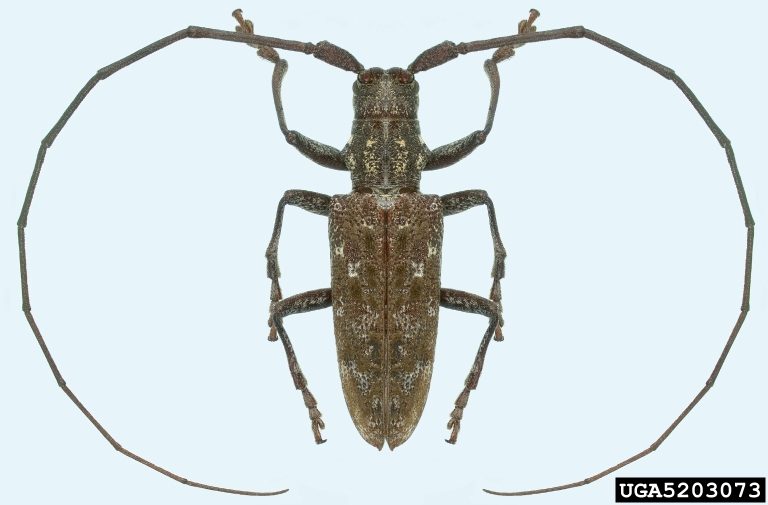
Adult longhorned beetles are usually elongated, cylindrical to flattened beetles, and often a nondescript brown, reddish brown, or black color. Some are mottled, banded, or spotted with white, gray, or another color. A few species are brightly colored with red, yellow, orange, or even bluish coloration, or have bold markings. Some species mimic bees, wasps, and ants. The thorax on some species bear small, stout spines. They range in size from very small (only a few mm long) to very large (20-50 mm or 1-2 inches long). The adults are called longhorned beetles because of their long and distinctive 11-segmented antennae are often longer than the beetle's body (Fig. 1).
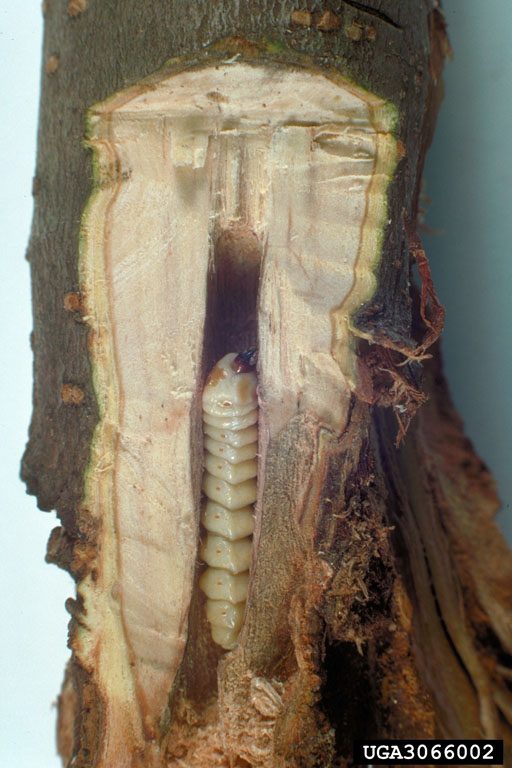
The larvae are called roundheaded borers. They have elongated, cylindrical, and highly segmented soft bodies with large gnawing mandibles and frequently no legs (Fig. 2). They are usually white or yellow with a brown head capsule. The name roundheaded borer refers to the enlarged thorax located directly behind the head. Depending on the species, the larger cerambycid larvae may measure 83 mm (3.25 inches) or more in length.
Order: Coleoptera, Family: Cerambycidae
Habitat
Most of the hundreds of species of roundheaded borers are found in weakened, dying, and dead trees where they feed under the bark in the sapwood. They usually leave a round exit hole in the wood when they emerge as adults. Roundheaded borers may also feed on felled trees, stumps, and cut firewood. Other species tunnel in the stems, root crown, and roots of herbaceous plants. Some are found in healthy trees. Many species are nocturnal as adults and are attracted to bright lights.
Adult longhorn beetles sometimes emerge from firewood that has been brought into a warm house. While the sudden appearance of these insects may cause concern, they will not infest structural wood and are only a nuisance.
Life Cycle
Many species emerge as adults in the spring, while others emerge later during the growing season. Some species may emerge over a two- to three-month period. Some adults do not feed while others feed on flowers. Adults of wood-boring species lay their eggs on weakened and damaged parts of the tree. The larvae bore into the tree, feeding under the bark at first, and later tunneling into the heartwood. They may take one to several years to mature before they pupate inside the tree just under the bark.
Type of Damage
Roundheaded borers feed under the bark and in the sapwood of trees. They tunnel long galleries as they feed, which weakens and destroys the wood. Infested trees are often rendered unusable for commercial purposes. A number of species in this family attack live, healthy trees, including: locust borer, dogwood twig borer, azalea stem borer, sugar maple borer, red oak borer, white oak borer, and the round-headed apple tree borer. Pine sawyers feed on weakened and stressed live pine trees. Adult longhorned beetles do very little damage to trees and spend most of their time feeding on the pollen of flowers. A few species, commonly referred to as twig pruners, will girdle small branches and twigs as adults.
Prevention (Non-chemical Control)
Sanitation and prompt action are the best controls against roundheaded borers. Felled timber should be removed from the woods as soon as possible and the bark should be removed from the logs to prevent infestation. Wounded, damaged, or otherwise weakened areas of a tree are susceptible to borer attack and should be pruned or chemically treated to prevent borer infestation. Promptly burn, chip, or otherwise destroy pruned material to prevent borers emerging and attacking nearby trees. Properly planted, watered, and fertilized trees maintained in vigorous condition are less likely to be attacked by borers.
Chemical Control
Soil drenches or trunk and branch sprays are effective against borers. See the Virginia Pest Management Guide for Home Grounds and Animals (PMG 456-018) for current recommendations for insecticides and treatment times for longhorn borers in Virginia.
Revised
Theresa A. Dellinger, February 12, 2020.
Virginia Cooperative Extension materials are available for public use, reprint, or citation without further permission, provided the use includes credit to the author and to Virginia Cooperative Extension, Virginia Tech, and Virginia State University.
Virginia Cooperative Extension is a partnership of Virginia Tech, Virginia State University, the U.S. Department of Agriculture, and local governments. Its programs and employment are open to all, regardless of age, color, disability, sex (including pregnancy), gender, gender identity, gender expression, national origin, political affiliation, race, religion, sexual orientation, genetic information, military status, or any other basis protected by law
Publication Date
March 19, 2020