Bagworms in Virginia
ID
2808-1008 (ENTO-624NP)
Introduction
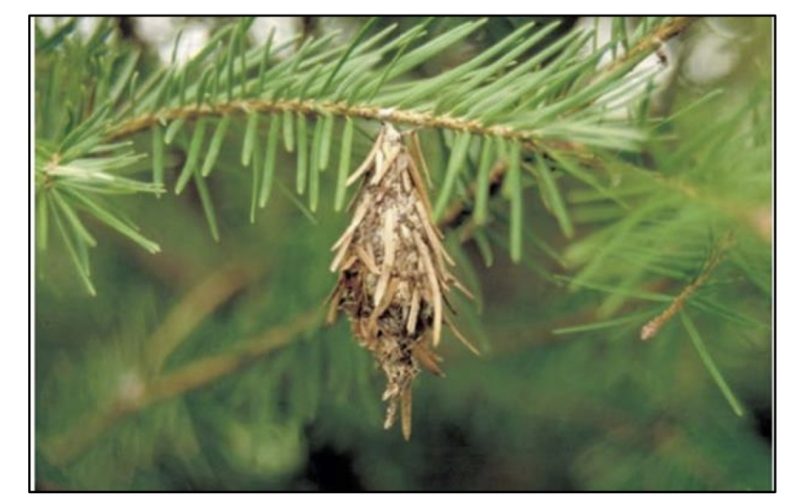
Bagworms (Lepidoptera: Psychidae) are moths that construct spindle or cone-shaped silk bags decorated with plant debris as a camouflage shelter during the larval stage. The caterpillars can move around and feed inside the bags. The bags are usually covered with debris from the host plant, such as bits of leaves, needles, twigs, and even lichen (Fig. 1). The bags may be streamlined (Fig. 2) or have an irregular surface depending on the size and shape of materials attached to the surface (Fig. 3). Newly hatched bagworm larvae make small cases lightly covered with debris and continue to enlarge and decorate the bag until they pupate. Their bodies are largely hidden inside their bag, and infestations of these caterpillars go largely unnoticed until dense populations begin to damage trees.
The evergreen bagworm (Thyridopteryx ephemeraeformis) is a native species commonly found on conifers and deciduous trees across Virginia. Psyche casta, the common bagworm moth, is an introduced species found in Virginia (Fig. 2). The larvae often add grass stems to their bags in a parallel fashion (Fig. 2). An unusual bagworm, the snailcase bagworm (Apterona helix), creates small spiraled-shaped bags of silk and soil. It is an introduced species found sporadically throughout the mid-Atlantic states.


Description
Bagworm caterpillars are almost never seen outside of their bag (Fig. 3), but the front part of the body has a mottled brown and cream pattern, and the rest of the abdomen inside the bag is a solid grayish-brown color. Evergreen bagworm caterpillars are typically 1.5-2" long (38-50 mm) when fully mature. The caterpillars pupate inside their bag. Adult female bagworms are wingless and look similar to the caterpillar, but pale colored. Adult males emerge from their bag and mate with the grub-like adult females, which remain inside their bag. The females lay eggs inside their bag and never leave the bag. The eggs hatch in the spring and the caterpillars emerge to feed and make their own bags. Adult evergreen bagworm moths do not feed. The adult males are small, dark, hairy moths. They often lose the scales on their wings when leaving their bag.
Host Plants
Evergreen bagworms feed on conifers and deciduous trees, and are primarily found on juniper, arborvitae, other cedars, pine, hemlock, spruce, Chinese elm, and honeylocust. They also occur on crabapple, maple, sycamore, box elder, willow, linden, poplar, and many others. They are a pest of a wide range of landscape trees, fruit trees, and Christmas trees.
Bagworms may leave their host tree when they are ready to pupate. They are sometimes found attached to non-plant surfaces, such as wooden fences, decking, and sides of houses and other buildings.
Life Cycle
Overwintering eggs begin to hatch inside the mother’s bag in early June. Each tiny larva immediately begins to construct a tiny silken bag around itself and begins feeding. Larvae and bags remain small (less than 1/4" or 6 mm long) for a few weeks and are not easily discovered. Feeding and molting continue until August when pupation occurs. Adults are active in late August and September. Only males leave the bag to mate with females, which remain in their bags and lay overwintering eggs there. Prior to molting and pupation, larvae attach the bag to twigs by silk strands and also close the opening, protecting the larva. The silk loop around the twig may eventually girdle the twig with time, long after the bagworm has died. There is a single generation of bagworms each year.
Damage
Evergreen bagworms feed on host plants between June to late July and August. Branches stripped of leaves are usually most noticeable in the uppermost parts of trees and shrubbery. Heavy feeding and defoliation are associated with large numbers of silk bags on the branches (Fig. 4). Large piles of crumbly insect droppings may be found on the ground under heavily infested trees.
Continuing infestation over several years can stunt tree growth, cause branch dieback, thin foliage, and even kill the plant. Heavily infested plants with sparse, brown foliage and many bagworm bags are unsightly and may warrant removal rather than treatment (Fig. 4).

When the caterpillars are mature, they wrap strands of silk around a twig to secure it to the tree before pupating. This silk attachment is very strong and may persist for years later. Sometimes it girdles the twig as the twig grows, forming a gall-like swelling on the twig (Fig. 5).

Control
Bagworm is a serious pest capable of rapid buildup and extensive defoliation. However, completely defoliated trees usually make a full recovery the next spring if they are otherwise healthy and were planted correctly. Inspect plants in the landscape during the fall, winter, or early spring each year to detect any infested plants that need treatment before serious damage occurs.
Treat for bagworms during mid-June when the larvae are small, actively feeding, and more susceptible to insecticides. Insecticides with some residual activity are preferable. Larger larvae are not easily killed, and insecticides do not penetrate the silk bags to kill pupating bagworms. Homeowners should consult the current Virginia Cooperative Extension Pest Management Guide for Home Grounds and Animals recommended insecticides for bagworm control on ornamental trees. Commercial Christmas tree growers should consult the current Virginia Cooperative Extension Pest Management Guide to Horticulture and Forest Crops.
Picking off and destroying the bags from fall until spring will reduce populations but is tedious work for all but the lightest infestations. If only a few bagworms are found, cut the attached bags from the twig using a sharp knife or scissors. It’s best to remove the silk strap wrapped around the twig so it doesn’t interfere with the twig’s growth. Otherwise, prune the branch to remove the bag entirely. Destroy any picked bagworms or infested pruned branches as the eggs may still hatch even after removal from the host tree.
Revised
Olivia C. McCraw 2014; Theresa A. Dellinger, 2020 and 15 July 2025.
Virginia Cooperative Extension materials are available for public use, reprint, or citation without further permission, provided the use includes credit to the author and to Virginia Cooperative Extension, Virginia Tech, and Virginia State University.
Virginia Cooperative Extension is a partnership of Virginia Tech, Virginia State University, the U.S. Department of Agriculture (USDA), and local governments, and is an equal opportunity employer. For the full non-discrimination statement, please visit ext.vt.edu/accessibility.
Publication Date
August 28, 2025