Fall Webworm in Virginia
ID
2808-1013 (ENTO-628NP)
Introduction
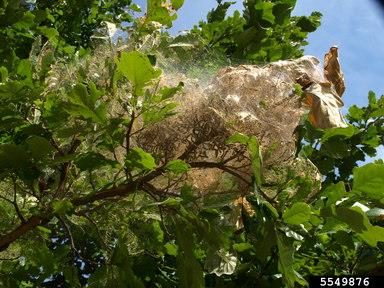
Native to North America, the fall webworm (Hyphantria cunea) occurs throughout the United States and southern Canada. Its hosts include more than 100 species of deciduous forest, shade, and fruit trees, with preferences varying from region to region. Fall webworm has several generations each year, but the silk nests (Fig. 1) made in late summer are very visible and get most of the attention.
Description & Life Cycle
Fall webworm overwinters in the pupal stage, and adult moths emerge in the spring. From May to July, females deposit small, light green eggs in hair- covered masses on the underside of leaves (Fig. 2).

The eggs hatch within two weeks. Caterpillar coloration is highly variable, often ranging from white to pale yellow or light green (Fig. 3). There can be two lines of black dots down the caterpillar’s back, sometimes with a black stripe down the center. A line of yellow spots usually runs along both sides. Caterpillars may be partially or completely dark, with light-colored hairs. The head color varies from red to black.

Newly hatched larvae construct their nests by spinning silken webbing over foliage on the terminal portions of the branches (Figs. 1 & 4). The caterpillars feed on the upper surfaces of leaves (Fig. 3) within the webbing. As the larvae grow, they enlarge the webs to enclose more fresh foliage. Older larvae eat entire leaves except for the midrib and large veins. Large portions of tree branches are commonly enclosed by such webs and are most apparent from mid- to late-summer (Fig.1).

After four to eight weeks of feeding, mature caterpillars measure about 25-31 mm (about 1”) long. They pupate in thin cocoons usually spun in the duff or just beneath the surface of the soil below the host plant. The cocoons are typically covered with the caterpillars’ long, silky hairs.
Adult fall webworm moths have a wingspan of 25- 50 mm (about 1-2”). They can be snowy white (Fig. 2), with a few scattered small dark spots, or even with more numerous larger brown spots (Fig. 5). There are at least two generations per year in the southern states.

Damage
The insect is considered an ornamental pest due to the unsightliness of the webs (Fig. 1), but it is generally not an important pest in the forest. Large trees can withstand defoliation from fall webworm better than small trees with smaller canopies.
However, trees often have late-season defoliation from fall webworm without lasting harm the following year.
Management
Nests can be cut out of small trees and destroyed. Nests in larger trees can be removed using a small rake to comb the silk nests out of the foliage. Do not use flame to burn nests in trees, as this will likely damage the tree. Remove nests when first seen and before the caterpillars mature to limit defoliation and the size of the following generation.
Insecticides may be applied against fall webworm from mid- to late summer or when webs are first observed. See the Virginia Pest Management Guide for Home Grounds and Animals (https://www.pubs.ext.vt.edu/456/456-018/456-018.html) or Horticulture and Forest Crops (https://www.pubs.ext.vt.edu/456/456-017/456- 017.html) for specific insecticide recommendations depending on homeowner or commercial production use.
More than 50 species of insect parasitoids and 36 species of predators of the fall webworm are known in the U.S., but they are not commercially available for biological control.
Note
Fall webworm is often confused with eastern tent caterpillar. Fall webworm makes its nests at the tips of branches and is active in summer and early fall, while eastern tent caterpillar (https://www.pubs.ext.vt.edu/444/444-274/444-274.html) nests in the crotches of deciduous trees in the spring.
Revision
Theresa Dellinger, September 8, 2025.
Virginia Cooperative Extension materials are available for public use, reprint, or citation without further permission, provided the use includes credit to the author and to Virginia Cooperative Extension, Virginia Tech, and Virginia State University.
Virginia Cooperative Extension is a partnership of Virginia Tech, Virginia State University, the U.S. Department of Agriculture (USDA), and local governments, and is an equal opportunity employer. For the full non-discrimination statement, please visit ext.vt.edu/accessibility.
Publication Date
September 29, 2025