ENERGY SERIES: What about Radiant Barriers?
ID
2908-9021 (BSE-308NP)
Reflective insulation systems are made from aluminum foils with a variety of backings such as roof sheathing, kraft paper, plastic film, cardboard, bubble wrap, etc. The resistance to heat flow depends on the direction of heat flow with this type of insulation most effective in reducing downward heat flow and requiring an air space next to the reflective side. Reflective systems are usually located between roof rafters, floor joists, or wall studs. Reflective insulation placed in walls or on the attic floor must be perforated to allow water vapor to pass through it.
If a single reflective surface is used alone and faces an open space, such as an attic, it is called a radiant barrier (sometimes called radiant heat barrier). Some radiant barriers have a reflective surface on both sides so either side can face the open air space. Properties to look for are high reflectivity and very low emittance (the energy radiated from the material’s surface), which enable it to reflect the radiant heat energy and give off (emit) very little.
Radiant barriers are most effective in blocking summer radiant heat gain and saving air- conditioning costs. Although the radiant barrier may be somewhat effective in retaining heat within a cold-climate home, it may also block any winter radiant heat gain in the attic.
What is radiant heat transfer and why are radiant barriers effective?
Radiant heat transfer occurs when electromagnetic waves travel in a straight line through a vacuum or air between surfaces that are at different temperatures, heating any object in its path. The earth receives all its solar heat through radiation.
Dark, rough surfaces will generally absorb radiant heat and become warm, while smooth, shiny surfaces will reflect the radiation. This is why radiant heat transfer can be limited by the use of radiant barriers, which have shiny foil surfaces.
Will I still need insulation if I use a radiant barrier?
Yes, due to the way heat is transferred, you still need insulation. The amount of thermal insulation affects the potential radiant barrier energy savings as does proper installation affording the required dead air space. For example, installing a radiant barrier in an attic that already has high levels of insulation (R-30 or above) would result in much lower energy savings than in an attic insulated at a low level (R-11 or less).
Conventional types of insulation consist of fibers or cells that trap air or contain a gas to retard heat conduction. These types of insulation reduce conductive, convective, and radiant heat transfer at a rate determined by their R-value. Radiant barriers reduce only radiant heat transfer. There is no current method for assigning an R-value to radiant barriers.
What is the effect of radiant barriers on heating and cooling bills?
According to the U.S. Department of Energy (DOE), your savings on heating and cooling bills will vary depending on a number of factors. These factors include: location of your ductwork, type of radiant barrier application, size of your house, whether your home is a ranch style or a two-story house, amount of insulation in the attic, effectiveness of attic ventilation, color of the roof, thermostat settings, tightness of the building envelope, actual weather conditions, efficiency of the heating and cooling equipment, and fuel prices. Their document, Radiant Barrier Attic Fact Sheet, shows how to calculate the economics of radiant barriers and added ceiling insulation. The document includes an Energy Savings Worksheet with an example. The worksheet is part of the fact sheet and can be found at https://web.ornl.gov/sci/buildings/tools/radiant/
How are radiant barriers installed?
A radiant heat barrier must have an air space next to a reflective side to be effective. If you do not allow for this air space, the radiant barrier acts as a conductor and just passes the heat along from a hot surface to a cooler surface. Therefore, if the material you purchase is reflective on only one side (has only one “shiny side”), this side should be facing the air space. It cannot be sandwiched between two materials, as the air space is critical to its performance. They should also be installed to prevent dust build-up as dust and dirt will decrease their effectiveness.
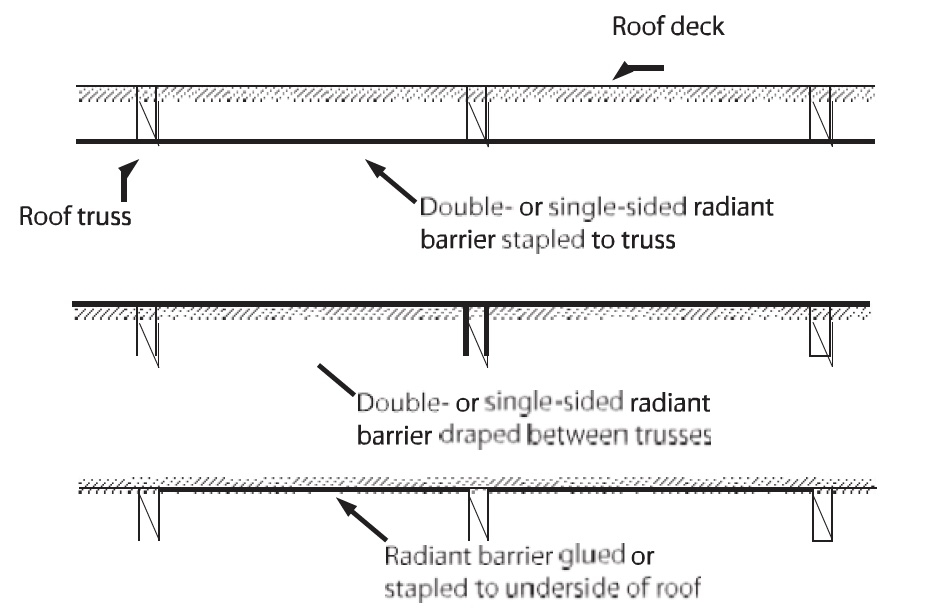
Several methods for installing radiant barriers in new construction include (Figure 1):
- Attached to either the faces or bottoms of the rafters or top chords of the roof trusses (this method can also be used in existing homes).
- Draped over the rafters or trusses in a way that allows the product to droop (i.e. hang loosely) 1½ to 3 inches between each rafter.
- Attached to the underside of the roof deck (sheathing) with the foil side facing the air space or attic space.
Installation methods differ depending on the individual home, with issues such as dust and/or possible moisture accumulation, locations of bathroom/kitchen vents and recessed lights, safety, visibility of roof components, attic accessibility, etc. You will have to do further research to determine the best option for your home.
References and Resources
University of Florida. 2009. Energy Efficient Building Construction in Florida. Florida Cooperative Extension Service, Institute of Food and Agricultural Sciences, Gainesville, FL. SP 267.
U.S. Department of Energy. Revised June 2001. Radiant Barrier Attic Fact Sheet. https://web.ornl.gov/sci/buildings/tools/radiant/
Developed as part of the NASULGC/DOE Building Science Community of Practice. The factsheet editors are: Robert "Bobby" Grisso, Ph. D., Extension Engineer, Biological Systems Engineering; Martha A. Walker, Ph.D, Community Viability Specialist, Central District; Philip Agee, Ph. D., Assistant Professor, Department of Building Construction, and John Ignosh, Extension Specialist, Biological Systems Engineering, Virginia Tech.
DISCLAIMER – This document is intended to give the reader only general factual information current at the time of publication. It is not a substitute for professional advice and should not be used for guidance or decisions related to a specific design or construction project. This document is not intended to reflect the opinion of any of the entities, agencies or organizations identified in the materials and, if any opinions appear, are those of the individual author and should not be relied upon in any event.
Virginia Cooperative Extension materials are available for public use, reprint, or citation without further permission, provided the use includes credit to the author and to Virginia Cooperative Extension, Virginia Tech, and Virginia State University.
Virginia Cooperative Extension is a partnership of Virginia Tech, Virginia State University, the U.S. Department of Agriculture, and local governments. Its programs and employment are open to all, regardless of age, color, disability, sex (including pregnancy), gender, gender identity, gender expression, national origin, political affiliation, race, religion, sexual orientation, genetic information, military status, or any other basis protected by law
Publication Date
February 14, 2020