ENERGY SERIES: What is the Whole-House Systems Approach to Energy Efficiency?
ID
2908-9025 (BSE-312NP)
The whole-house systems approach looks at the entire house as an energy system with interdependent parts. Like a human body, when one part functions poorly it affects the performance of the entire system. For instance, the benefits of an energy-efficient air conditioner are lessened when a duct system leaks, windows do not close tightly, the attic is uninsulated, and humid summer breezes are drifting in under the door.
The systems approach recognizes the interaction of windows, attics, foundations, mechanical equipment, and all other components and assemblies within the home. Changes in one or a few of these components can cause changes in how other components perform. If you recognize and take advantage of this fact, and apply appropriate advances in technology to the components, you can reduce your energy costs while improving your comfort. From a builder’s or seller’s perspective, an energy-efficient home is more marketable, especially if you can show the prospective buyers your low energy bills.
Systems Approach to Home Renovation
Why is it important?
Energy efficiency not only saves you money, it also saves natural resources. Take a look at your electric bill, just the electric part, not the fees for service, taxes, etc. How many kilowatt-hours of electricity did you use last month? Generating that electricity typically uses nonrenewable resources like coal, natural gas, and oil. So although it’s your home, it’s everyone’s environment. We all play a role in sustainability and energy efficiency helps reduce the negative effects of burning fossil fuels by providing the same quality of services with reduced energy inputs and emissions. One study suggests greenhouse gas emissions associated with home energy use can be cut by 70% with current technologies (McMahon, et al., 2007).
Even water quantity and quality are related to energy consumption as it takes water to process fuels and generate electricity and it takes energy to withdraw, distribute, and treat water. New materials and technologies in home construction and remodeling mean you can live more comfortably and help the environment by reducing pollution and conserving natural resources.
Where do I start?
We can begin by looking at the mechanical heating, cooling and ventilation system (HVAC) as it generally accounts for about half of the energy use in a home.
Efficiency of the HVAC system controls both temperature and humidity within the home and is highly dependent on many of your homes structural features. Taking a step-wise approach to home renovation, or equipment replacement, will ensure that you get the most bang for your buck when it comes to thermal comfort and energy efficiency.
Air Sealing
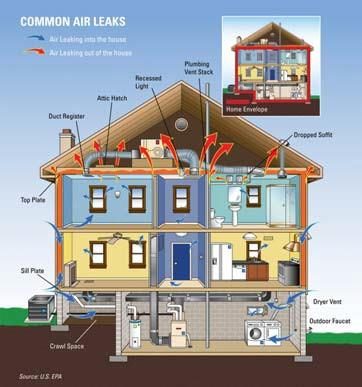
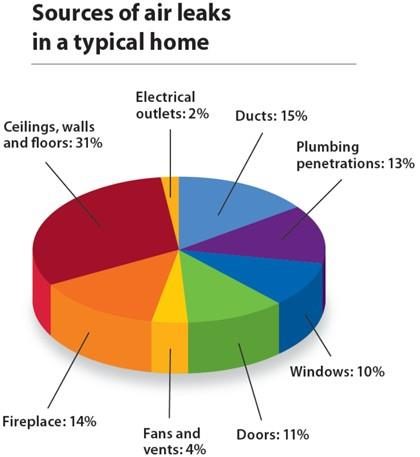
Your home is constantly breathing, or exchanging air, with the surrounding outdoor environment. Unconditioned air is coming in while your conditioned air is flowing out. Generally the first place to start in creating an energy-efficient living space is air sealing. This means sealing cracks and gaps around windows, doors, plumbing, electrical and venting penetrations so that you can control air exchange and ventilation. Sealing these leaks will mean that less unconditioned air makes it into your house and produces less load on your HVAC system. Start by using caulking and weatherstripping to seal air leaks. This is a low budget item that most homeowners can do. Table 1 and Figure 2 will help you determine where to look for leaks and the references below will give you more information on air sealing.
Table 1. Steps to look for air leaks
Though every situation is unique, the best general approach includes the following steps in roughly this order:
| Step | System Component | Strategy | Impact |
|---|---|---|---|
| 1 | Doors, windows, walls, floor, and ceiling | Weatherize and seal any holes or gaps in building envelope | Improves air barrier by reducing air leakage |
| 2 | Heating / air conditioning (HVAC) ductwork | Seal and insulate ductwork | Improves air barrier by reducing air leakage |
| 3 | Attic insulation | Improve / replace to R-value recommended for your area | Improves thermal barrier by increasing insulation function |
| 4 | Windows | Replace single-pane metal framed windows with double-paned low-E wood or vinyl framed alternatives | Improves air and thermal barriers by reducing air leakage and reducing solar heat gain |
| 5 | Heating / air conditioning (HVAC) system | Service existing HVAC system and/or upgrade to properly sized HVAC system with higher SEER rating | Improves heating and cooling efficiency |
| 6 | Water heater | Replace old inefficient model with modern ENERGY STAR alternative | Reduces water heater energy consumption |
| 7 | Lighting | Replace high wattage bulbs (such as incandescent and halogen) with low wattage alternatives of comparable lumen value | Reduces lighting energy consumption and unnecessary heat load to indoor spaces |
| 8 | Ceiling fans | Install ENERGY STAR ceiling fans in commonly occupied rooms | Reduces load on HVAC system by improving occupant comfort |
| 9 | Appliances | Replace old inefficient models with modern ENERGY STAR alternatives | Reduces appliance energy consumption |
For more information on air sealing visit:
- Weatherize Your Home—Caulk and WeatherStrip. National Renewable Energy Laboratory(NREL). US Department of Energy http://www.nrel.gov/docs/fy01osti/28039.pdf
- Home Series-1: Home Tightening, Insulation and Ventilation. Iowa Energy Center. https://www.iowaeconomicdevelopment.com/userdocs/programs/HomeSeries1.pdf
- Caulking and Weatherstripping. Energy Efficiency and Renewable Energy (EERE): Energy Savers. https://www.nrel.gov/docs/fy01osti/28039.pdf
- Air Seal and Insulate with ENERGYSTAR. https://www.energystar.gov/campaign/seal_insulate/why_seal_and_insulate
Ductwork
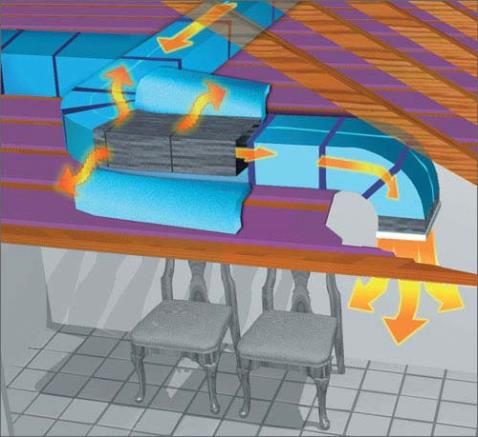
Leaky ductwork can cause major loss in energy efficiency. Leaky ductwork dumps your conditioned air in undesirable places, like in your attic or underneath your house. That means that you are paying to heat or cool the outdoors. In addition, when your cool air goes out, hot humid air comes in through air gaps to take its place. This puts twice the strain on your HVAC and makes your ductwork a prime target for an energy efficiency upgrade. First, visually inspect your ductwork for gaps or disconnected runs.
Use mechanical fasteners to secure ducts, then mastic sealant to seal gaps, and then insulate to prevent radiation loss.
For more information on ductwork visit:
- Energy Efficient Homes: The Duct System.University of Florida IFAS Extension.http://edis.ifas.ufl.edu/FY1024
- “Ducts.” EERE: Energy Savers
Insulation
The next step for your efficient home is insulating. Roof temperatures can reach over 140°F so first target attic insulation. In the southeast the attic insulation level should be at least R-30. Wall and floor insulation are generally less important. Due to their high cost and lower impact implement other efficiency measures and consider other options before addressing walls and floors. One exception may be homes with raised wood floors and crawlspaces. If your elevated wood floor feels cold or drafty during the winter consider adding insulation. In addition, some home features, such as slab on grade foundations may actually reduce HVAC load in cooling dominated climates. See https://www.energy.gov/energysaver/weatherize/insulation for more information on insulation levels recommended for your area and building location.
Windows
As previously mentioned, the most important consideration for improving the efficiency of windows is air sealing. (Once windows are properly sealed using caulking and weatherstripping, shading is the next step. First consider adding exterior shading on the east, west and south sides using properly placed trees, awnings, tinted window film, or solar screens. Exterior shading has the most benefit as it blocks solar radiation from entering the home while still allowing light to enter the home. Next consider using blinds or drapes to shade the home from the interior. Interior shading options stop solar radiation near the window, limiting heat gain in the home but also limiting day lighting. If your windows are unable to be properly sealed, or if you are considering replacing windows for functionality or aesthetic reasons, consider using energy efficient windows.
Windows are a big ticket item in home renovation and can drastically improve comfort and energy performance. Replacing old windows with double pane, low-e windows can be a major benefit but remember that proper, air-tight installation is as important as the window itself. If you are going to replace windows, it should be done before HVAC replacement as window efficiency plays a large part in heating and cooling load calculations that determine the size of your HVAC equipment. Better windows could mean that you will need a smaller HVAC unit.
For more information on windows visit:
- Air Seal and Insulate with ENERGYSTAR. https://www.energystar.gov/campaign/seal_insulate/why_seal_and_insulate.
- Energy Efficient Homes: Windows and Skylights. University of Florida IFAS Extension.
HVAC
The best way to ensure that your home continues to perform at peak energy efficiency is to perform regular HVAC maintenance. This includes steps that you can take such as replacing air filters often, cleaning condenser coils, straightening coil fins, and cleaning condensate lines. The resources listed below can help you with these tasks. There are other steps that need to be taken by a qualified HVAC technician such as checking refrigerant levels, testing for refrigerant leaks, checking the air flow and testing the electrical controls.
For more information on HVAC visit:
- Energy Efficient Homes: Air Conditioning.University of Florida IFAS Extension.http://edis.ifas.ufl.edu/FY1026
- Air Conditioning. EERE: Energy Savers.https://www.energy.gov/energysaver/heat-and-cool
- Heat & Cool Efficiently. ENERGYSTAR.https://www.energystar.gov/campaign/heating_cooling
Lighting/Appliances
Lighting and appliances should be replaced as needed with more energy efficient options or models. Initially their individual energy consumption is reduced and they may produce less heat therefore reducing cooling load on your HVAC system.
This will hold true for lighting, and appliances such as refrigerators, clothes dryers,water heaters, among others.
For more information on lighting and appliances visit:
- Lighting Choices to Save You Money.EERE: Energy Savers: Your Home.https://www.energy.gov/energysaver/save-electricity-and-fuel/lighting-choices-save-you-money
- Energy Efficient Homes: Appliances inGeneral. University of Florida IFASExtension
- Appliances and Electronics. EERE: EnergySavers https://www.energy.gov/energysaver/save-electricity-and-fuel/appliances-and-electronics
References and Resources
See the following publications for more information about the whole-house systems approach, the importance of realizing your home as a system, and the changes that you might be able to make to your home to improve both energy efficiency and occupant comfort:
- McMahon, J.E., M.A. McNeil, and I.S. Ramos. 2007. Chapter 9: “Buildings,” in The First State of the Carbon Cycle Report (SOCCR): The North American Carbon Budget and Implications for the Global Carbon Cycle, A.W. King, et al., Editors.National Oceanic and Atmospheric Administration, National Climatic Data Center.Asheville, NC, USA. pp. 95-102.
- Amann, J., Wilson, A., and Ackerly, K. 2007.Consumer Guide to Home Energy Savings. 9thEdition. American Council for an Energy-Efficient Economy. Washington, D.C.
- U.S. Department of Energy. Energy Efficiency Pays: Systems approach cuts home energy waste and saves money. Office of Energy Efficiency and Renewable Energy.https://www1.eere.energy.gov/buildings/publications/pdfs/building_america/26290.pdf
- U.S. Department of Energy. 2003. Whole-House Energy Checklist: 50 Steps to Energy Efficiency in the Home. Office of Energy Efficiency and Renewable Energy
- U.S. Department of Energy. 2009. Whole-house Systems Approach. Office of Energy Efficiency and Renewable Energy.https://www.energy.gov/energysaver/energy-efficient-home-design/whole-house-systems-approach
Many utility companies offer free or low-cost audits, as well as incentive and rebate programs for many of the above recommended steps. In addition, you may be eligible for state or federal tax credits when you purchase certain energy efficient components. See the Database of State Incentives for Renewables & Efficiency (http://www.dsireusa.org) for additional information.
Developed as part of the NASULGC/DOE Building Science Community of Practice. The factsheet editors are: Robert "Bobby" Grisso, Ph. D., Extension Engineer, Biological Systems Engineering; Martha A. Walker, Ph.D, Community Viability Specialist, Central District; Philip Agee, Ph. D., Assistant Professor, Department of Building Construction, and John Ignosh, Extension Specialist, Biological Systems Engineering, Virginia Tech.
DISCLAIMER – This document is intended to give the reader only general factual information current at the time of publication. It is not a substitute for professional advice and should not be used for guidance or decisions related to a specific design or construction project. This document is not intended to reflect the opinion of any of the entities, agencies or organizations identified in the materials and, if any opinions appear, are those of the individual author and should not be relied upon in any event
Virginia Cooperative Extension materials are available for public use, reprint, or citation without further permission, provided the use includes credit to the author and to Virginia Cooperative Extension, Virginia Tech, and Virginia State University.
Virginia Cooperative Extension is a partnership of Virginia Tech, Virginia State University, the U.S. Department of Agriculture (USDA), and local governments, and is an equal opportunity employer. For the full non-discrimination statement, please visit ext.vt.edu/accessibility.
Publication Date
February 12, 2020