Healthy Weights for Healthy Kids: What Should I Do if My Child Is Overweight?
ID
348-273 (HNFE-916P)
If your child is overweight, he or she is not alone. Over- weight and obesity are growing at epidemic rates among American children and teens. The rate has tripled in 30 years and is expected to rise. In 2012, 18 percent of children ages 6 to 11 and 20 percent of adolescents ages 12 to 19 were considered obese.
How Do I Know if My Child Is Overweight?
It is important to remember that there is not one healthy weight for your child. A healthy weight can be a range of weights depending on gender, age, and body type. The best way to assess if your child is overweight is to talk to your child’s doctor or other health professional. They can use growth charts developed by the Centers for Disease Control and Prevention to decide if your child is overweight and developing optimally. Overweight is classified as a BMI for age and gender of the 85th percentile to less than the 95th percentile. Obese is classified as a BMI for age and gender of greater than or equal to the 95th percentile. BMI, or body mass index, is calculated as weight divided by height squared (in kg/m2).
Health professionals can also track any weight gain over time to see if the weight gain occurred slowly or rapidly. If it’s sudden, it is possible that the child is getting ready for a growth spurt and may outgrow the excess weight, which is normal. These factors, along with information about body type (such as amount of muscle), diet, physical activity, and emotional stress can provide information to use in developing a care plan for your child.
What Are Some Concerns for Overweight Children?
Overweight children often complain of being teased or singled out by other children. This can be extremely traumatic and may lead to low self-esteem, poor body image, and feelings of isolation.
Overweight is also associated with a number of health problems. Overweight children are at higher risk for asthma, Type 2 diabetes, high blood pressure, and sleep disorders. They are also more likely to become over- weight adults. Maintaining a reasonable weight, eating well, and being physically active during childhood are important for a lifetime of good health.
What Can I Do to Help My Child?
While overweight is certainly a concern that has many health and social consequences, it is important not to overemphasize weight, but rather to focus on health. Weight is only one factor in health. Plus, some research shows that it may be healthier over time to be fit and overweight than unfit and thin. If overweight is accom- panied with an unhealthy lifestyle, then you need to take steps now to improve your child’s lifestyle. If you feel that there may be a psychological basis for the overweight, like sadness, consult a health professional. Nutritious food choices, plenty of physical activity, and a positive body image help create a healthy kid at any size. As a parent or caregiver, you play a vital role in creating supportive and healthy environments and opportunities for your child to achieve these goals.

What Should My Child Eat?
Do not place an overweight child on a calorie-restricted diet unless it is recommended and supervised by a health professional or doctor. First, such restrictions could lead to nutrient deficiencies or other health concerns. Second, focusing on weight loss may cause some overweight children to develop unhealthy attitudes toward food or even an eating disorder.
Examine your family’s overall diet. Try to make small, simple, gradual improvements in the quality of food offered to your whole family. Do not single out your overweight child. He or she may feel deprived or additionally sensitive about his or her weight. The changes needed depend on your family’s current practices. The following list provides a few examples of areas you may be able to target for improvement.
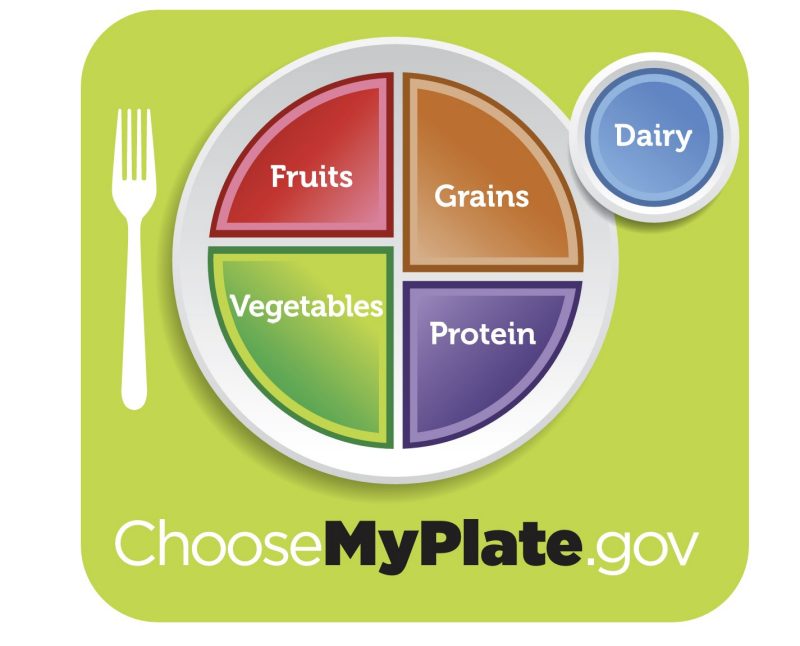
Are you following MyPlate? Visit www. ChooseMyPlate.gov. MyPlate illustrates the five food groups that are the building blocks for a healthy diet using a familiar image — a place setting for a meal. Make half your plate fruits and vegetables. Serve plenty of whole grains. Incorporate low-fat dairy foods and a variety of lean proteins.
What size are your family’s portions? If it’s hard to control how much you eat and you are tempted to serve seconds or thirds, serve yourself in the kitchen. Sometimes seeing food makes you want to eat more even if you’re not hungry. The extra walk may make you think twice. Serve yourself less and then check in to see if you really need more, rather than want more. Consider using smaller plates. If you have a young child, use child-size plates, cups, and utensils. At fast-food restaurants, consider ordering regular- size portions or splitting meals, rather than super-size portions. Even better, choose fast-food restaurants that offer sensible portion sizes and lower-fat entrees. Avoid buffet-style restaurants.

What types of high-fat foods are available to your family? These may include fried foods (such as fried chicken, french fries, potato chips, donuts), whole milk, creamy soups, gravies, butter or margarine, bacon, mayonnaise, and ice cream. Start by identifying one or two items that your family eats regularly and offer a healthier, low-fat alternative. These could include low-fat milk in place of whole milk, and oven-baked meats and potatoes in place of fried foods. Over time, replace other foods with healthier options.
What types of high-sugar foods and beverages does your family consume? Sugar-sweetened drinks are the No. 1 source of sugar in American diets. They offer little or no health benefit for nutrient value. In place of fruit drinks, soda, and other sugary drinks, offer water (try carbonated — it’s bubbly without all the additives), low-fat milk or vegetable juice. In place of high-sugar foods like candy, cookies, and cake, offer pretzels or fruit.
How Much Should My Child Eat?
Young children need smaller servings than adults. A good rule of thumb is one tablespoon of each food for each year of age. Teach your child to listen to his or her body. It is important for a child to eat when he or she is hungry and stop when full. Don’t ask children to “clean their plates.” It is important to teach children how to gauge their hunger and self-regulate their food intake, using internal, not external, cues. Most adult portion sizes and super sizes offer too much food for a child. Provide smaller portions on smaller plates, then let your children know they can have a second helping if they are hungry.
Rather than focusing on quantity and quickness, work toward quality. This can be done a few ways:
- Eat and chew slowly.
- Take time to enjoy a meal or a snack. Don’t eat on the run or standing up. Schedule regular meals. Sit down. Set your table. Make eating a pleasurable experience for your family.
- Encourage happy conversations at mealtime. Avoid sitting in front of the television.
- Encourage using all of the senses when eating. Enjoy food.
- Finally, show your children what is involved in healthy eating. Involve your children in planning and preparing meals. Create fun ways to incorporate healthy foods into your family’s diet, such as fruit smoothies made with yogurt. Be careful not to use food as a reward or punishment. Children will form positive or nega- tive associations with food and will also have mixed messages about food. Good deeds should get healthy rewards, not unhealthy ones.

How Can I Promote Physical Activity?
Children can spend all day studying in school, doing homework, working on a computer, watching television and never be active. Children need daily physical activity to be healthy and alert and to learn better. Current recommendations suggest 20 minutes of vigorous physical activity — enough to break a sweat or breathe hard — three or more days each week, and at least 60 minutes of total physical activity each day.

It is important to make physical activity a fun part of each day. Don’t make exercise a chore. Avoid criticizing or labeling your child as “bad” at sports. Take part in activities as a family. Buy gifts that promote movement, emphasize fun rather than skill, and plan parties and vacations around physical activities such as swimming or ice skating. Remember to set a good example for your children. Limit the hours spent watching television, playing on a computer, or being sedentary to no more than two hours a day. Encourage your children to try new activities, join community or school sports groups, and enjoy the simple pleasures of playing.
How Can I Promote Positive Body Image?
Remember that each child is unique. Children come in different sizes, shapes, and weights. They also grow at different rates. Every body is a good body. Be sensitive about discussions focusing on weight, weight loss, dieting, and food. Also be cautious about singling out an overweight child from other children in your family who may not be overweight. Weight is only one aspect of a child’s make up and health.
Here are some ways to promote a healthy body image among kids:
Provide praise and positive comments that focus on personal strengths, not on weight.
Build a sense of uniqueness in your children.
Create an environment of acceptance.
Recognize that body shapes will change with growth.
Understand that children may be healthy at a variety of weights.
Teach children to treat their bodies with love and respect.
Have a positive attitude about your own body and weight too.
A healthy weight is a weight that can be maintained healthfully, ensuring that children are well-nourished, active, and have a positive attitude about their body and size.
Where Can I Get More Information?
If you have any questions or concerns about your child’s weight, consult your physician or a registered dietitian. They can work with you to determine if your child is at a healthy weight and how to proceed if there are any concerns.
Virginia Cooperative Extension offers educational and cooking classes that focus on preventing childhood overweight for parents, childcare providers, and children. Visit the Virginia Cooperative Extension website at www.ext.vt.edu to locate your nearest Extension agent or program assistant for more information on food, nutrition, and health programs and resources.
Visit www.ChooseMyPlate.gov to obtain daily food plans for everyone in your family. The website also has links to other diet and physical information and a page for kids, MyPlate Kids’ Place, that includes games and ideas for increasing physical activity.
Virginia Cooperative Extension materials are available for public use, reprint, or citation without further permission, provided the use includes credit to the author and to Virginia Cooperative Extension, Virginia Tech, and Virginia State University.
Virginia Cooperative Extension is a partnership of Virginia Tech, Virginia State University, the U.S. Department of Agriculture, and local governments. Its programs and employment are open to all, regardless of age, color, disability, sex (including pregnancy), gender, gender identity, gender expression, genetic information, ethnicity or national origin, political affiliation, race, religion, sexual orientation, or military status, or any other basis protected by law.
Publication Date
February 19, 2020