Compost Bedded-pack Dairy Barns
ID
442-124 (BSE-228P)
 EXPERT REVIEWED
Introduction
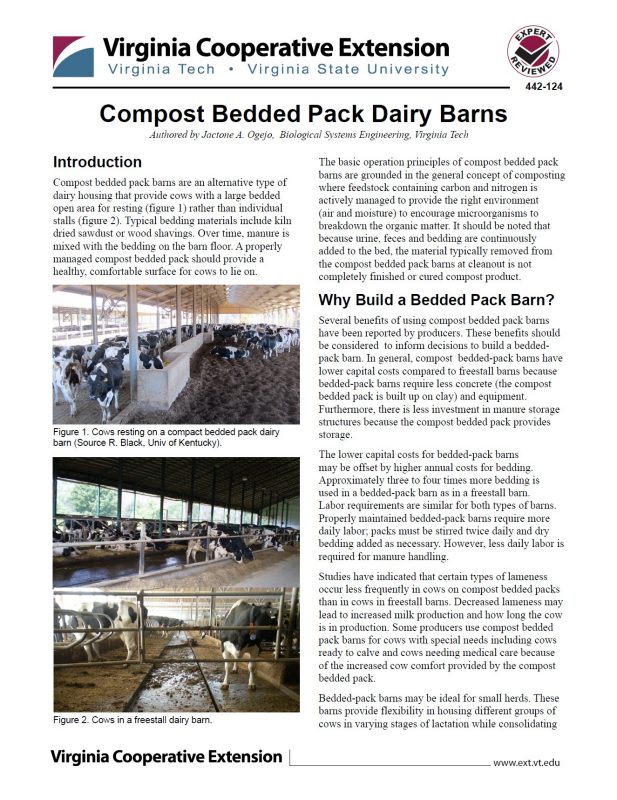
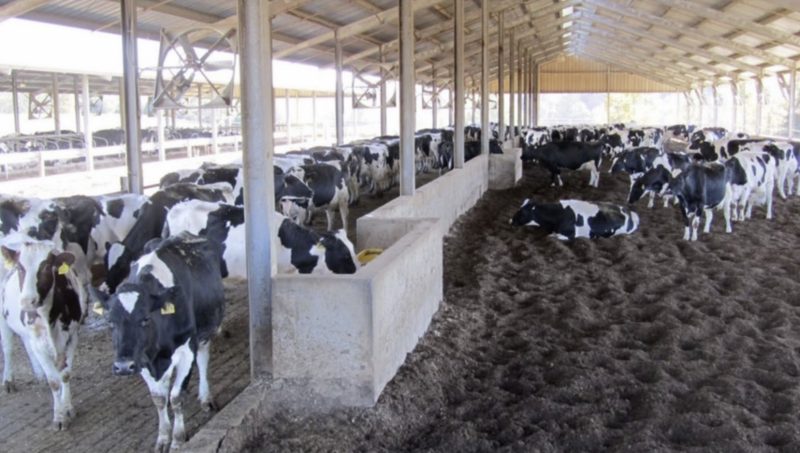
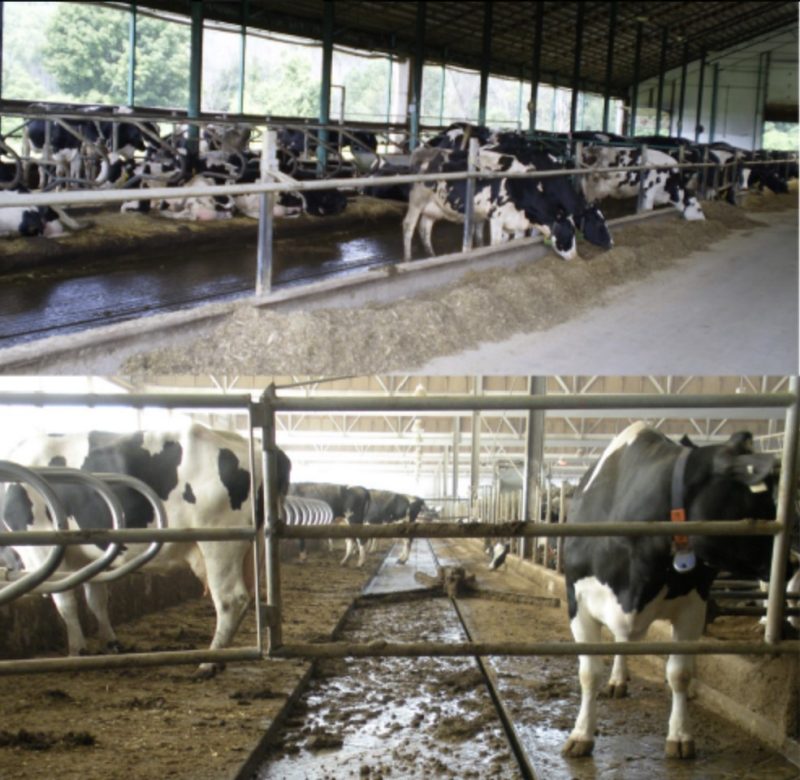
Compost bedded pack barns are an alternative type of dairy housing that provide cows with a large bedded open area for resting (Figure 1) rather than individual stalls (Figure 2). Typical bedding materials include kiln dried sawdust or wood shavings. Over time, manure is mixed with the bedding on the barn floor. A properly managed compost bedded pack should provide a healthy, comfortable surface for cows to lie on.
The basic operation principles of compost bedded pack barns are grounded in the general concept of composting where feedstock containing carbon and nitrogen is actively managed to provide the right environment (air and moisture) to encourage microorganisms to breakdown the organic matter. It should be noted that because urine, feces and bedding are continuously added to the bed, the material typically removed from the compost bedded pack barns at cleanout is not completely finished or cured compost product.
Why Build a Bedded Pack Barn?
Several benefits of using compost bedded pack barns have been reported by producers. These benefits should be considered to inform decisions to build a bedded-pack barn. In general, compost bedded-pack barns have lower capital costs compared to freestall barns because bedded-pack barns require less concrete (the compost bedded pack is built up on clay) and equipment. Furthermore, there is less investment in manure storage structures because the compost bedded pack provides storage.
The lower capital costs for bedded-pack barns may be offset by higher annual costs for bedding. Approximately three to four times more bedding is used in a bedded-pack barn as in a freestall barn. Labor requirements are similar for both types of barns. Properly maintained bedded-pack barns require more daily labor; packs must be stirred twice daily and dry bedding added as necessary. However, less daily labor is required for manure handling.
Studies have indicated that certain types of lameness occur less frequently in cows on compost bedded packs than in cows in freestall barns. Decreased lameness may lead to increased milk production and how long the cow is in production. Some producers use compost bedded pack barns for cows with special needs including cows ready to calve and cows needing medical care because of the increased cow comfort provided by the compost bedded pack.
Bedded-pack barns may be ideal for small herds. These barns provide flexibility in housing different groups of cows in varying stages of lactation while consolidating feeding and manure handling. Furthermore, cows can be added to these barns without additional capital costs until the recommended space per cow is reached.
Facility Design
Most bedded-pack barns are based on plans for three-row, drive-by, freestall barns (Figure 3). Using such a plan allows for conversion from a bedded-pack barn to a freestall barn if necessary. In a bedded-pack barn, the freestalls and freestall alleys are replaced by the bedded pack. A feed alley should be located along one side of the compost bedded pack. Waterers are located in the feed alley. The recommended feed alley width is 14 feet to allow cows eat off one side of the alley and drink from waterers on the other side.
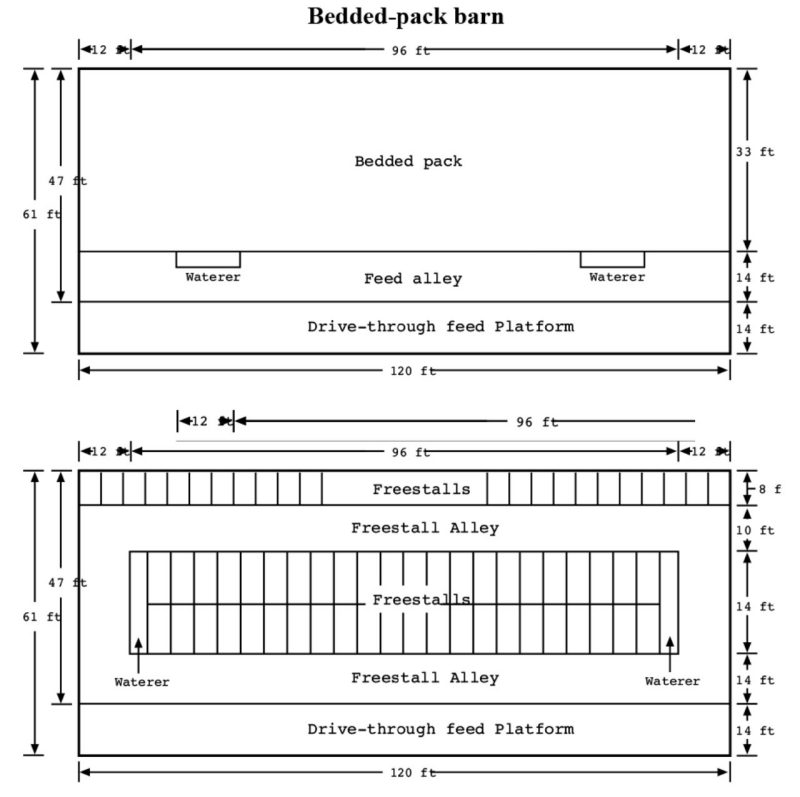
The compost bedded pack must provide 100 sq ft per cow. However, 140 sq ft per cow is recommended for dry cows or cows recuperating from illness. The compost bedded pack should be enclosed by a 4-foot high concrete wall to prevent feed and water from spilling onto the pack and to limit access points. The wall that separates the feed alley and the compost bedded pack should have a fence to prevent cows from walking over the wall.
Good ventilation is essential to maintain a dry bedded-pack surface. Sidewall height should be 14 to 16 feet to enhance natural ventilation. Sidewall curtains are recommended to control ventilation throughout the year. Mixing fans should be installed over the bedded-pack area to increase surface drying. These fans will also provide a cooling draft over cows during hot weather. A 3-foot overhang will minimize the amount of roof runoff and rain that may be blown onto the compost bedded pack. More information on natural ventilation of dairy barns is available from Natural Ventilation for Freestall Dairy Barns, Virginia Cooperative Extension publication 442-763.
Sizing a Bedded-pack Area – Example
A dairy producer plans to build a bedded-pack barn for 60 cows. The compost bedded pack will be 33 feet wide because it is based on the freestall barn in Figure 3. Determine the length of the bedded-pack barn using the recommended space of 100 sq ft per cow.
Bedded-pack area = 60 cows × 100 sq ft/cow = 6,000 sq ft
Length of barn = 6,000 sq ft ÷ 33 ft = 181 ft
Actual barn dimensions will be 61 ft by 181 ft.
Bedding
Softwood shavings are highly recommended for bedded-pack barns because pine, cedar, and other softwoods support minimal bacterial growth. Wood shavings are preferred over sawdust because the small size of sawdust particles can enhance bacterial growth and irritate teat ends. Sawdust should be kiln-dried if used as bedding. Studies have indicated that green hardwood sawdust can lead to increased mastitis in dairy cows. Some producers use straw bedding, although it is also associated with higher incidences of mastitis.
Managing the Compost Bedded Pack
The compost bedded packs must be properly managed to maintain a healthy and comfortable cow environment. Proper pack management requires twice daily stirring to a depth of 10 to 12 inches. Stirring incorporates oxygen into the bedding and encourages aerobic decomposition for good composting and generate the temperatures necessary to kill pathogens. The compost bedded pack should be stirred while the cows are being milked. Stirring can be done using a small loader with a front-mounted adapted cultivator or tines mounted on the front of the loader or rototillers.
A sufficient amount of dry bedding is essential to keep cows clean and SCC (somatic cell count) low. Daily bedding requirements can range from 10 to 35 lb of bedding per cow depending on the size of the cow. Lactating cows produce more manure than dry cows, so will require more bedding. Hot and humid or wet weather will require more frequent application of fresh bedding than dry weather. Fresh bedding should be added when the bedding becomes moist enough to stick to cows after they rise from laying on the compost bedded pack.
A minimum 100 sq ft per cow must be provided to maintain the integrity of the compost bedded pack. The compost bedded pack barns are easy to overcrowd because there are no stalls. These barns should always look like there is room for another cow. It is important not to exceed the number of cows for which the barn is designed.
Manure Management
The compost bedded packs should be completely cleaned out once or twice a year and applied to cropland as part of a manure nutrient management plan. Use caution when removing material from the compost bedded pack during clean out to avoid disturbing the barn floor clay base. The feed alley should be scraped daily and the manure moved to storage until land applied according to a manure management plan. An adequately sized manure storage-pit for short-term storage should be considered.
Summary
Compost bedded pack barns are a low capital-cost alternative to freestall barns. However, the lower initial investment for compost bedded pack barns may be offset by higher annual operating costs. Daily labor requirements are similar for both systems. The decision to build a compost bedded pack barn should include consideration of both capital and annual costs for this type of barn.
Many freestall barns started out as compost bedded pack barns until enough capital was saved to add freestalls and freestall alleys. Freestall barns evolved from bed- ded-pack barns to reduce bedding costs and the amount of labor spent on bedding management.
Compost bedded pack barns require careful and consistent daily management to create a healthy and comfortable cow environment. Poorly managed compost bedded packs can quickly degrade to a mire of wet manure and bedding. Effective pre-milking cow preparation is also required to maintain low bulk tank SCC.
Acknowledgements
The author acknowledges contribution of Former Extension Engineer Susan Gay, the author of the previous version of this factsheet. Also, the author acknowledges the review and comments made by Robert "Bobby" Grisso, Professor and Extension Engineer, Biological Systems Engineering; Robert James, Professor Emeritus, Dairy Science; and Tina Horn, formerly Extension Dairy Agent, Augusta County.
References
Barberg, A.E., Endres, M.I., Janni, K.A. (2007). Compost dairy barns in Minnesota: A descriptive study. Applied Engineering in Agriculture, 23(2), 231-238. (doi: 10.13031/2013.22606)
Black, R.A., Taraba, J.L., Day, G.B., Damasceno, F.A., Newman M.C., Akers, K.A., Woo, L.C., McQuerry, K.J., Bewley, J.M. (2014). The relationship between compost bedded pack performance, management, and bacterial counts. Journal of Dairy Science, 97, 1-11. (http://dx.doi.org/10.3168/jds.2013-6779)
Black, R.A., Taraba, J.L., Day, G.B., Damasceno, F.A., Bewley, J.M. (2013). Compost bedded pack dairy barn management, performance, and producer satisfaction. Journal of Dairy Science, 96, 8060-8074. (http://dx.doi.org/10.3168/jds.2013-6778)
Janni, K.A., Endres, M.I., Reneau, J.K., Schoper, W.W. (2007). Compost dairy barns layout and management recommendations. Applied Engineering in Agriculture, 23(1), 97-102. (doi: 10.13031/2013.22333)
Tyson, J., Bewley, J., Taraba, J. (2013). Guidelines for managing compost bedded pack barns. Dairy Practices Council (DPC-110).
Livesey, C.T. 2002. Hock injuries in cattle kept in straw yards or cubicles with rubber mats or mattresses. The Veterinary Record 150(22): 677-679.
Webster, A.J. F. 2002. Effects of housing practices on the development of foot lesions in dairy heifers in early lactation. The Veterinary Record 151(1): 9-12.
Natural Ventilation for Freestall Dairy Barns, Virginia Cooperative Extension publication 442-763
NRCS. (2007). Compost bedded pack dairy barns. Manure Management Information Sheet Number 3. (https://www.nrcs.usda.gov/Internet/FSE_DOCUMENTS/stelprdb1096993.pdf) Accessed March 2018.
Virginia Cooperative Extension materials are available for public use, reprint, or citation without further permission, provided the use includes credit to the author and to Virginia Cooperative Extension, Virginia Tech, and Virginia State University.
Virginia Cooperative Extension is a partnership of Virginia Tech, Virginia State University, the U.S. Department of Agriculture (USDA), and local governments, and is an equal opportunity employer. For the full non-discrimination statement, please visit ext.vt.edu/accessibility.
Publication Date
February 15, 2024