Lilac Borer/Ash Borer
ID
444-278 (ENTO-359NP)
Description
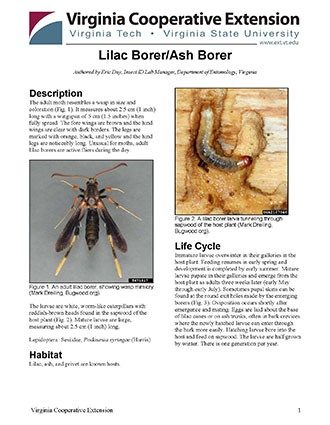
The adult moth resembles a wasp in size and coloration (Fig. 1). It measures about 2.5 cm (1 inch) long with a wingspan of 5 cm (1.5 inches) when fully spread. The fore wings are brown and the hind wings are clear with dark borders. The legs are marked with orange, black, and yellow and the hind legs are noticeably long. Unusual for moths, adult lilac borers are active fliers during the day.
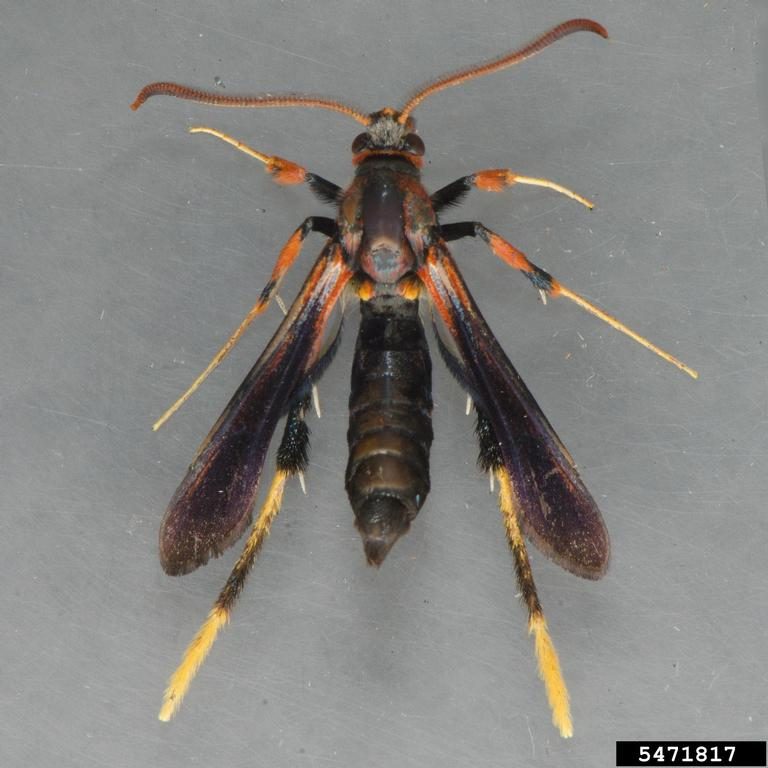
The larvae are white, worm-like caterpillars with reddish-brown heads found in the sapwood of the host plant (Fig. 2). Mature larvae are large, measuring about 2.5 cm (1 inch) long.
Lepidoptera: Sesiidae, Podosesia syringae (Harris)
Habitat
Lilac, ash, and privet are known hosts.
Life Cycle
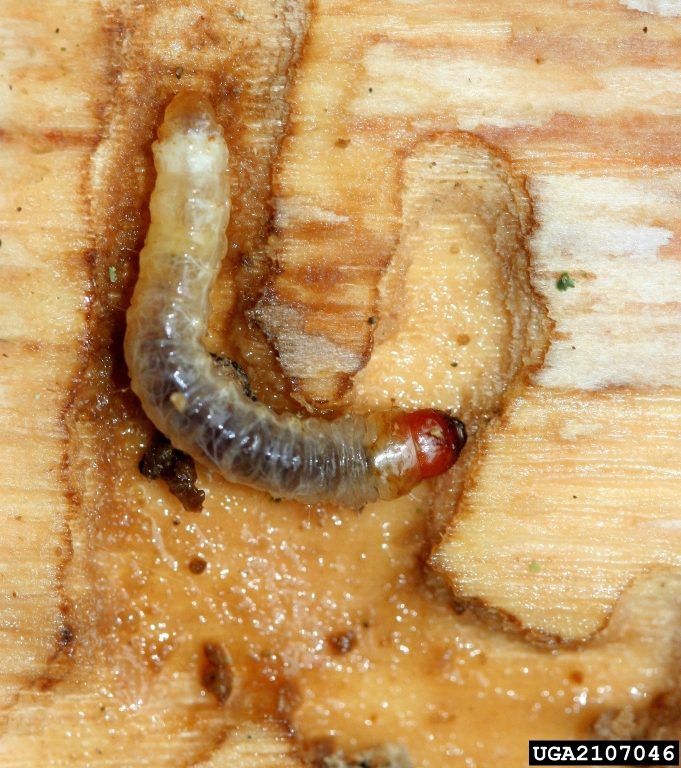
Immature larvae overwinter in their galleries in the host plant. Feeding resumes in early spring and development is completed by early summer. Mature larvae pupate in their galleries and emerge from the host plant as adults three weeks later (early May through early July). Sometimes pupal skins can be found at the round exit holes made by the emerging borers (Fig. 3). Oviposition occurs shortly after emergence and mating. Eggs are laid about the base of lilac canes or on ash trunks, often in bark crevices where the newly hatched larvae can enter through the bark more easily. Hatching larvae bore into the host and feed on sapwood. The larvae are half grown by winter. There is one generation per year.
Damage
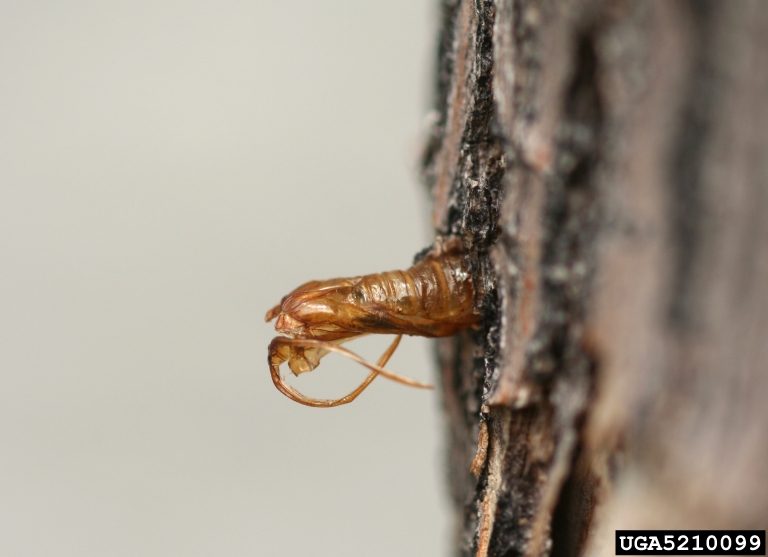
Sap may flow from entrance holes as larvae bore through the wood. Larval tunneling through the sapwood causes the base of infested branches or trunks to swell, cracking the bark and breaking it away from the wood. Limbs may die back and break. Fine, sawdust-like material may extrude from holes in the bark. Smaller canes or branches may wilt suddenly. Even light infestations will weaken and kill the plant over time.
Control Methods
Non-chemical: Susceptible host plants should be well maintained to minimize stress. Avoid wounding plants as wounds are attractive to female moths looking for places to lay their eggs. Heavily infested plants should be cut and burned during the fall and winter periods to kill overwintering larvae.
Chemical: Spray an insecticide labeled for insect borers, completely covering the trunk and any of the lower main branches. Spraying in early May and again in about six weeks usually provides good control by killing adults emerging from the trunk as well as larvae boring into it. Wetting the foliage is not necessary. Soil drenches of imidacloprid are not effective against moth larvae and are not recommended for lilac borer control.
Remarks
The banded ash clearwing, Podosesia aureocinta, is a closely related borer on ash. It is similar in appearance to the ash borer and emerges from ash in August. Insecticide treatments for banded ash clearwing should be applied in late summer. Do not confuse banded ash clearwing with the similarly named banded ash borer, which is a beetle with a different life history and treatment recommendations.
Also, lilac borer in ash should not be confused with emerald ash borer, an introduced beetle pest of ash trees. Emerald ash borer occurs throughout much of Virginia and has a different life history and control measures than lilac borer. Damage to ash caused by either the lilac borer or the banded ash clearwing is minimal compared to that produced by emerald ash borer. See the Virginia Cooperative Extension fact sheet on emerald ash borer (2904-1290) for more information about this pest.
Revision
Theresa A. Dellinger, February 12, 2020.
Virginia Cooperative Extension materials are available for public use, reprint, or citation without further permission, provided the use includes credit to the author and to Virginia Cooperative Extension, Virginia Tech, and Virginia State University.
Virginia Cooperative Extension is a partnership of Virginia Tech, Virginia State University, the U.S. Department of Agriculture, and local governments. Its programs and employment are open to all, regardless of age, color, disability, sex (including pregnancy), gender, gender identity, gender expression, genetic information, ethnicity or national origin, political affiliation, race, religion, sexual orientation, or military status, or any other basis protected by law.
Publication Date
March 19, 2020