Leafy Green Vegetables
ID
426-408 (SPES-785P)
 EXPERT REVIEWED

Culture
Planting: Seed leaf or butterhead types as soon as the soil can be worked in the spring, or in late summer. Crisphead and cos types may be transplanted in early spring or fall.
Spacing: Romaine, leaf or butterhead: 4 to 10 inches x 12 to 24 inches; crisphead:12 to 15 inches x 18 to 30 inches.
Hardiness: Hardy annual.
Fertilizer needs: Medium-heavy feeder; use starter solution on transplants, sidedress if nutrient deficiencies are noted.
Cultural Practices
Lettuce, a cool-season vegetable crop, is one of the easiest to grow. Lettuce withstands light frost; however, sunlight and high summer temperatures often trigger seed stalk formation (bolting) and a bitter flavor. Slow-bolting or heat-resistant varieties are available and are recommended for extending the lettuce-growing season.
There are several types of lettuce commonly grown in gardens.
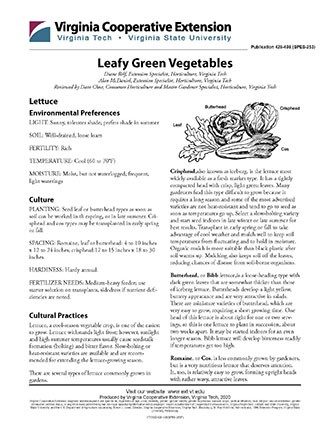
Crisphead, also known as iceberg, is the lettuce most widely available as a fresh market type. It has a compact head with crisp, light-green leaves. Many gardeners find this type difficult to grow because it requires a long season and some of the most advertised varieties are not heat-resistant and tend to go to seed as soon as temperatures go up. Select a slow-bolting variety and start seed indoors in late winter or late summer for best results. Transplant in early spring or fall to take advantage of cool weather and mulch well to keep soil temperatures from fluctuating and to hold in moisture. Organic mulch is preferable to black plastic once the soil warms up. Mulching also keeps soil off the leaves, reducing the chances of disease from soil-borne organisms.
Butterhead, or Bibb lettuce, is a loose-heading type with dark green leaves that are somewhat thicker than those of iceberg lettuce. Butterheads develop a light yellow, buttery appearance and are very attractive in salads. There are miniature varieties of butterhead that are very easy to grow and have a short growing time. One head of this lettuce is about right for one or two servings, so plant it in succession, about two weeks apart. It may be started indoors for an even longer season. Bibb lettuce will develop bitterness readily if temperatures get too high.
Romaine, or Cos, is less commonly grown by gardeners, but it is a very nutritious lettuce that deserves attention. It, too, is relatively easy to grow, forming upright heads with rather wavy, attractive leaves.
Leaf-type lettuce, either with green or reddish leaves, is the one most gardeners raise. This type is a fast-growing, long-lasting lettuce used for salads, sandwiches, and in wilted lettuce salads. Leaf lettuce basically needs only to be planted, thinned, and harvested. Cultivate carefully as lettuce is shallow-rooted. Use frequent light waterings to encourage rapid growth, but do not overwater, as this may cause root or leaf disease. Overhead watering should always be done in the morning to give plants time to dry off. As mentioned above, mulches help maintain soil moisture and keep leaves off the ground.

Lettuce planted in very early spring should be given full sun so that the soil warms enough for rapid growth. For long-season lettuces, plant so that crops such as sweet corn, staked tomatoes, pole beans or deciduous trees will shade the lettuce during the hottest part of the day, when temperatures are over 70°F. Interplanting (i.e., planting between rows or within the row of later-maturing crops like tomatoes, broccoli, and Brussels sprouts) is a space-saving practice. Many lettuces are attractive in flower borders.
Lettuce is best planted in succession, or using different varieties that mature at different times. Thirty heads of iceberg lettuce harvested at once can present a major storage problem! Leaf and Bibb lettuces do well in hotbeds or greenhouses during the winter and in cold frames in spring and late fall.
Common Problems
Diseases: Stem, leaf, and root rots.
Insects: Aphids, flea beetle, harlequin bug.
Cultural: Tip burn from irregular moisture or lack of calcium; bolting, bitterness due to high temperature or lack of moisture; leaf rots due to soil and/or water on leaves.
Refer to the current year’s version of Virginia Cooperative Extension’s Pest Management Guide - Home Grounds and Animals, Home Vegetable Chapter for current control recommendations (https://www.pubs.ext.vt.edu/456/456-018/456-018.html).
Harvesting and Storage
Days to maturity: 40 to 80 days, depending on type.
Harvest: Leaf lettuce can be used as soon as plants are 5 to 6 inches tall. Use the older, outer leaves, which contain high levels of calcium, first. You may wish to harvest every other one of the largest plants to accomplish thinning.
Bibb lettuce is mature when leaves begin to cup inward to form a loose head. The heads will never become compact.
Cos or Romaine is ready to use when the leaves have elongated and overlapped to form a fairly tight head about 4 inches wide at the base and 6 to 8 inches tall.
Crisphead is mature when leaves overlap to form a head similar to those available in groceries; heads will be compact and firm.
Crisphead lettuce will keep about two weeks in the refrigerator. Leaf, Bibb, and Romaine will store for up to 4 weeks if the leaves are dry when bagged. If lettuce is to be stored, harvest when dry, remove outer leaves, but do not wash; place in a plastic bag, and store in the crisper drawer.
Approximate yields: 2 to 4 pounds per 10-foot row
Amount to raise: 5 to 10 pounds per person planted over the cool season
Storage: Cool (32°F), moist (95% relative humidity) conditions for two to three weeks
Preservation: Cool, moist refrigeration; canning and freezing not recommended
Spinach
Environmental Preferences
Light: tolerates partial shade
Soil: well-drained loam, high organic matter
Fertility: medium
pH: 6.0 to 7.5
Temperature: cool (60° to 65°F)
Moisture: moist, but not waterlogged
Culture
Planting: Sow seeds 1/2 inch deep in early spring as soon as soil can be tilled and in late summer for fall and early winter harvest
Spacing: 2 to 4 inches x 12 to 18 inches
Hardiness: hardy annual.
Fertilizer needs: medium-heavy feeder; sidedress with one pound of 10-10-10 or two pounds of 5-10-5 (or 5-10-10) per 100 feet of row and scratch into the top inch of soil with a rake.

Cultural Practices
Spinach is a cool-season vegetable and should be grown in the spring or fall.
Long days and high temperatures cause the plants to bolt. There are spring and fall varieties of spinach. Spring varieties tend to bolt more slowly than fall varieties.
Conditions that stress the plant (such as excess cold, transplant shock, etc.) can cause it to stop growing and greatly reduce yield. Close crowding in the row also encourages early development of flower stalks.
In the mild parts of the state, spinach can be grown through the winter. Protection will be required in severe weather.
Because spinach is shallow-rooted, it does not compete well with weeds. Deep cultivation will destroy spinach roots and should not be used. An adequate supply of water is very important for good production, but waterlogged soil will also decrease production.
New Zealand spinach is an unrelated crop sometimes recommended as a summer substitute as it does well in hot weather. Yield is relatively low for the space required (1 foot x 3 to 4 feet). The 3 to 4 inches of branch tips are removed and cooked.
Common Problems
Diseases: downy mildew, yellow blight.
Insects: aphid, leaf miner, cabbage worms, flea beetle, harlequin bug.
Cultural: early development of flower stalks (seeds were sown too late in the spring and hot weather induced bolting).
Refer to the current year’s version of Virginia Cooperative Extension’s Pest Management Guide - Home Grounds and Animals, Home Vegetable Chapter for current control recommendations (https://www.pubs.ext.vt.edu/456/456-018/456-018.html).
Harvesting and Storage
Days to maturity: 40 to 70 days from seed
Harvest: Spinach may be harvested from the time the plant has six to eight leaves until just before the seed stalk develops. The entire plant may be cut off just above the ground, or leaves can be harvested individually. The outer leaves should be pinched and not pulled off. Excellent raw for salads as well as cooked.
Approximate yields: (per 10-foot row) 4 to 6 pounds
Amount to raise per person: 10 pounds
Storage: cold (32°F), moist (95% relative humidity) conditions 10 to 14 days
Preservation: freeze, can
Cooking Greens
Environmental Preferences
Light: sunny, tolerates partial shade
Soil: well-drained
Fertility: rich
pH: 6.0 to 7.0
Temperatures: cool (60° to 70°F)
Moisture: average
Culture
Planting: Sow seeds from early spring to early summer or in late summer. Kale, collards and Chinese cabbage can be grown as transplants.
Spacing: Collards: 18 to 24 inches x 24 to 36 inches; Kale: 10 to 18 inches x 18 to 36 inches; Mustard: 4 to 6 inches x 18 to 30 inches; Chinese cabbage- 12 to 24 inches x 18 to 30 inches
Hardiness: Kale and collards are hardy biennials; mustard is a hardy annual; Chinese cabbage is a half-hardy annual.
Fertilizer needs: medium feeder; sidedress when plants are 4 to 6 inches tall; one pound of 10-10-10 or two pounds of 5-10-5 (or 5-10-10) per 100 feet of row and scratch into the top inch of soil with a rake.
Cultural Practices
Most greens prefer the cool weather of spring and fall. Kale and collards are tolerant of hot summer weather. Mustard greens and some Chinese cabbage bolt quickly in summer and may be better suited to fall. Rapid, succulent growth is desirable, so supply ample moisture and fertilization.
Many varieties of greens are available. Kale can be tall or short; highly curled or plain-leafed; blue-green, yellow-green, or red. Chinese cabbage has heading or upright varieties.
Most greens are frost-tolerant and may taste better after cold weather sets in. In many areas of Virginia, kale and collards will grow all through the winter if slightly protected.
Common Problems
Diseases: blackleg and black rot, clubroot, yellows
Insects: flea beetle, cutworm, imported cabbageworm, caterpillar looper, aphid, harlequin bug
Cultural: bolting (too much heat, planting too early, growth stress due to drought)
Refer to the current year’s version of Virginia Cooperative Extension’s Pest Management Guide - Home Grounds and Animals, Home Vegetable Chapter for current control recommendations (https://www.pubs.ext.vt.edu/456/456-018/456-018.html).
Harvesting and Storage
Days to maturity: 45 to 80
Harvest: All green parts are edible, and may be harvested at any time. Seed can be sown somewhat thickly and the thinnings may be good in salads. Mustard, kale and collards may have their larger leaves harvested. New leaves will provide a continuous harvest until they become tough or the flavor becomes strong. Chinese cabbage should be harvested as a mature plant, 15 to 18 inches tall, and makes an excellent salad crop as well as a cooking green.
Approximate yields: (per 10-foot row) Collards: 4 to 8 pounds; Kale: 3 to 6 pounds; Chinese Cabbage: 8 to 28 pounds; Mustard: 3 to 6 pounds
Amount to raise per person: all cooking greens- 5 to 20 pounds
Storage: cool (32°F), moist (95% relative humidity) conditions; 10 to 14 days
Preservation: cool, moist storage is best (may be canned)
Chards
Environmental Preferences
Light: tolerates light shade
Soil: well-drained loam
Fertility: medium
pH: 6.0 to 7.0
Temperature: cool (60° to 65°F)
Moisture: moist, but not waterlogged

Culture
Planting: Sow or transplant after the danger of frost is past. For seed germination, soil temperature should be 40° F. Plant seeds 1/2 to 3/4 inch deep.
Spacing: 8 inches x 12 to 18 inches
Hardiness: hardy biennial
Fertilizer needs: medium to light feeder; sidedress one month after planting with one pound of 10-10-10 or two pounds of 5-10-5 (or 5-10-10) per 100 feet of row and scratch into the top inch of soil with a rake.
Cultural Practices
Chard prefers cool temperatures, but is more tolerant of heat than spinach. Chard will produce greens steadily throughout the summer.
Because the chard "seed" is actually an aggregate of seeds, thinning is necessary. Thin to 4 to 6 inches apart when plants become 6 to 8 inches tall. When the plants reach 8 to 10 inches tall, thin them to 8 inches apart. Plants removed during thinning can be used in the kitchen.
Chard should be continuously harvested throughout the summer, as removing of the outer leaves encourages the development of new leaves.
Chard does not compete well with weeds; therefore, shallow cultivation to control weeds is necessary.
Crop rotation is recommended to control leaf spot.
Common Problems
Diseases: leaf spot
Insects: cabbage worm, aphid, beet leaf miner, flea beetle.
Refer to the current year’s version of Virginia Cooperative Extension’s Pest Management Guide - Home Grounds and Animals, Home Vegetable Chapter for current control recommendations (https://www.pubs.ext.vt.edu/456/456-018/456-018.html).
Harvesting and Storage
Days to maturity: 50 to 60 days from seed
Harvest: Outer leaves are harvested when they are 8 to 10 inches tall and still tender and succulent. Leaves should be cut with a sharp knife, 1 inch above the ground. Continue to harvest in this way until fall. For the final harvest in the fall, the plants should be dug up before the first heavy freeze.
Approximate yields: (per 10-foot row) 8 to 12 pounds
Amount to raise per person: 5 pounds
Storage: cold (32°F), moist (95% relative humidity) conditions; 10 to 14 days
Preservation: freeze
Virginia Cooperative Extension materials are available for public use, reprint, or citation without further permission, provided the use includes credit to the author and to Virginia Cooperative Extension, Virginia Tech, and Virginia State University.
Virginia Cooperative Extension is a partnership of Virginia Tech, Virginia State University, the U.S. Department of Agriculture (USDA), and local governments, and is an equal opportunity employer. For the full non-discrimination statement, please visit ext.vt.edu/accessibility.
Publication Date
February 17, 2026