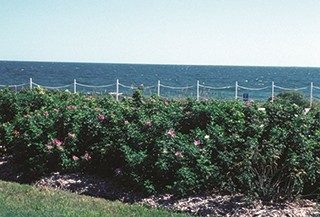
Trees and Shrubs that Tolerate Saline Soils and Salt Spray Drift
ID
430-031 (SPES-342P)
Introduction
High salinity in soil can reduce plant growth, diminish plant appearance, and cause plant death. Concentrated sodium (Na) and chloride (Cl), components of salt, can damage plant tissue whether they contact parts above or below ground. Care should be taken to avoid excessive salt accumulation from any source on tree and shrub roots, leaves, or stems. Accumulated salts in the environment may also:
- Adversely impact surface and ground waters (including creeks, streams, rivers, the Chesapeake Bay, lakes, stormwater and irrigation ponds, and drinking water reservoirs and wells).
- Build to levels that are toxic to many types of organisms.
- Reduce water availability and degrade water for various uses.
This publication discusses causes and symptoms of salt damage to plants, suggests treatments to alleviate salt contamination, and provides a list of salt-tolerant trees and shrubs suitable for planting in salt-prone landscapes.
Saline Soils
Saline soils occur when salts accumulate in the soil. Significant salt accumulation is uncommon in areas where rainfall exceeds 20 inches per year because rain washes natural and synthetic salts from the soil. Since Virginia averages 43 inches of rain per year (Runkle et al. 2017), saline soils generally are not a widespread problem. However, saline soils do occur in specific situations such as:
- Along the coastline and barrier islands where seawater may surge inland, and where salt from sea spray may accumulate in the soil.
- Along brackish tidal rivers and estuaries where flooding during storms and high tides can deposit salt in low-lying areas. Wooded wetlands are frequently found in these locations.
- Along sidewalks and roads where de-icing products containing salt are used to melt ice and snow. As the ice and snow melt, runoff carries the salt to low- lying areas and into the soil. Vehicles also splash and spray salt melt into roadside areas as they travel. Salt accumulation in the soil usually occurs within 30-50 feet of roads. Snow and ice laden with salt is often heaped in parking lot islands and sidewalk tree lawns where melting carries salt into the soil.
- When fertilizers are overapplied in landscapes and agricultural areas, when high salt index fertilizers are used, or when manures are used.
- In areas where crops or landscape plants are irrigated with water containing dissolved salts. Repeated light watering without leaching or adequate drainage can result in salt accumulation in the soil.
- In areas with high groundwater tables.
How do saline soils affect trees and shrubs? Plant root cells absorb water through a semi-permeable membrane that blocks large molecules, but allows water and small molecules to get through. Under normal soil conditions, water flows freely through the membrane into the roots because dissolved molecules are more concentrated inside the roots than the surrounding soil. This process is called osmosis and keeps roots hydrated as long as there is ample water in the soil. When salt accumulates in the soil, it changes the balance of molecules inside and outside the roots and causes water to reverse course and flow out of the roots even if the soil is wet. Water exiting roots into the soil dehydrates the roots and eventually the entire plant vascular system. This appears as “salt burn” on the foliage as leaf cells dry out and die.
High levels of soluble salts also cause changes to soil structure. Salt breaks down soil aggregates, causing small soil particles to wash into the spaces between large soil particles. This makes it difficult for the soil to absorb and drain water. Loss of soil structure also makes soil (especially soils with high clay content) more susceptible to compaction (Provin and Pitt 2012). Compaction causes a reduction of pore spaces between soil particles, reducing water and oxygen in the soil and water drainage through the soil layers. As a result, water and oxygen availability to plant roots, and consequently plant growth, are affected.
High levels of soluble salts can also cause a very high soil pH (greater than 8), which can cause some plant nutrients to be toxic or unavailable. Plants stressed by high salt levels are unhealthy and may be more vulnerable to pests and diseases.
Plants vary in their ability to tolerate saline soils. Plants with adaptations to grow in saline soils are called “halophytes” or salt plants. These plants are generally found in coastal areas, in salt-water marshes, and in brackish (moderately saline) wetlands. Some halophyte plants exclude salts at the root, while others excrete salt through specialized salt glands. The presence of some of these plants, such as spartina and sea oats, generally indicates that the soil is saline.
The amount of salt in the soil can be measured with a soil test. The Virginia Cooperative Extension Service Soil Test Laboratory reports salt levels using the measure “parts per million” or “ppm.” Salt concentrations of 1-1,000 ppm are considered low, and those from 1,000- 2,000 ppm medium. Most landscape plants can tolerate salt concentrations in the low range and sometimes the medium range. If salt content is higher than that, treating the soil or choosing salt-tolerant plants is recommended.
Salt Spray
Salt spray is tiny water droplets containing dissolved salts that are propelled through the air and fall upon nearby soil and plants. When the droplets evaporate, the salt’s sodium (Na) and chloride (Cl) ions move into the soil or penetrate plant stems, buds, and leaves, causing direct damage to tissues. Salt spray damage to trees and shrubs occurs in specific situations, including near the seaside or bayside when salt water is blown by storms, near roads where de-icing salts are applied, and vehicular traffic causes splashing, or in areas irrigated through sprinklers with saline water. Saline irrigation water can happen when using reclaimed/recycled water sources or when salt water intrudes into a well that is used for irrigation.

De-icing Salts
Roads, sidewalks, and parking lots used for pedestrian and vehicular traffic need to be made safe when precipitation falls during freezing temperatures. De-icing salts are applied to these surfaces to reduce the freezing temperature of water and improve traction. Within the United States, it is estimated that 24 million tons of de-icing products are applied annually (Lilek 2017). Sodium chloride (NaCl, rock salt) is the most common de-icing salt. Other de-icing products include calcium chloride (CaCl2), potassium chloride (KCl), and magnesium chloride (MgCl2). Some products are applied as granules or pellets while others are applied as brine or liquid solution. Damage to plants occurs when these de-icing products dissolve and are splashed onto plants by passing vehicles or run off the impervious surfaces and contaminate the soil and plant root zones.


Symptoms of Salt Damage
Most landscape plants are sensitive to salt. Seedling trees and shrubs, newly planted plants, and plants with tender new growth can be particularly sensitive to salt exposure. Generally, plants are more sensitive to salts on the foliage than on stems, trunks, or in the root zones (Wu and Dodge 2005). The severity of salt damage to plants depends primarily upon the type, amount, and length of exposure, and the concentration of salt. Additional stresses such as wind, sun, heat, and heavy traffic can increase the severity of damage.
Symptoms can be acute or chronic. Acute conditions develop suddenly and last a short time, such as brown edges on leaves or tips of evergreen needles after exposure to salt in the wind from a hurricane or nor’easter storm. Chronic conditions develop slowly and generally worsen over an extended period of time, such as when plant health declines after repeated flooding of an area with brackish water (e.g., tidal flooding). If salt exposure persists or is repeated, damage will be more severe.
Symptoms of salt damage can be on one part, one side, or the entire plant and can include:
- White salt residue on leaves and stems.
- Reduced or stunted growth.
- Stem and foliage disfigurement.
- “Witches-broom” (tufting) of new growth.
- Reduced leaves, flowers, and fruit.
- Buds that fail to open or die.
- Marginal or tip leaf/needle burn.
- Early fall color or early leaf drop.
- Leaf necrosis (death), or death of a branch or entire plant.

Damage on deciduous plants can show up quickly or months after the exposure occurred, whereas evergreen plants tend to show damage soon after the exposure. When trying to diagnose plant damage, keep in mind that all of the above symptoms can also be caused by a variety of other factors, including root damage, drought, insects, diseases, and chemical misuse. Try to eliminate these other possibilities, and use tools such as soil and water analyses and weather data to arrive at a correct damage diagnosis. If damage is seen on several different plant species in the same area, then insects and diseases can generally be ruled out as they are usually species-specific. In contrast, salt damage is often evident on a variety of plants occupying a common landscape area that has been contaminated by salt. The gradual appearance of salt-tolerant halophytes in areas where other plants have experienced damage indicates increasing salt in the soil.
Treatment of Salt Damage
Treatments are few and depend on the specific plant, location, type of salt exposure, time of year, and access to fresh water. If there is adequate precipitation or irrigation to wash salt off the leaves and stems and leach the salt out of soil soon after the initial exposure, the amount of injury can be significantly reduced. Treatments for salt include:
- Wash off any residue observed on the foliage and stems with fresh water.
- Replant with tolerant species.
- Improve soil structure, drainage, and moisture-holding capacity by adding organic matter.
- Flush salts through the soil by applying 2 inches of water over a period of two to three hours, stopping when runoff occurs. Repeat this treatment two days later if salt levels are still high.
- An application of 20-40 pounds of granular gypsum (calcium sulfate, or CaSO4) followed by heavy irrigation has been shown to be effective in flushing sodium (Daniel 2020), but it may not reduce sodium to acceptable levels.
Prevention of Salt Damage
Prevention measures can reduce the likelihood of salt damage and the need for treatment. More options are available for preventing salt damage than for treating salt damage, and prevention is generally easier and less expensive. These measures include:
- Select and plant salt-tolerant species (table 1 and table 2).
- Reduce application frequency of de-icing products. Use products that don’t contain salt, or use a 50/50 mix of sand and granule/pellet de-icing product to reduce total amount of salt applied. Use calcium, potassium, or magnesium products instead of sodium-based products.
- Improve soil structure, drainage, and moisture-holding capacity by adding organic matter.
- Plant sensitive plants uphill, on berms, or in raised beds where salty water will not drain toward or accumulate.
- Plant sensitive plants at least 50-60 feet away from paving where de-icing products might be applied.
- Irrigate deeply and infrequently rather than lightly/ shallowly and frequently to promote deep, healthy plant root systems that can resist salt damage or recover from it quickly. For established landscapes, 1 inch of water applied once a week is generally adequate.
- Mulch to prevent evaporation and subsequent build-up of salt in the soil.
- Fertilize only when a soil test or plant symptom indicates that fertilizer is needed, and then only at rates recommended by soil analyses and fertilizer labels. Design planting areas to reduce exposure of trees and shrubs to salt spray. Put the most salt-tolerant species in higher exposure areas to shield the less-tolerant species.
- Use windbreaks (fences and buildings) to intercept aerial salt drift before it reaches sensitive plants.
- To protect plants adjacent to roads during the winter, erect burlap fencing or other barriers between the road and the plant. Consider fencing or signage along roads to prevent plows from piling treated snow and ice on adjacent plantings.
References
Daniel, Kyle. 2020. “Alleviating Landscape Soils with High Salt Concentrations.” Purdue University Landscape Report, Issue 20-21. https://www. purduelandscapereport.org/article/3557/.
Lilek, Joseph. 2017. “Roadway Deicing in the United States.” Factsheet 2017-003, AGI Critical Issues Program. https://www.americangeosciences.org/ geoscience-currents/roadway-deicing-united-states.
Provin, Tony, and J. L. Pitt. 2012. “Managing Soil Salinity.” Texas A&M AgriLife Extension Service publication E-60. https://cdn-ext.agnet.tamu.edu/ wp-content/uploads/2018/10/E60-managing-soil-salinity.pdf.
Runkle, Jennifer, Kenneth E. Kunkel, Laura Stevens, Sarah Champion, Brooke C. Stewart, Rebekah Frankson, and William Sweet. 2017. “Virginia State Climate Summary.” National Oceanic and Atmospheric Administration (NOAA), National Centers for Environmental Information (NCEI), Technical Report NESDIS 149-VA, 4 pp. https:// statesummaries.ncics.org/chapter/va/.
Wu, Lin, and Linda Dodge. 2005. “Landscape Plant Salt Tolerance Selection Guide for Recycled Water Irrigation.” A Special Report for the Elvenia J. Slosson Endowment Fund, Department of Plant Sciences, University of California, Davis. http:// slosson.ucdavis.edu/Landscape_Plant_Selection_ Guide_for_Recycled_Water_Irrigation/.
Resources
Cornell University Woody Plants Database. http:// woodyplants.cals.cornell.edu/.
Digital Atlas of the Virginia Flora. http://vaplantatlas. org/
Native Plants for Conservation, Restoration, and Landscaping, Virginia Department of Conservation and Recreation. https://www.dcr.virginia.gov/ natural-heritage/nativeplants
Native Plants for Wildlife Habitat and Conservation Landscaping, Chesapeake Bay Watershed. U.S. Fish and Wildlife Service. https://www.fws.gov/ chesapeakebay/resources/native-plants.html
Riparian Buffers and Bay Friendly Gardens. Virginia Institute of Marine Science. https://www.vims. edu/ccrm/outreach/teaching_marsh/native_plants/ riparian_buffers/index.php
Salt Tolerant Plants. https://norfolkbotanicalgarden.org/ salt-tolerant-plants-by-les/
Salt Tolerant Northern Neck Native Plants. Northern Neck Chapter of the Virginia Native Plant Society. https://static1.squarespace.com/ static/5a848930cf81e0bad21ebac2/t/5ab17334758d4 654e4805b59/1521578805958/Salt+Tolerant.pdf
Acknowledgments
The authors express their appreciation to the authors of the original 2009 publication: Extension specialist Bonnie Appleton, Horticulture Associate Laurie Fox, and graduate students Vickie Greene and Aileen Smith of the Hampton Roads Agricultural Research and Extension Center, Virginia Tech; Brian Kane, Department of Forestry, Virginia Tech; and Virginia Cooperative Extension agents Susan French (Virginia Beach), Adam Downing (Madison), Traci Gilland (Portsmouth). The authors also thank reviewers David Close, Consumer Horticulture and Master Gardener specialist, Virginia Tech; Virginia Cooperative Extension agents Mike Andruczyk (Chesapeake) and Megan Tierney (York/ Poquoson); Les Parks, Director of Horticulture, Norfolk Botanical Garden; Eric Wiseman, Associate Professor of Urban Forestry, Virginia Tech; and Karen Duhring, Marine Scientist, Virginia Institute of Marine Science Center for Coastal Resources Management.
Plant Lists
When selecting trees and shrubs, consider all site and management constraints so that the plants will thrive and be assets to the landscape. Consider climate, growing space (both vertical and horizontal), soil type and volume, utilities above and below ground, site use and users, and maintenance needs. The native status of a plant is also important, as natives are generally better adapted to local environmental conditions. Please note that the native status of a plant is also important, as natives are generally better adapted to local environmental conditions.
Table 1. Trees Tolerant of Saline Conditions
Common Name |
Latin Name |
Deciduous/ Evergreen | Mature Size Small <30 ft. Med. 30-60 ft. Large > 60 ft. |
Native to VA |
Trident maple | Acer buergerianum | D | S | No |
Hedge maple | Acer campestre | D | S | No |
Red maple | Acer rubrum | D | M | Yes |
Sycamore maple | Acer pseudoplatanus | D | M | No |
Horse chestnut | Aesculus hippocastanum | D | L | No |
Red buckeye | Aesculus pavia | D | S | No |
Downy serviceberry, shadbush | Amelanchier arborea | D | S | Yes |
Canadian serviceberry | Amelanchier canadensis | D | S | Yes |
River birch, red birch | Betula nigra | D | L | Yes |
Gray birch | Betula populifolia | D | M | No |
Catalpa | Catalpa speciosa | D | M | No |
Sugarberry, Southern hackberry | Celtis laevigata | D | L | Yes |
White fringetree | Chionanthus virginicus cus | D | S | Yes |
Lavalle hawthorn | Crataegus x lavallei | D | S | No |
Washington haw- thorn | Crataegus phaenopyrum | D | S | Yes |
Green hawthorn | Crataegus viridis | D | S | Yes |
Japanese cedar | Cryptomeria japonica | E | M | No |
Common persimmon | Diospyros virginiana | D | M | Yes |
White ash | Fraxinus americana | D | L | Yes |
Green ash | Fraxinus pennsylvanica | D | L | Yes |
Ginkgo | Ginkgo biloba | D | L | No |
Honeylocust | Gleditsia triacanthos | D | L | Yes |
Kentucky coffeetree | Gymnocladus dioicus | D | L | No |
American holly | Ilex opaca | E | M | Yes |
Black walnut | Juglans nigra | D | L | Yes |
Eastern redcedar | Juniperus virginiana | E | S | Yes |
Goldenraintree | Koelreuteria paniculata | D | S | No |
Common larch | Larix decidua | D | L | No |
Sweetgum | Liquidambar styraciflua | D | L | Yes |
Amur maackia | Maackia amurensis | D | S | No |
Southern magnolia | Magnolia grandiflora | E | L | Yes |
Sweetbay magnolia | Magnolia virginiana | E | S | Yes |
Black gum | Nyssa sylvatica | D | M | Yes |
Colorado spruce | Picea pungens | E | M | No |
Austrian pine | Pinus nigra | E | M | No |
Longleaf pine | Pinus palustris | E | L | Yes |
Loblolly pine | Pinus taeda | E | L | Yes |
Japanese black pine | Pinus thunbergiana | E | M | No |
White poplar | Populus alba | D | L | No |
Pin cherry, fire cherry | Prunus pensylvanica | D | M | Yes |
Black cherry | Prunus serotina | D | M | Yes |
White oak | Quercus alba | D | L | Yes |
Bur oak | Quercus macrocarpa | D | L | Yes |
Water oak | Quercus nigra | D | L | Yes |
Pin oak | Quercus palustris | D | L | Yes |
Willow oak | Quercus phellos | D | L | Yes |
Red oak | Quercus rubra | D | L | Yes |
Post oak | Quercus stellata | D | M | Yes |
Live oak | Quercus virginiana | E | M | Yes |
Black locust | Robinia pseudoacacia | D | M | Yes |
Sassafras | Sassafras albidum | D | M | Yes |
Weeping willow | Salix alba | D | L | No |
Corkscrew willow | Salix matsudana | D | S | No |
Japanese pagodatree | Sophora japonica | D | L | No |
Japanese tree lilac | Syringa reticulata | D | S | No |
Baldcypress | Taxodium distichum | D | L | Yes |
Chinese elm, lacebark elm | Ulmus parvifolia | D | M | No |
Chastetree | Vitex angus-castus | D | S | No |
Table 2. Shrubs Tolerant of Saline Conditions
Common Name |
Latin Name | Deciduous/ Evergreen |
Native to VA |
Red chokeberry | Aronia arbutifolia | D | Yes |
Black chokeberry | Aronia melanocarpa | D | Yes |
Saltbush | Baccharis halimifolia | D | Yes |
Littleleaf boxwood | Buxus microphylla | E | No |
Beautyberry | Callicarpa americana | D | Yes |
False cypress | Chamaecyparis pisifera | E | No |
Summersweet | Clethra alnifolia | D | Yes |
Silky dogwood | Cornus amomum | D | Yes |
Redosier dogwood | Cornus sericea | D | Yes |
Spreading cotoneaster | Cotoneaster divaricatus | D | No |
Rockspray cotoneaster | Cotoneaster horizontalis | D | No |
Scotch broom | Cytisus scoparius | D | No |
Gardenia | Gardenia jasminoides | E | No |
Rose-of-Sharon | Hibiscus syriacus | D | No |
Big leaf or mophead hydrangea | Hydrangea macrophylla | D | No |
St. John’s wort | Hypericum calycinum | D | No |
Chinese holly | Ilex cornuta | E | No |
Japanese holly | Ilex crenata | E | No |
Inkberry | Ilex glabra | E | Yes |
Winterberry | Ilex verticillata | D | Yes |
Yaupon holly | Ilex vomitoria | E | Yes |
Anise | Illicium floridanum | E | No |
Marsh elder, high tide bush | Iva frutescens | E | Yes |
Chinese juniper | Juniperus chinensis | E | No |
Common juniper | Juniperus communis | E | No |
Shore juniper | Juniperus conferta | E | No |
Creeping juniper | Juniperus horizontalis | E | No |
Wax myrtle | Morella (Myrica) cerifera | E | Yes |
Bayberry | Morella (Myrica) pennsylvanica | D | Yes |
Oleander | Nerium oleander | E | No |
Prickly pear cactus | Opuntia | E | Yes |
Mock orange | Philadelphus coronarius | D | No |
Mugo pine | Pinus mugo | E | No |
Japanese pittosporum | Pittosporum tobira | E | No |
Shrubby cinquefoil | Potentilla fruticosa | D | No |
Purple-leaf sand cherry | Prunus x cistena | D | No |
Carolina Cherry laurel | Prunus caroliniana | D | Yes |
Cherry laurel | Prunus laurocerasus | E | No |
Beach plum | Prunus maritima | D | Yes |
Pyracantha | Pyracantha coccinea | E | No |
Indian hawthorn | Rhapiolepis indica | E | No |
Winged or shining sumac | Rhus copallinum | D | Yes |
Smooth sumac | Rhus glabra | D | Yes |
Staghorn sumac | Rhus typhina | D | Yes |
Lady Banks rose | Rosa banksiae | D | No |
Carolina or pasture rose | Rosa carolina | D | Yes |
Rugosa rose | Rosa rugosa | D | No |
Scotch rose | Rosa spinosissima | D | No |
Elderberry | Sambucus canadensis | D | Yes |
Bumalda Japanese spirea | Spiraea x bumalda | D | No |
Snowberry | Symphoricarpos albus | D | No |
Lilac | Syringa vulgaris | D | No |
English yew | Taxus baccata | E | No |
Japanese yew | Taxus cuspidata | E | No |
Highbush blueberry | Vaccinum corymbosum | D | Yes |
Arrowwood | Viburnum dentatum | D | Yes |
European cranberry bush | Viburnum opulus | D | No |
Yucca | Yucca spp. | E | Yes |
Virginia Cooperative Extension materials are available for public use, reprint, or citation without further permission, provided the use includes credit to the author and to Virginia Cooperative Extension, Virginia Tech, and Virginia State University.
Virginia Cooperative Extension is a partnership of Virginia Tech, Virginia State University, the U.S. Department of Agriculture (USDA), and local governments, and is an equal opportunity employer. For the full non-discrimination statement, please visit ext.vt.edu/accessibility.
Publication Date
August 19, 2021