Myth-busting Integrated Pest Management
ID
ENTO-388NP (ENTO-643NP)
Introduction
Integrated pest management (IPM) is a strategy commonly used by pest management professionals but is often not widely understood by the general public. IPM provides an important framework for making practical, effective, and environmentally sound pest management decisions. This publication will identify common myths surrounding IPM and debunk these misconceptions.
What Is IPM?
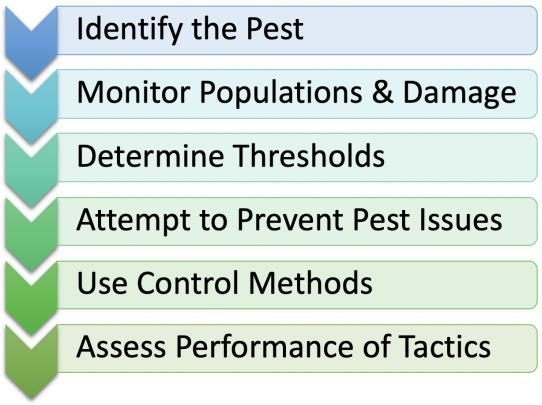
IPM is a holistic, ecological approach to controlling pests. In an IPM program, the pest situation is assessed before taking action. The first step is to identify the pest to determine biological information, such as the pest’s habitat and life cycle. Once this information is gathered and evaluated, it can be used to develop a pest management plan. IPM uses an assortment of control methods and employs the best practices available to protect people, animals, and the environment (fig. 1).
Myth: IPM Does Not Include Chemical Controls
Fact: IPM Includes Chemical Controls
An IPM program may include chemical control, which involves the use of pesticides. A pesticide is any substance used to prevent, destroy, repel, or mitigate a pest. When selecting a product, consider the type of pesticide needed (e.g., insecticide, herbicide, fungicide) and the intended application site. This information appears on the pesticide product label, along with directions for use and instructions for personal and environmental protection. Always read the label before you purchase, use, store, or dispose of a pesticide product.
Myth: IPM Focuses on Chemical Controls
Fact: IPM Considers All Control Methods
Although some people view IPM as a nonchemical strategy, others see it as chemically focused. In reality, IPM considers all control methods — chemical and nonchemical — to manage pests in the safest, most effective way (fig. 2). When nonchemical methods are available, they often reduce the need for chemicals. Nonchemical control methods include host-plant resistance (e.g., using plant varieties with disease resistance), biological control (e.g., using natural enemies such as lady beetles or lacewings), cultural control (e.g., moisture management or crop rotation), and mechanical and physical control (e.g., screens or netting for pest exclusion). Nonchemical controls are often most effective when implemented before pest populations reach damaging levels.

Myth: IPM and Organic Are the Same
Fact: IPM and Organic Are Not the Same
IPM and organic production share many similar practices, but these pest management approaches are not interchangeable. IPM and organic production use many of the same nonchemical controls for pest management. However, the main difference lies in the types of chemical controls each one allows.
Although both IPM and organic production incorporate pesticides when needed, organic systems do not permit the use of conventional (or synthetic) pesticides. Instead, only pesticides derived from naturally occurring sources and approved by the United States Department of Agriculture for use in organic production can be applied. In an IPM program, you are free to choose the type of pesticide needed for control, whether it is synthetic or organic.
Myth: IPM Is Only for Gardens or Landscapes
Fact: IPM Is for Any Pest Situation
Naturally, you may find yourself reflecting on your own lawn or garden when thinking about IPM. However, it is important to remember that IPM can be used to deal with any pest situation. From greenhouse and farm operations to urban housing and beyond, IPM can help tackle the most difficult of pests.
Conclusion
An IPM program is only as effective as the person managing it, so take time to familiarize yourself with IPM’s core principles. Understanding the facts associated with IPM is just as important as recognizing the myths and will better prepare you when educating others or making your own pest management decisions. If implemented correctly, an IPM program can provide real-world solutions for anyone seeking to keep pests in check.
Additional Resources
To learn more about IPM, please visit:
- Virginia Cooperative Extension: https://www.pubs.ext.vt.edu/content/pubs_ext_v t_edu/en/ENTO/ENTO-365/ENTO-365.html
- Virginia Tech Pesticide Programs: https://sites.google.com/vt.edu/vtppconsumerpse/integrated-pest-management
- Virginia Department of Agriculture and Consumer Services: https://www.vapesticidesafety.com/integrated_p est_management.shtml
- Pesticide Environmental Stewardship: https://pesticidestewardship.org/ipm/
Virginia Cooperative Extension materials are available for public use, reprint, or citation without further permission, provided the use includes credit to the author and to Virginia Cooperative Extension, Virginia Tech, and Virginia State University.
Virginia Cooperative Extension is a partnership of Virginia Tech, Virginia State University, the U.S. Department of Agriculture (USDA), and local governments, and is an equal opportunity employer. For the full non-discrimination statement, please visit ext.vt.edu/accessibility.
Publication Date
February 26, 2026