Guidelines for Managing Food Allergies: Crustacean Shellfish Allergies
ID
FST-199NP
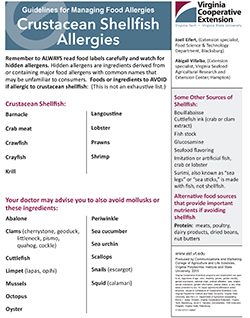
Remember to ALWAYS read food labels carefully and watch for hidden allergens. Hidden allergens are ingredients derived from or containing major food allergens with common names that may be unfamiliar to consumers. Foods or ingredients to AVOID if allergic to crustacean shellfish: (This is not an exhaustive list.)
Crustacean Shellfish:
- Barnacle
- Crab meat
- Crawfish
- Crayfish
- Krill
- Langoustine
- Lobster
- Prawns
- Shrimp
Your doctor may advise you to also avoid mollusks or these ingredients:
- Abalone
- Clams (cherrystone, geoduck, littleneck, pismo, quahog, cockle)
- Cuttlefish
- Limpet (lapas, opihi)
- Mussels
- Octopus
- Oyster
- Periwinkle
- Sea cucumber
- Sea urchin
- Scallops
- Snails (escargot)
- Squid (calamari)
Some Other Sources of Shellfish:
- Bouillabaisse
- Cuttlefish ink (crab or clam extract)
- Fish stock
- Glucosamine
- Seafood flavoring
- Imitation or artificial fish, crab, or lobster
- Surimi, also known as “sea legs” or “sea sticks,” is made with fish, not shellfish.
Alternative food sources that provide important nutrients if avoiding shellfish
Protein: meats, poultry, dairy products, dried beans, nut butters
Virginia Cooperative Extension materials are available for public use, reprint, or citation without further permission, provided the use includes credit to the author and to Virginia Cooperative Extension, Virginia Tech, and Virginia State University.
Virginia Cooperative Extension is a partnership of Virginia Tech, Virginia State University, the U.S. Department of Agriculture (USDA), and local governments, and is an equal opportunity employer. For the full non-discrimination statement, please visit ext.vt.edu/accessibility.
Publication Date
February 3, 2021