Exotic Invasive Plants
ID
420-320 (CNRE-105NP)
Introduction
Economically, exotic invasives cost the United States over $120 billion annually (Pimentel et al. 2005). Costs arise from decreased productivity and expenses associated with control efforts. Exotic invasives come in all shapes, sizes, and kingdoms. There are exotic invasive mammals, fish, insects, crustaceans, mollusks, bacteria, fungi, plants, and viruses. This publication will focus on exotic invasive plants. Virginia has over 90 species of exotic invasive plants.
So, what makes exotic invasive plants exotic and invasive? In general, they are species introduced (intentionally or unintentionally) from somewhere else that flourish in their new environment. They all tend to share certain characteristics that help them excel at being exotic and invasive. These include:
A lack of natural predators in their new environment. Most species that are invasive in their introduced location are not invasive in their native range. There is something in their native range that keeps them in check. This might be competition with other plants, soil conditions, weather, an insect or disease, or likely a combination of factors. Unfortunately, when exotic invasives are brought here, the controlling agents typically are not.
Prolific reproduction. Exotic invasives tend to be extremely good at reproducing. An example is ailanthus or tree-of-heaven (Ailanthus altissima). A single female tree can produce over 300,000 seeds a year.
Multiple means of reproduction. Some species are able to reproduce in more than one way. For example, the aquatic invasive plant, hydrilla (Hydrilla verticillata), has four means of reproducing. New plants come from fragments of mature plants, tubers, turions (detachable buds), and seeds.
Excellent dispersal. A key element of being an invader is the ability to spread across the landscape. The exotic invasive shrub, autumn olive (Elaeagnus umbellata), produces juicy, nutritious berries that are eaten and dispersed by wildlife.
Adaptability. Many exotic invasives are generalists and are able to grow and live under a wide variety of soil, moisture, and light conditions. The exotic mile a minute vine (Persicaria perfoliate) invades a wide- variety of habitats, from forest openings to stream sides.
Early arrival. Exotic invasive plants tend to be pioneer species. They quickly occupy sites that have been recently disturbed. Japanese stiltgrass (Microstegium vimineum) is a good example of an invader that fills in on disturbed soils along hiking trails, rights-of-way, and logging roads. As parcelization and fragmentation (land use change) occur across Virginia, these disturbed areas increase.
Exotic invasive species have negative ecological impacts. These may include:
Altered forest structure. Heathy forests have a vertical structure that includes ground cover vegetation, shrubs and young trees, and an overstory canopy. This vertical structure is important for diversity of both plants and animals. An exotic invasive like kudzu (Pueraria lobata) can eliminate this vertical structure by covering up and pulling over shrubs and trees, resulting in a mat of vines with little vertical structure.
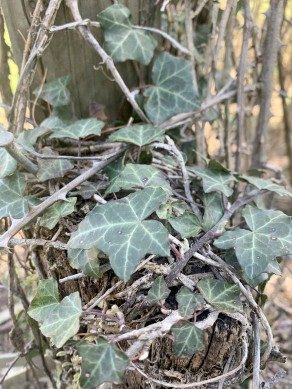
Altered ecosystem function. Exotic invasives change how our native ecosystems function. For example, English ivy (Hedera helix) is an exotic invasive (and widely-planted) vine that climbs up large trees, eventually taking over their canopies and killing them (figure 1.). The result is similar to that of kuzdu; eventually, all that remains is a mat of vines.
Reduction of native species. Because of the aforementioned characteristics, exotic invasive species can out-compete slower-growing, less prolific, native species. And sometimes they get help from an opportunistic native species, the white- tailed deer. Deer will selectively browse on native plants, while leaving the non-natives alone. This gives the exotics an additional advantage.
Decreased productivity. Timber and native wildlife production on sites overtaken by most exotic invasive species will decrease, as native species often do not compete well with exotic invasives.
Decreased biodiversity. In areas inundated with exotic invasives, there is typically a significant diversity loss as natives are pushed out and one or several exotic invasive species take over.
The best advice for woodland owners is to know how to identify common exotic invasive species in their woods. Then, they should walk the property regularly looking for signs of these species. When problems are found, a mitigation plan should be formed as soon as possible. The earlier that exotic invasive problems are addressed, the less expensive and time-consuming control will be, and chances of successful eradication (or at least containment) will improve.
To help narrow down what problems could be lurking in the woods, woodland owners should talk to neighbors and seek the advice of local service foresters (http://www.dof.virginia.gov/aboutus/contact- us.htm) or other natural resource professionals. Most natural resource professionals are all too familiar with exotic invasive species.
And what should woodland owners do if they find a problem? Learn about the species. Knowing how the species of concern grows, spreads, reproduces, etc., will help to formulate an effective mitigation plan. One important aspect of exotic invasive plant control is reclaiming the site afterwards. Once an exotic invasive is removed (or at least under control) it’s important to reestablish native species to claim the site. Otherwise, the area will be ripe for a new invasion.
There are several tools available for woodland owners with exotic invasive plant problems. Some may be more or less appropriate depending on the species, the site, and the woodland owners’ resources. Access to machinery, ability to perform physical labor, time, and money may all affect which tools are used.
Mechanical control
Mechanical control entails pulling, digging, mowing, disking, grazing, or burning. Timing of mechanical controls can be crucial to success. For example, in most instances, mowing should occur before the target plants produce seed.
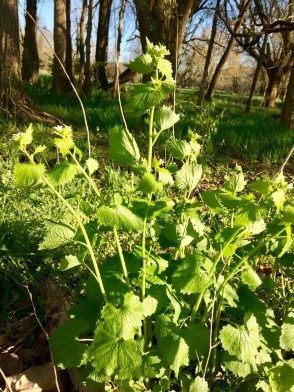
Mechanical control can be effective with certain species. For example, garlic mustard (Alliaria petiolata) is an exotic invasive herbaceous plant that can easily be hand pulled. However, in some cases, attempts at manual control without chemical follow- up, can exacerbate the problem. When tree of Heaven is cut, the remaining stump and roots produce numerous sprouts; one stem is replaced by many. Chemical follow-up is required to manage the problem. Additionally, repeat mechanical treatments are most likely necessary for many species.
Biological Control
Biological control methods involve the introduction of natural predators to control pests. Biological controls can be effectively used for some plant pests. However, all biological controls must undergo intense study prior to being released into the environment, lest they too become a problem. Appropriate biological controls must only affect the desired pest species and must not become invasive themselves.
Chemicals(Herbicides/ Pesticides/Fungicides)
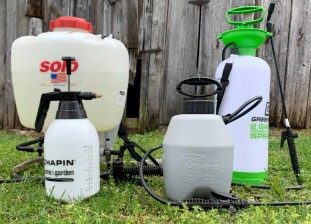
Chemicals can be an effective means of reducing or eradicating exotic invasives. A wide variety of herbicides are available.
Chemicals vary in their selectivity. Some are broad- spectrum (non-selective) that may kill a wide variety of species. Others are narrow-spectrum (selective) and may only work on one or a few species. The label explains which species are affected by the active ingredients in the chemical formulation.
Some chemicals tend to leach through the soil and reach waterways, while others remain in the soil long after the targeted species dies. Many chemicals are available in either water-based or oil-based solutions; the difference between these formulations contributes to the chemical’s environmental persistence and efficacy.
It is always important to read the label before choosing a chemical control option. Not only does the label state what the chemical is designed to control, it also states if it is safe to use around water. The label lists required personal protective equipment to wear during application and mixing, usage rates, and other pertinent guidelines. Pesticide labelling carries the force of law. Understanding Pesticide Labels, Virginia Cooperative Extension publication 426-707, provides greater detail about the information found on labels.
Cultural Control
Certain cultural practices, like promoting the use of native species and preventing the sale of exotic invasives can also help slow the spread of exotic invasives on the landscape. And landowners can directly aid with cultural control by learning what exotic invasives are in their woods and taking steps to manage them.
For many exotic invasive species, the best approach is integrated pest management. IPM incorporates two or more of the above control methods.
There are numerous exotic invasive resources available.
Accomplishing Forest Stewardship with Hand- Applied Herbicides: https://forestry.ces.ncsu.edu/2019/02/accomplish ing-forest-stewardship-with-hand-applied-herbicides/
Blue Ridge PRISM: https://blueridgeprism.org/
Early Detection & Distribution Mapping System (EDDMapS): http://www.eddmaps.org/
Environmental Safety of Forestry Herbicides: http://www.cof.orst.edu/cof/fs/kpuettmann/FS%20533/Vegetation%20Management/Environmental%20safety.htm
eXtension: https://www.extension.org
Herbicides and Forest Vegetation Management: https://extension.psu.edu/herbicides-and-forest-vegetation-management
Invasive and Exotic Species of North America: www.invasive.org
Non-native Invasive Plant Species Control Treatments http://www.dof.virginia.gov/infopubs/_forestry- topics/FT0031_Nonnative-Invasive-Plant-Species-Control-Treatments_pub.pdf
Nonnative Invasive Plants of Southern Forests: A Field Guide for Identification and Control: https://www.srs.fs.usda.gov/pubs/gtr/gtr_srs062/
Plant Invaders of Mid-Atlantic Natural Areas: https://www.invasive.org/eastern/midatlantic/
Southern Regional Extension Forestry Forest Health: http://www.southernforesthealth.net/
Virginia Cooperative Extension materials are available for public use, reprint, or citation without further permission, provided the use includes credit to the author and to Virginia Cooperative Extension, Virginia Tech, and Virginia State University.
Virginia Cooperative Extension is a partnership of Virginia Tech, Virginia State University, the U.S. Department of Agriculture, and local governments. Its programs and employment are open to all, regardless of age, color, disability, sex (including pregnancy), gender, gender identity, gender expression, national origin, political affiliation, race, religion, sexual orientation, genetic information, military status, or any other basis protected by law
Publication Date
April 29, 2020