Periodical Cicada
ID
444-276 (ENTO-455NP)
Introduction
In Virginia, both the 17- and 13-year cicadas damage many species of ornamental and hardwood trees. Oaks are commonly attacked, but the most seriously damaged plants are newly-planted fruit and ornamental trees such as apple, dogwood, peach, hickory, cherry, and pear. Pines and other conifers are not commonly attacked, and sometimes non- woody plants will have adult cicadas on them.
Identification
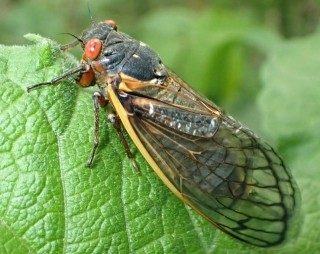
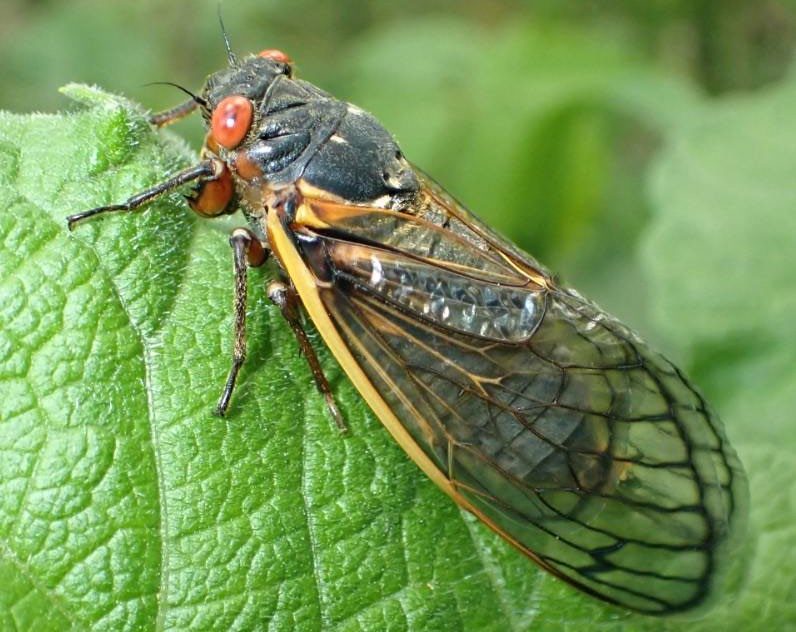
Most people have seen the dog-day cicada that emerges every year in mid-summer. Dog-day cicadas (Neotibicen spp.) have mottled, dark green bodies with dark eyes and legs. They can be distinguished easily from the periodical cicada, which is about 4 cm (1.5 inches) long, with a black body, red eyes, and orange legs (Fig. 1). Adult periodical cicadas have clear wings with distinctive orange veins; the wings are held tented over the body. Periodical cicadas (Magicicada spp.) belong to the family Cicadidae in the order Hemiptera.
Immature cicadas are wingless, pale white to tan nymphs with a bulbous head and well-developed legs. Because the nymphs develop underground, they are rarely collected or observed. Periodical cicadas are also commonly called the 17-year cicada, 13-year cicada, or locusts. The common name "locust" is inaccurate because this term should apply to migratory grasshoppers, not cicadas.
Damage
Damage caused by cicada nymphs feeding on plant roots is considered to be very minor, though there is evidence of reduced growth in apple trees due to root feeding. Adult cicadas feed very little in tree crowns after they emerge from the soil, but egg- laying by female cicadas causes significant damage to small twigs in the canopy. The female inserts her saw-like egg-laying tube, called an ovipositor, into
small branches and twigs that are about the diameter of a pencil (Fig. 2). These twigs will die because the wood splits when the eggs are placed under the thin bark. The brown, dead twigs contrast with the surrounding healthy green foliage, a condition called "flagging" (Fig. 3). Young trees are the most severely damaged by flagging because they have more branches of the size preferred for egg laying by female cicadas. Furthermore, these damaged young branches may not be as strong when they eventually become the weight-bearing scaffold limbs later.
Cicadas are not poisonous and do not bite or sting, but adult periodical cicadas can be shockingly loud during their mass emergence. Communities and farms with large numbers of periodical cicadas emerging from the ground often have a substantial noise problem due to the males "singing" or calling for the females. Thankfully the annoyance from the singing is tempered by the fact that the periodical cicadas are only out for 4-6 weeks once every 13 or 17 years. However, adult populations in some areas occur more frequently where broods overlap.
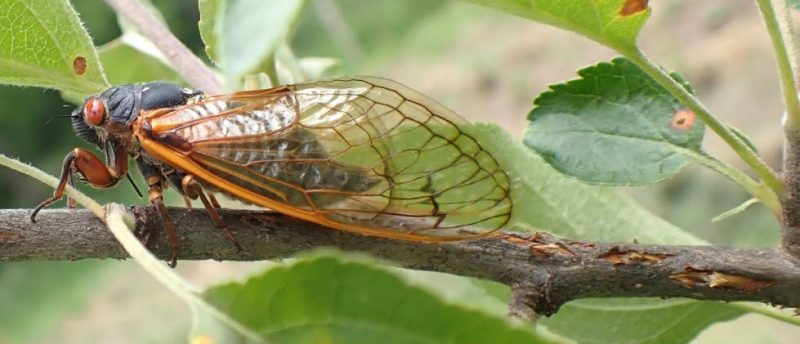
Figure 2. Periodical cicada and egg laying damage (Eric Day, Virginia Cooperative Extension).
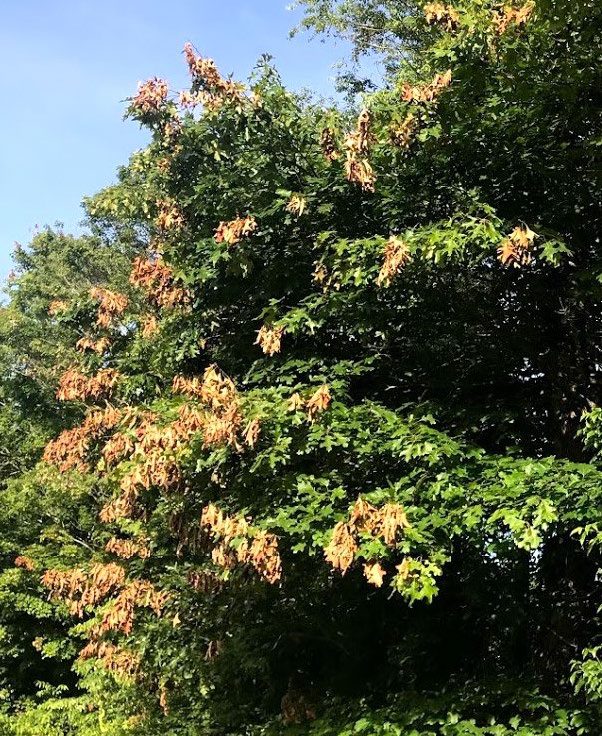
Figure 3. Periodical cicada “flagging” caused by egg laying damage (Eric Day, Virginia Cooperative Extension).
Life Cycle
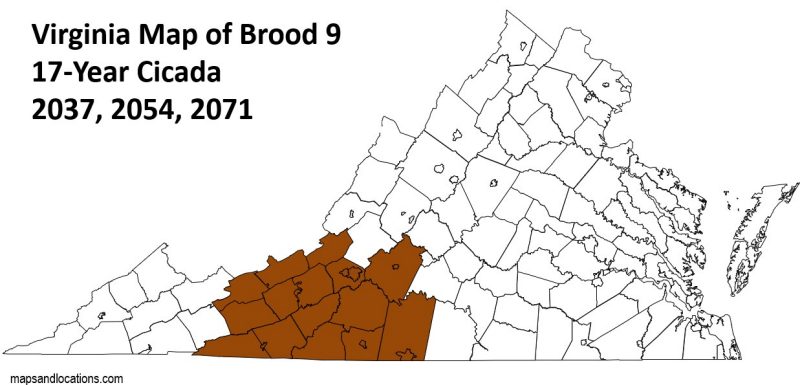
The common name of 13- or 17-year cicada refers to the developmental period required for the nymphs to reach adulthood. In Virginia, adult periodical cicadas start appearing in early May with numbers peaking in early June. Numbers decline by late June and most cicadas are gone by July. In most of Virginia, periodical cicadas emerge in specific locations once every 17 years (Figs. 4, 6, 7, 8, and 9). In some of the southern counties there are periodical cicadas that emerge once every 13 years (Fig. 5). Some counties have several broods in different locations; they may emerge in the same year or in alternate years. The massive brood emergence associated with periodical cicadas is believed to overwhelm predators. Birds are the primary predator of periodical cicadas, but reptiles and mammals such as squirrels, raccoons, and dogs readily feed on cicadas as well.
Immature cicadas, called nymphs, do not feed on the twig where they hatch, but instead drop to the ground and burrow to the root system below the tree. The nymphs attach to the tree’s roots and feed on sap. After developing for 13 or 17 years below ground, mature nymphs burrow to the soil surface.
The nymphs sometimes construct a mud turret, also known as a cicada hut, in which they wait for the right moment to emerge from the soil. When the time is right, the nymphs emerge from the soil and climb onto nearby vegetation or any vertical surface where they molt to the winged adult stage. Their empty, brown outer skins (the exoskeleton) that they shed are frequently found attached to tree trunks and foliage. The emergence of the periodical cicada nymphs is often tightly synchronized, with most adults appearing in a short period of time, often over a few nights. Adult cicadas live for only 2-4 weeks.
Male cicadas sing to attract females for mating by vibrating thin membranes on the sides of the first abdominal segment. Females are silent. After mating, females lay their pale, oblong, small eggs in twigs 0.6-1.3 cm (0.25-0.5 inches) in diameter. The female's ovipositor slices into the wood and deposits the eggs under the bark (Fig. 2). One to several dozen eggs can be laid at a time, with up to 400 eggs being laid by each female in 40 to 50 different locations among twigs. Cicada eggs remain in the twigs for 6-10 weeks before hatching. The newly hatched, ant-like nymphs do not feed on the twigs. They fall to the ground where they burrow 15-46 cm (6-18 inches) underground to feed on tree roots.
Control Tactics
Periodical cicadas are most damaging to small young trees with pencil-sized branches that are the most desirable size for egg laying. Large, established trees often have large amounts of flagging, but rarely suffer severe damage (Fig. 3).
If living in a county with large periodical cicada populations, consult a cicada map and avoid planting new fruit and ornamental trees in the same year as predicted cicada emergence. This information can be found in the Brood Maps included in this fact sheet; from your local Cooperative Extension office; and in the current Spray Bulletin for Commercial Tree Fruit Growers (VCE Publication 456-419) or Figures 4-9 of this publication.
Newly-planted trees can be covered with fine netting to protect the small tender twigs from egg-laying females. Secure the netting around the trunk to stop the cicadas from climbing up into the tree canopy. Remove the netting at the end of June when the adult periodical cicadas have died. Remove and destroy any flagged, damaged twigs where female cicadas have laid their eggs within 6 weeks of ovipositing, before the nymphs hatch and drop to the ground. This reduces the number of nymphs establishing on the roots of that tree.
Spraying in commercial nurseries provides only limited control as cicadas from untreated areas will fly into the treated areas. Scout trees every 2-3 days to check for females laying eggs and treat as soon as they are found. Consult the current appropriate Virginia Pest Management Guide or the Spray Bulletin for Commercial Tree Fruit Growers for current chemical recommendations for control of periodical cicadas. Insecticides in backyard plantings will give limited control of periodical cicadas, but often the sprays will cause worse problems by disrupting the natural enemies of many other pests. Blooming trees and plants should not be treated as this may kill pollinators or beneficial insects. Caution should be used, as populations of spider mites will often increase after application of Sevin or pyrethroid insecticides.
Remarks
The dog-day cicada is also called the annual cicada, harvestfly, or jarfly. Dog-day cicadas are related to the periodical cicada and are usually associated with oaks, maples, and other mature, well-established deciduous trees. Dog-day cicadas appear during the long, summer days of July and August. These cicadas have 2- to 5-year life cycles, but adult dog- day cicadas are seen every summer because their broods overlap each other. Annual cicadas do not ordinarily cause much damage.
Brood Maps
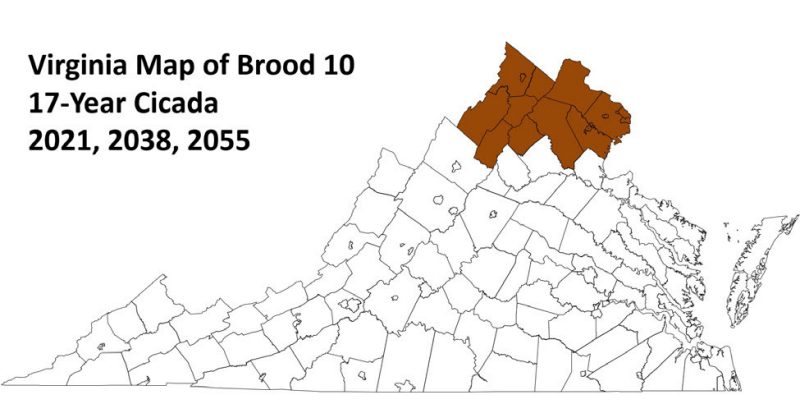
Figure 4. Map of counties (marked in brown) where Brood 10 periodical cicadas are expected to emerge in 2021, 2038, 2055.

Figure 5. Map of counties (marked in blue) where Brood 19 13-year periodical cicadas are expected to emerge in 2024, 2037, and 2050.

Figure 6. Map of counties (marked in brown) where Brood 14 periodical cicadas are expected to emerge in 2025, 2042, 2059.
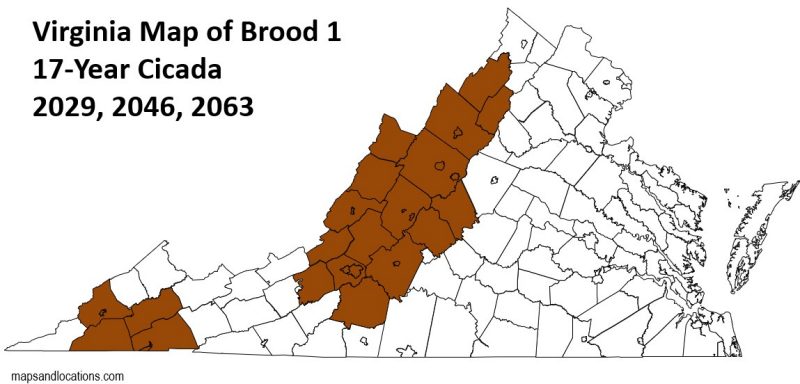
Figure 7. Map of counties (marked in brown) where Brood 1 periodical cicadas are expected to emerge in 2029, 2046, 2063.
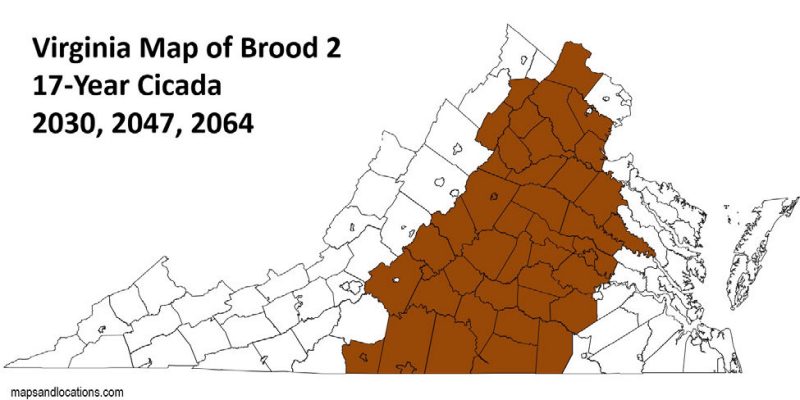
Figure 8. Map of counties (marked in brown) where Brood 2 periodical cicadas are expected to emerge in 2030, 2047, 2064.
Virginia Cooperative Extension materials are available for public use, reprint, or citation without further permission, provided the use includes credit to the author and to Virginia Cooperative Extension, Virginia Tech, and Virginia State University.
Virginia Cooperative Extension is a partnership of Virginia Tech, Virginia State University, the U.S. Department of Agriculture (USDA), and local governments, and is an equal opportunity employer. For the full non-discrimination statement, please visit ext.vt.edu/accessibility.
Publication Date
July 7, 2021