Onions, Garlic, and Shallots
ID
426-411 (SPES-788P)
 EXPERT REVIEWED
Onions
Environmental Preferences
Light: Sunny. (Green onions tolerate partial shade.)
Soil: Well-drained loam.
pH: 6.2 to 6.5
Temperature: Cool (45 to 60˚F) during development; Medium-hot (60 to 75˚F) during bulbing and curing.
Moisture: Moist, but not waterlogged.
Culture
Planting: Use sets, seeds, or transplants in the spring for bulbs and for green or bunching onions. Seeds may be started indoors eight weeks before setting out; use sets in the fall for perennial or multiplier types of onions.
Spacing: 1 to 6 inches by 12 to 24 inches for standard spacing; 4 inches by 4 inches for wide row in rows up to 2 feet apart. Plant close, then thin using thinnings as green onions.
Hardiness: Hardy biennial - bulb onions, green or bunching onions; Hardy perennials - Egyptian onions or perennial tree and multiplier.
Fertilizer needs: Heavy feeder. In the absence of a soil test, apply 4 to 5 pounds of 10-10-10 per 100 square feet before planting. Use starter solution for transplants. Sidedress one to two weeks after bulb enlargement begins, using 3 tablespoons 33-0-0 per 10-foot row.
Cultural Practices
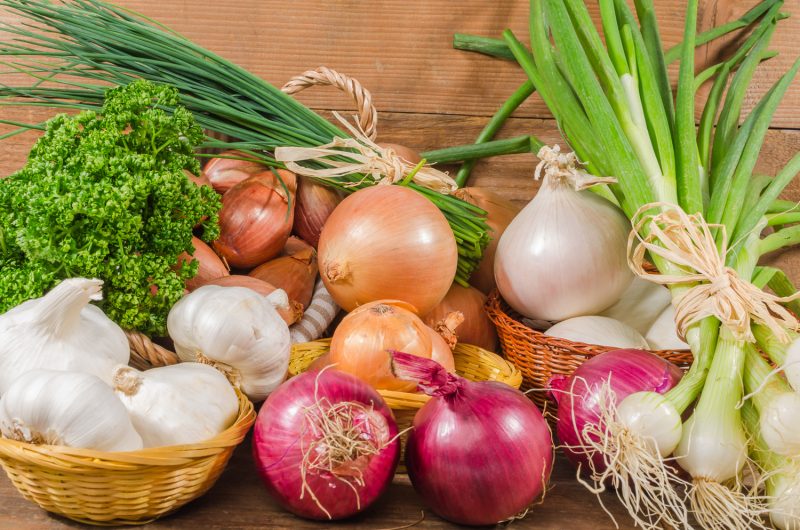
Onion bulbs come in three different colors: red, yellow, and white. Some red and yellow varieties are known to be very mild and sweet in flavor, while others tend to be more pungent.
Onion varieties also have different requirements for the number of hours of daylight needed to form a bulb. If the seed catalog lists the onion as a long-day variety, it sets bulbs when it receives 15 to 16 hours of daylight and is used to produce onions in Northern summers. Short-day varieties set bulbs with about 12 hours of daylight and are used in the deep South for winter production. This explains why Virginia is not a major onion production area, and yields are lower than in the more northern and southern regions of the U.S. Consider selecting quick-maturing varieties marked as day-neutral for earlier bulb production while the weather is still cool for sweeter bulbs.
For green or bunching onions, use sets, seeds, or transplants in spring; or use Egyptian (Perennial Tree) and the Yellow Multiplier (Potato Onion) sets in the fall.
For bulb production, plant sets in early spring. Set 1 to 2 inches apart and 1 to 2 inches deep in the row. Thin to 4 inches apart, and eat the thinned plants as green onions. Avoid sets more than an inch in diameter because they are likely to bolt and produce seed stalks. Too early planting and exposure to cold temperatures also cause seed stalk development. Some people have the best bulb production using seedlings or transplants rather than sets. Egyptian Tree or Multiplier onions should be set in late October or early November. Plant 4 inches apart in rows 1 to 2 feet apart. The distance between rows is determined by the available space and cultivating equipment.
Bulbs compete poorly with weeds because of their shallow root systems. Shallow cultivation is necessary; do not hill up soil on onions as this can encourage stem rot. Ensure ample moisture especially after bulbs begin enlarging. Onions should be harvested when about three-fourths of the tops have fallen over. Careful handling to avoid bruising helps control storage rots. Onions may be pulled and left in the field for several days to dry, then cured in a well-ventilated attic or porch for 1 to 2 weeks out of direct sunlight. Tops may be left on or cut off; but leave at least 1 inch of the top when storing. Thorough curing will increase storage life.
Common Problems
Diseases: Neck or stem rot, bulb rot, Botrytis leaf blight, Downy mildew
Insects: Thrips, onion root maggots, aphids, allium leafminer
Cultural: Bulb rot from bruising, insufficient drying; split or double bulb from dry soil during bulb formation; very small bulb from too late planting, too dry soil, or wrong varieties.
Refer to the current year’s version of Virginia Cooperative Extension’s Pest Management Guide - Home Grounds and Animals, Home Vegetable Chapter for current control recommendations (https://www.pubs.ext.vt.edu/456/456-018/456-018.html).
Harvesting and Storage
Days to maturity: 85 to 185 days for mature bulbs.
Harvest: Harvest green onions when tops are 6 inches tall. Harvest bulbs after 3/4 or more of the tops have fallen over. Do not wait more than one to two weeks after this occurs. Allow for thorough drying before storage.
Approximate yields: 10 to 15 pounds per 10-foot row.
Amount to raise: 7 to 10 pounds per person.
Storage: Cool (45˚F and 55˚F), dry (50 to 60% relative humidity) conditions for six to seven months.
Preservation: Onions may be stored dry or pickled and canned. They freeze well if chopped and covered with water. For fresh storage, maintain good air circulation. One effective storage method is to place an onion in discarded hosiery, tie a knot, and add another onion. When hosiery is filled, suspend it from rafters in the storage area..
Garlic
Environmental Preferences
Light: sunny, (will tolerate partial shade)
Soil: well-drained loam, moderate organic matter
pH: 6.2 to 6.5
Temperatures: cool (45 to 60˚F) during early development, medium hot (60 to 75˚F) during bulbing
Moisture: moist, but not waterlogged
Culture
Planting: Use cloves, which are divisions of the mature bulb. Divide just before planting. Plant early in spring in well-drained soils or in fall and mulch well. Young plants are frost-tolerant.
Spacing: standard 3 to 5 inches x 12 to 24 inches (cover to a depth of 1 inch); wide row 3 x 4 inches in rows 12 inches apart
Hardiness: hardy perennial, grown as an annual
Fertilizer needs: In the absence of a soil test, add 3 to 4 lbs. of 10-10-10 per 100 sq. feet when preparing soil; sidedress one to two weeks after bulb enlargement begins with 2 lbs. of 10-10-10 over 100 sq. feet.
Cultural Practices
Garlic, a member of the onion family, can be successfully grown in most Virginia home gardens. While garlic may be planted early in Virginia (March or April), to permit full development, fall planting is recommended.
Garlic is started by planting cloves that are divisions of the large bulb. Each bulb contains a dozen or more cloves; each clove is planted separately. The larger cloves yield larger size mature bulbs at harvest. Do not divide the bulb until ready to plant; early separation decreases yields. Select “seed bulbs” that are large, smooth, fresh, and free from disease.
Plant the cloves 3 to 5 inches apart in an upright position (to assure a straight neck), and cover them to a depth of about 1 inch. Allow 12 to 24 inches between rows. Garlic also lends itself well to a wide-row planting system, with cloves spaced 3 to 4 inches apart in rows 1 foot wide. This requires considerably less garden space for the same yield.
Garlic grows best in well-drained garden loam soils that are fertile with moderate organic matter. Gardeners who grow good onion crops can grow garlic. Bulbs will be small if the soil is excessively dry, and irregular in shape if the soil becomes compacted.
Harvest bulbs when the tops start to dry in early summer. Brush off the soil bud (do not wash the bulbs) and place in trays with screens or slatted bottoms, and remove tops when dry. Mature bulbs are best stored under cool, dry conditions.
Common Problems
Diseases: bulb rot in poorly drained soils
Insects: thrips, root maggots, aphids, allium leafminer
Cultural: bulb rot (from bruising, insufficient drying)
Refer to the current year’s version of Virginia Cooperative Extension’s Pest Management Guide - Home Grounds and Animals, Home Vegetable Chapter for current control recommendations (https://www.pubs.ext.vt.edu/456/456-018/456-018.html).
Shallots
Environmental Preferences
Light: sunny
Soil: well-drained, sandy loam
pH: 6.2 to 6.5
Temperature: cool (55 to 75˚F)
Moisture: moist, but not wet
Culture
Planting: Plant individual sets 1 to 2 inches deep in early spring. In warmer climates, plant in fall for winter and spring harvest.
Spacing: standard 4 to 6 inches x 12 to 18 inches or in double rows
Hardiness: hardy perennial
Fertilizer needs: In the absence of a soil test, mix 3 lbs. 10-10-10 per 100 sq. feet into soil before planting; sidedress with 2 lbs. 10-10-10 per 100 sq. feet twice during the growing season.
Cultural Practices
Shallots like a rich, loose soil; mix plenty of compost or other organic matter into the bed before planting. If shallots for planting are sold in clumps, divide them into individual sets (bulbs) before planting. Plant as soon as the soil can be worked in spring. Plant with pointed tip up; tip should be just below the soil line or barely poking through. Mulch or cultivate to keep weeds from competing for moisture. Shallot roots are shallow so cultivation must be carried out with care. Shallot bulbs develop on top of ground. Do not cover with soil.
Shallots have a mild flavor prized by gourmets, and are used in the green onion stage, or as bulbs. Pull green shallots when they are about 1/4 inch in diameter and store them in a cold, moist place for short periods. Mature, dry bulbs are dug after the tops die back, usually in mid- to late summer. Cure in a warm, dry place for about a week. Store in mesh bags in cool, dry conditions. Replant the smaller bulbs or use them first since they do not keep well.
Common Problems
Diseases: downy mildew, bacterial soft rot, neck rot
Insects: onion maggot, thrips, aphids, allium leafminer
Cultural: bulb rot from bruising or planting too deeply; tip burn from ozone (air pollutant)
Refer to the current year’s version of Virginia Cooperative Extension’s Pest Management Guide - Home Grounds and Animals, Home Vegetable Chapter for current control recommendations (https://www.pubs.ext.vt.edu/456/456-018/456-018.html).
Harvesting and Storage
Days to maturity: 60 to 75 days
Harvest: Harvest as green onions when tops are 6 to 8 inches high (about 6 weeks after planting). Harvest mature bulbs when the tops have turned yellow and the bulbs are 1 to 1 1/2 inches in diameter. Cut off the tops and cure.
Approximate yields: 10 to 20 shallots per bulb planted; 4 to 8 lbs. per 10-foot row
Amount to raise per person: 3 to 4 lbs.
Storage: cool, dry area (32 to 40˚F, 60 to 70% RH); six months or longer
Preservation: store dry or freeze by chopping and covering with water
Virginia Cooperative Extension materials are available for public use, reprint, or citation without further permission, provided the use includes credit to the author and to Virginia Cooperative Extension, Virginia Tech, and Virginia State University.
Virginia Cooperative Extension is a partnership of Virginia Tech, Virginia State University, the U.S. Department of Agriculture (USDA), and local governments, and is an equal opportunity employer. For the full non-discrimination statement, please visit ext.vt.edu/accessibility.
Publication Date
September 16, 2020