An Introduction to Integrated Pest Management
ID
ENTO-365NP (ENTO-637NP)
Introduction
Pest management professionals commonly discuss “IPM” or integrated pest management. Although IPM is seldom understood by the general public, it remains an important framework for making pest management decisions. This publication seeks to increase your understanding of IPM. It explains what IPM is, why it is an important pest management tool for both professionals and homeowners, and shares guidelines and resources to help you start using IPM.
What Is IPM?
IPM is an assessment-based, ecological approach to controlling pests. In an IPM program, the pest is identified to determine important information about its biology, such as its habitat and life cycle. Once this information is understood, it can be used to develop a management plan tailored to control that pest. Because integrated pest management considers both nonchemical and chemical control methods, it ensures the most effective management tactics are used for each pest situation. IPM provides practical, cost-effective solutions while protecting people, animals, and the environment.
Guidelines for IPM
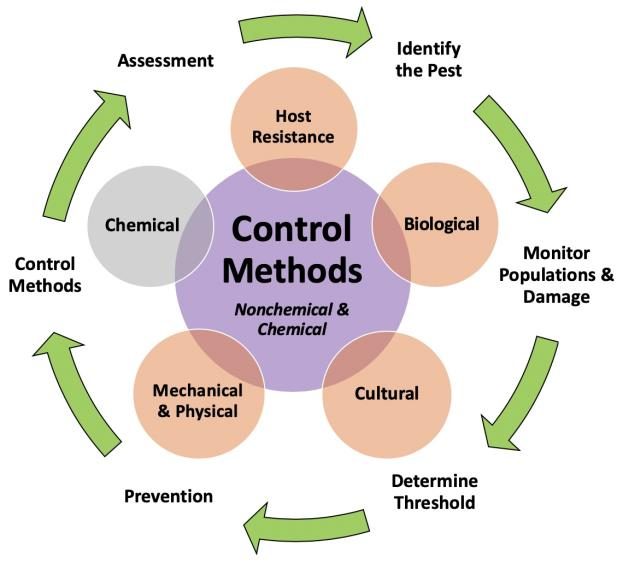
The major components of any IPM program include:
- Identify the pest(s) to be managed.
- Use prevention strategies to deter the pest(s) and/or minimize population buildup.
- Monitor pest populations and assess their damage.
- Determine a guideline (threshold) for when proactive management action is needed (e.g., the point at which the pest is causing economic or aesthetic losses from its activity).
- Use nonchemical and/or chemical control methods to “reduce” pest populations.
- Assess how well the management tactics controlled the pest.
These components work together to create an IPM program (fig. 1). It is important to note that the goal of IPM is often not to eliminate the pest population, but to “reduce” it to levels that are considered acceptable (or below threshold levels). Using an integrated pest management program helps promote a more balanced ecosystem.
Nonchemical & Chemical Control Methods
Different pests require different control methods, so always identify the pest before choosing management tactics!
Nonchemical controls are often most effective before pest populations reach damaging levels. Nonchemical control methods include:
- Host plant resistance – Using plant varieties or cultivars that are resistant or tolerant to pest damage (e.g., planting rose varieties that are less susceptible to black spot).
- Biological controls – Using living organisms (i.e., natural enemies) to reduce pest populations (e.g., ladybird beetles feeding on aphids).
- Cultural controls – Modifying the pest’s habitat to make it less favorable for survival (e.g., using mulch for moisture control, eliminating standing water from plant pots to discourage mosquito breeding, or sanitation practices like cleaning up food spills to discourage household pests).
- Mechanical and physical controls – Using hands-on techniques involving simple equipment/devices to reduce or prevent the spread of pest populations (e.g., using screens/row covers to exclude pests or hand removal of weeds from garden beds).
Chemical control involves the use of pesticides. A pesticide is any substance used to prevent, destroy, repel, or mitigate a pest. Pesticide selection depends on the type of pest (e.g., insects, weeds, diseases, etc.) and the target site (i.e., the intended application site). You can find this information on the pesticide product label along with personal and environmental safety considerations, directions for use, and storage and disposal instructions. Consider what application equipment you will need, as well as any personal protective equipment. Choose the pesticide product that is most compatible with your pest situation and any nonchemical control methods already in place. When implemented correctly, an IPM program can provide the most balanced approach for controlling pests without harming human health or the environment.
Integrated pest management is not only for commercial farming or greenhouse operations. It is an approach anyone can use. IPM should be used in the home, garden, or wherever a pest problem occurs.
Resources for IPM & Pest Identification
There are many resources to help you get started using IPM:
- Environmental Protection Agency: https://www.epa.gov/safepestcontrol/integrated- pest-management-ipm-principles
- Virginia Department of Agriculture and Consumer Services: http://www.vapesticidesafety.com/integrated_pe st_management.shtml
- Virginia Tech Pesticide Programs: https://sites.google.com/vt.edu/vtppconsumerpse/integrated-pest-management
- National Pesticide Information Center: http://npic.orst.edu/pest/ipm.html
- Pesticide Environmental Stewardship: https://pesticidestewardship.org/ipm/
For help identifying pests in Virginia, contact your local Extension agent: https://ext.vt.edu/offices.html. The agent can help you submit samples to the following Virginia Tech services:
- Insect Identification Lab: https://www.ento.vt.edu/idlab.html
- Weed Identification Clinic: https://weedid.cals.vt.edu/
- Plant Disease Clinic: https://spes.vt.edu/affiliated/plant-disease- clinic.html
You can also explore fact sheets and publications on the Virginia Cooperative Extension website: https://www.pubs.ext.vt.edu/.
Virginia Cooperative Extension materials are available for public use, reprint, or citation without further permission, provided the use includes credit to the author and to Virginia Cooperative Extension, Virginia Tech, and Virginia State University.
Virginia Cooperative Extension is a partnership of Virginia Tech, Virginia State University, the U.S. Department of Agriculture (USDA), and local governments, and is an equal opportunity employer. For the full non-discrimination statement, please visit ext.vt.edu/accessibility.
Publication Date
January 14, 2026