Invasive Exotic Plant Species: Autumn Olive (Elaeagnus umbellata)
ID
420-321 (CNRE-97P)

Autumn olive was introduced to the U.S. from Japan and China in 1830. It was originally planted for wildlife habitat, shelterbelts, and mine reclamation, but has escaped cultivation. It is dispersed most frequently by birds and other wildlife, that eat the berries.
It spreads rapidly in open and disturbed areas. Autumn olive’s drought tolerance and ability to fix nitrogen allow it to colonize readily in dry, bare soil.

Identification
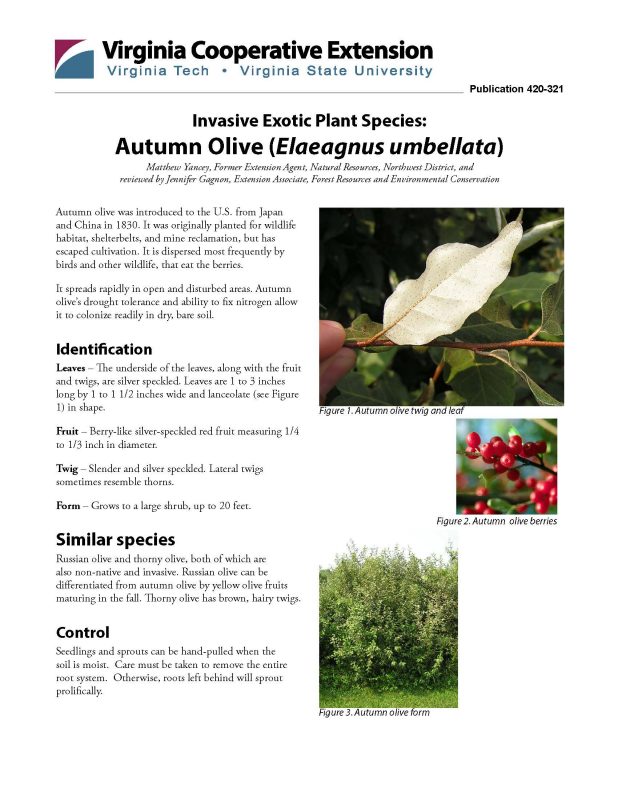
Leaves – The underside of the leaves, along with the fruit and twigs, are silver speckled. Leaves are 1 to 3 inches long by 1 to 1 1/2 inches wide and lanceolate (see Figure 1) in shape.
Fruit – Berry-like silver-speckled red fruit measuring 1/4 to 1/3 inch in diameter.
Twig – Slender and silver speckled. Lateral twigs sometimes resemble thorns.
Form – Grows to a large shrub, up to 20 feet.

Similar species
Russian olive and thorny olive, both of which are also non-native and invasive. Russian olive can be differentiated from autumn olive by yellow olive fruits maturing in the fall. Thorny olive has brown, hairy twigs.
Control
Seedlings and sprouts can be hand-pulled when the soil is moist. Care must be taken to remove the entire root system. Otherwise, roots left behind will sprout prolifically.
An herbicide with the active ingredient glyphosate can be used to control larger plants. Foliar application has Proven effective in controlling these species. Glyphosate is nonselective and will affect all green vegetation, so take care to avoid impacting native plant species. At sites where this is a concern, application of the herbicide to the freshly cut stumps of autumn olive shrub should achieve the desired results, while minimizing damage to other plants.
References
Jackson, David R. 2005. “Herbicides and forest vegetation management: Controlling unwanted trees, brush, and other competing forest vegetation.” University Park, Pa.: Penn State College of Agricultural Sciences – Agricultural Research and Cooperative Extension. 31 p.
Miller, James H. 2003. “Nonnative invasive plants of southern forests: a field guide for identification and control.” General Technical Report SRS–62. Asheville, N.C.: U.S. Department of Agriculture, Forest Service, Southern Research Station. 93 p.
Swearingen, J., K. Reshetiloff, B. Slattery, and S. Zwicker. 2002. Plant Invaders of Mid-Atlantic Natural Areas. National Park Service and U.S. Fish & Wildlife Service, 82 pp.
Virginia Department of Conservation and Recreation. Invasive Alien Plant Species of Virginia. Autumn olive and Russian Olive. 2 pp.
Photo Credits: James R. Allison, Georgia Department of Natural Resources, www.forestryimages.org
Disclaimer: Commercial products are named in this publication for informational purposes only. Virginia Cooperative Extension does not endorse these products and does not intend discrimination against other products which also may be suitable.
Virginia Cooperative Extension materials are available for public use, reprint, or citation without further permission, provided the use includes credit to the author and to Virginia Cooperative Extension, Virginia Tech, and Virginia State University.
Virginia Cooperative Extension is a partnership of Virginia Tech, Virginia State University, the U.S. Department of Agriculture, and local governments. Its programs and employment are open to all, regardless of age, color, disability, sex (including pregnancy), gender, gender identity, gender expression, genetic information, ethnicity or national origin, political affiliation, race, religion, sexual orientation, or military status, or any other basis protected by law.
Publication Date
April 28, 2020