


Patriotic Gardens: How to Plant a Red, White and Blue Garden
ID
426-210 (HORT-185P)
A Statewide Garden Theme
Virginia Cooperative Extension developed the America’s Anniversary Garden in 2007 to help individuals, communities, and groups mark America’s 400th Anniversary with a signature garden planting. The signature gardens have red, white, and blue color schemes. Although the commemoration has passed, this guide continues to be a useful guide for creating a patriotic garden. This publication is the first in a series of Virginia Cooperative Extension publications and support materials to guide gardeners - new and experienced - in developing their own patriotic gardens.
Garden Design
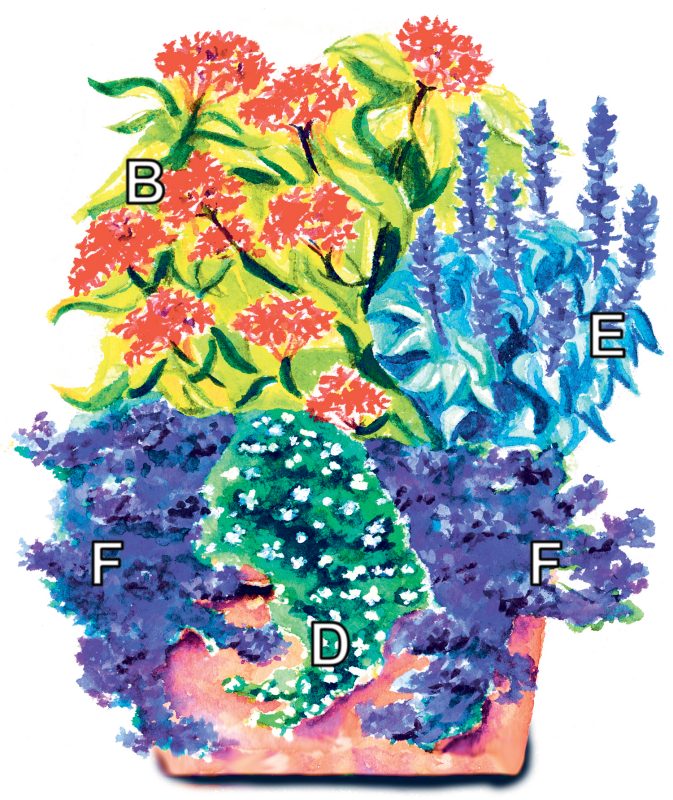
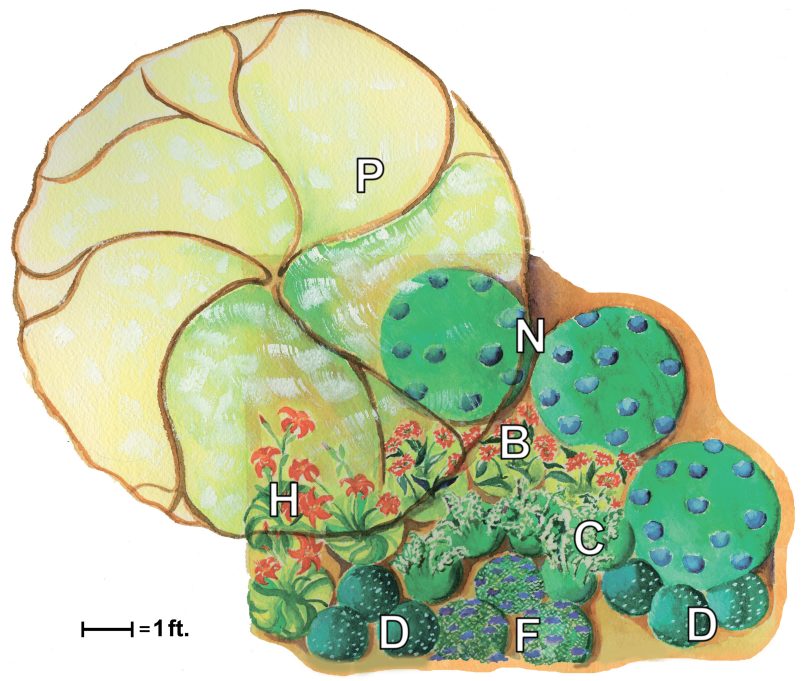
This publication features two designs, one for a 30-inch-wide container and one for an 8-foot-by-10- foot landscape area. Both are for full-sun locations. The selected plants - annuals, perennials, shrubs, and trees - all have at least one red, white, or blue feature. If these plants are unavailable or inappropriate for your area, use substitutions from the plant charts, or suggestions from your local garden retailer or Extension agent. Always select plants that are well-adapted to conditions of individual planting sites.
The letters on the designs correspond to the codes on the suggested plants list on page 4. Use the table to identify substitute plants as needed due to availability or personal preference.
Soil Preparation
Proper soil preparation is essential for the establishment and good growth of landscape plants.
Test soil drainage before planting. Dig a 12-inch test hole and fill it with water. If drainage is less than one inch per hour, relocate or raise the planting area, or install drainage to carry water away from the planting area.
Examine soil for compaction before planting. If the soil is compacted, consider replacing it with a good loam soil or incorporating several inches of an organic material, such as composted yard waste, to a depth of at least 8 to 12 inches over the entire planting area. Do not incorporate small quantities of sand; sand will increase compaction and decrease drainage.
Test the soil. Once the soil drains well and is not compacted, test the soil to determine if the pH should be adjusted or any nutrients added. To obtain a soil test kit, contact your local Virginia Cooperative Extension office. A complete list of VCE offices is available at www.ext.vt.edu/offices/.
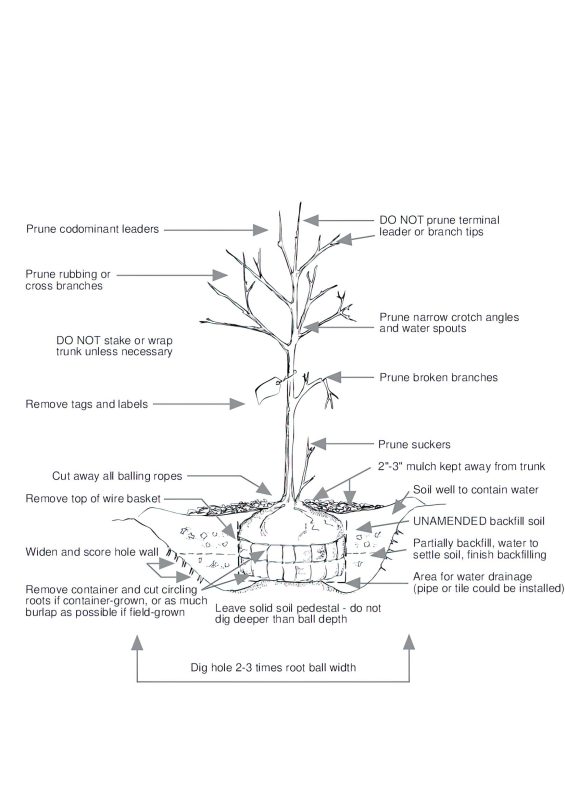
Do not amend the soil that will be used to backfill around the root-balls of your plants. Using amended backfill soil can cause water movement problems, causing the plant roots to be too wet or too dry.
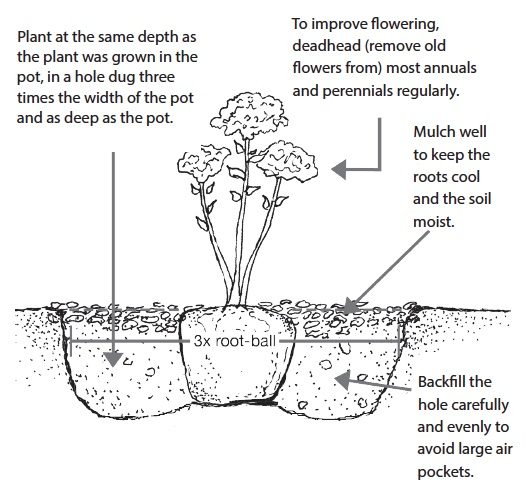
| Planting Tips for Annuals and Perennials |
|---|
|
Watering and Mulching
Watering is important to settle the soil at planting, encourage root growth into the landscape soil, and sustain plants once they are established.
During the growing season, plants need an average of one inch of water per week. If rainfall is limited, supplement with irrigation. Even during the winter, it may be important to water perennials, shrubs, and trees if the ground is frozen yet the temperature is warm. Use irrigation methods, such as drip irrigation and water reservoir devices, to conserve water, prevent soil erosion, and target the water application. Overwatering wastes water, may weaken roots and lead to root decay, and encourages undesirable weed growth.
Mulch benefits newly planted trees, shrubs, perennials, and annuals by conserving soil moisture, moderating soil temperature, and suppressing competing grass and weeds. Apply mulch immediately after watering newly installed plants. Do not over mulch! Two to three inches is adequate, less if you are using a fine material, more if it is coarse. Use either organic mulches (shredded or chunk pine bark, pine straw, shredded leaves) or inorganic mulches (shredded tires, volcanic and river rocks). To prevent insect, disease, and rodent problems if using organic mulches, and bark abrasion if using inorganic mulches, keep mulch from touching tree trunks and shrub stems. Do not use black plastic beneath mulch around trees and shrubs because it blocks air and water exchange.
Resources and Acknowledgments
Annuals: Culture and Maintenance, Virginia Cooperative Extension publication 426-200, http://pubs.ext.vt.edu/426-200/
Perennials: Culture, Maintenance and Propagation, Virginia Cooperative Extension publication 426-203, http://pubs.ext.vt.edu/426-203/
Tree and Shrub Planting Guidelines, Virginia Cooperative Extension publication 430-295, http://pubs.ext.vt.edu/430-295/
Reviewers: Debbie Dillion, program associate, Loudoun County; Laurie Fox, Extension specialist, Hampton Roads AREC; Susan French, Extension agent, Virginia Beach; and Barry Robinson, Extension agent, Montgomery County.
Container and landscape designs and watercolors by Elizabeth Maurer.
Project supported by funding from Jamestown 2007.
Virginia Cooperative Extension materials are available for public use, re-print, or citation without further permission, provided the use includes credit to the author and to Virginia Cooperative Extension, Virginia Tech, and Virginia State University.
Issued in furtherance of Cooperative Extension work, Virginia Polytechnic Institute and State University, Virginia State University, and the U.S. Department of Agriculture cooperating. Edwin J. Jones, Director, Virginia Cooperative Extension, Virginia Tech, Blacksburg; Jewel E. Hairston, Administrator, 1890 Extension Program, Virginia State, Petersburg.
| Code | Type | Botanical Name (suggested cultivars) | Height/ Spread | Sun/Shade 1 | Dry/Wet 2 | Color |
|---|---|---|---|---|---|---|
ANNUALS |
||||||
| A | lantana | Lantana ‘Patriot Cherry’ | 24" - 30"/ 30" - 42" | fs | d-m | red flowers |
| B | pentas | Pentas lanceolata ‘New Look Red’ ‘Mars Galaxy’ ‘Graffiti Bright Red’ | 12" - 24"/ 12" - 24" 16"/16" 10''/10'' | fs-ps | d-m | red flowers |
| C | angelonia | Angelonia ‘Angelface White’ | 12" - 18"/ 12" - 14" | fs-ps | d-m | white flowers |
| D | bacopa | Bacopa ‘Snowstorm’ | 3" - 8"/ 20" - 30" | fs-ps | d-m | white flowers |
| E | salvia | Salvia farinacea ‘Victoria Blue’ | 18" - 20"/ 12" - 14" | fs-ps | m | blue flowers |
| F | verbena | Verbena x hybrida ‘Temari Blue’ ‘Tukana Denim Blue,’ ‘Superbena Dark Blue’ | 12"/12" 6"/24" 8"/28" | fs-ps | m | blue flowers |
| PERENNIALS | ||||||
| G | yarrow | Achillea millefolium ‘Red Velvet’ | 24" - 30"/ 18" - 24" | fs-ps | m-d | red flowers |
| H | daylily | Hemerocallis ‘Frankly Scarlet’ | 24" - 30"/ 18" - 24" | fs-ps | w-d | red flowers |
| I | shasta daisy | Leucanthemum x superbum ‘Snowcap’ | 10" - 14" 12" - 18" | fs-ps | m | white flowers |
| J | speedwell | Veronica ‘Icicle’ (not recommended for SE. Va.) | 18" - 24" 18" - 24" | fs-ps | m | white flowers |
| K | cranesbill | Geranium ‘Rozanne’ | 18" - 20"/ 18" - 24" | fs-ps | m | blue flowers |
| L | speedwell | Veronica x ‘Goodness Grows’ | 12" - 15"/ 12" - 18" | fs-ps | m | blue flowers |
| SHRUBS | ||||||
| M | redtwig (red osier) dogwood3 | Cornus spp. | 4' - 8' 4' - 10' | fs-ps | w-d | white flowers, blue or white fruit, red stems |
| N | bigleaf hydrangea | Hydrangea macrophylla 'Summer Beauty,’‘Blue Billows,’‘Blue Wave’ | 3' - 6'/ 3' - 8' | ps-fs | m-w | blue flowers (in acid soil) |
| O | Virginia sweetspire3 | Itea virginica ‘Henry’s Garnet,’‘Little Henry’ | 3' - 4'/ 4' - 6' | ps-fs | w-d | white flowers, red fall leaf color |
| TREES | ||||||
| P | fringetree3 | Chionanthus virginicus | 12' - 20'/ 12' - 20' | fs-ps | m-w | white flowers, blue fruit on female |
| Q | dogwood3 | Cornus florida | 15' - 30'/ 15' - 30' | ps-fs | m | white flowers, red fruit, red fall leaf color |
1Sun/Shade: fs=full sun, ps=part sun/part shade
2Dry/Wet: w= prefers wetter soil, m=prefers evenly moist soil, d=somewhat dry/drought tolerant
3Virginia native plant
Virginia Cooperative Extension materials are available for public use, reprint, or citation without further permission, provided the use includes credit to the author and to Virginia Cooperative Extension, Virginia Tech, and Virginia State University.
Virginia Cooperative Extension is a partnership of Virginia Tech, Virginia State University, the U.S. Department of Agriculture (USDA), and local governments, and is an equal opportunity employer. For the full non-discrimination statement, please visit ext.vt.edu/accessibility.
Publication Date
July 9, 2020
