Reading the Pesticide Label
ID
ENTO-390NP (ENTO-646NP)
Introduction
Reading the label on your pesticide product may seem like a daunting task, but it is an essential step when working with pesticides. Always read the label before you purchase, use, store, or dispose of any pesticide or its container. This will ensure that you are prepared to work with a specific pesticide product.
A pesticide label is like a handbook; it outlines detailed information on how to use – or NOT use – a particular pesticide product. The label will answer any questions or concerns you have and can keep you from making mistakes.
Pesticide Product Labels and Your Safety
Before using any pesticide, you must read the product label and fully understand the information it contains. If any part of the label is unclear, contact your local Extension agent for assistance. Keep in mind that the pesticide label is a legally binding agreement between the manufacturer, the Environmental Protection Agency (EPA), and the end user. Once you have purchased a pesticide, you are required by law to follow all label directions. If a mishap occurs while a pesticide product is in your possession, you may be liable. Virginia is a “Label is the Law” state. Local, state, and federal officials take pesticide incidents very seriously.
Label Components
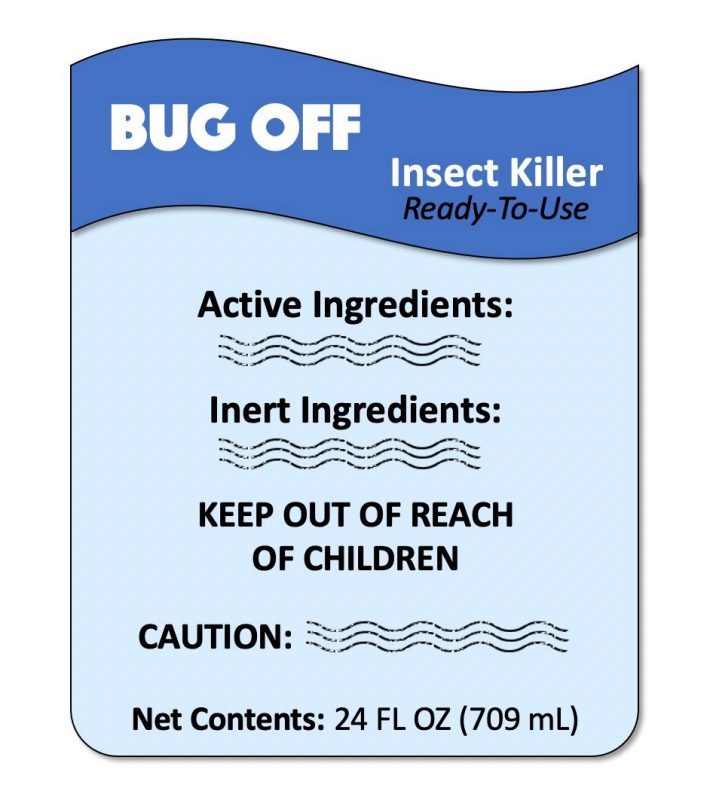
Pesticide product labels are printed directly on the container, or they may be a leaflet-style label that is attached to the container. Regardless of how the label is affixed, take note of the different components and sections. The front panel of the pesticide label will display the following identifying information (fig. 1):
- Brand Name – The marketing name of the product given by the manufacturer.
- Keep Out of Reach of Children – A mandatory child hazard warning. It is also necessary to keep pesticides away from pets.
- Signal Word – A word that indicates the relative acute toxicity of a product to humans. Possible signal words include CAUTION, WARNING, and DANGER.
- Ingredients Statement – A list of the amounts of active ingredient(s) (the specific chemical[s] that control the pest) and inert ingredients (other additives).
- Net Contents – The amount of product in the container, given in fluid ounces, pounds, etc.

- The back panel of the pesticide label, or the pages within a leaflet-style label, contains the following additional information (fig. 2):
- Directions for Use – This section lists:
- Pests the product claims to control.
- Sites where the product can be legally applied.
- Instructions on how to handle, mix, load, and apply the product.
- The application rate and how often the product can be used.
- Required application equipment.
- Storage and Disposal – Instructions for proper storage, product disposal, and container disposal.
- Precautionary Statements – Hazards to humans and domestic animals, and guidelines on how to reduce exposure to these hazards.
- First Aid – Recommended treatments for accidental exposure or poisoning.
- Environmental Hazards – Statements describing the potential harm a product may cause to fish, bees, birds, other nontarget organisms, and water sources, as well as required precautions to reduce these risks.
- Physical/Chemical Hazards – Information about the hazards a product may pose, like the potential for fires or explosions.
- EPA Registration Number – A number that identifies the product and indicates it has been approved by, and registered with, the EPA.
- EPA Establishment Number – A number that identifies the facility where the pesticide was produced.

Conclusion and Resources
Always read the product label every time you use a pesticide. Take time to familiarize yourself with the different components. Even if you have used the same pesticide product in the past, you should read the label each time you purchase it because its information could change over time. Reading the label will help you avoid errors that can lead to pesticide misuse and subsequent human health and environmental safety risks.
Additional information on reading pesticide labels:
- Consumer Pesticide Safety – Virginia Tech Pesticide Programs (sites.google.com/vt.edu/vtppconsumerpse)
- National Pesticide Information Center – Reading Pesticide Labels (npic.orst.edu/health/readlabel.html)
- Pesticide Environmental Stewardship – How to Read the Label (pesticidestewardship.org/homeowner/how-to-read-the-label/)
Virginia Cooperative Extension materials are available for public use, reprint, or citation without further permission, provided the use includes credit to the author and to Virginia Cooperative Extension, Virginia Tech, and Virginia State University.
Virginia Cooperative Extension is a partnership of Virginia Tech, Virginia State University, the U.S. Department of Agriculture (USDA), and local governments, and is an equal opportunity employer. For the full non-discrimination statement, please visit ext.vt.edu/accessibility.
Publication Date
May 20, 2026