Rockingham County 2023 Situation Analysis Report
ID
VCE-596-89NP (VCE-1175-89NP)

| Priority Issue | Planned Unit Response |
|---|---|
| Preserving Water Quality | Staff works with local NRCS and Soil and water districts. Staff will promote cover crops, no-till and managed grazing. |
| Assisting Farmers to preserve land and maintain profitability | Staff will assist with farm succession planning. Staff will promote science-based resources to promote profitability and preservation. |
| Helping youth develop leadership and life skills | Staff will hold workshops for youth promoting soft skills and leadership. Staff will provide lessons animal welfare and husbandry. Staff will hold workshops for raising livestock responsibly and profitably. |
| Ensuring a safe, high quality food supply | Staff will conduct safe food handling classes. Staff will promote healthy eating and living. Staff will teach home food preservation classes. |
Introduction
Rockingham County conducted a comprehensive situation analysis in the summer and fall of 2023. The situation analysis process was led by the Rockingham County Extension Unit and involved the development of a Rockingham County Unit Profile, as well as gathering community and resident perspectives on issues and problems in the county. Data and information from these activities were analyzed by the Rockingham County Unit and priority issues were identified.
Unit staff met several times to develop a survey tool and to discuss a distribution strategy. Staff utilized state survey data and a state provided survey tool to collect local data. Survey links were distributed by e-mail and promoted on social media. Following a thorough evaluation of qualitative and quantitative data, the key issues for Rockingham County were identified, including those that could be addressed with current Virginia Cooperative Extension (VCE) resources and those that were outside the scope of VCE.
Unit Profile
Rockingham County is in the central Shenandoah Valley of Virginia.
The data indicated that population by race has remained unchanged between 2018 and 2022. The total population has steadily increased from 2018 to 2022, the current population is estimated to be around 85,245 people. In addition, Harrisonburg City sits near the center of Rockingham County and has a population of around 51,000 people. The city and county have a mutually beneficial relationship to each other.
In Rockingham County, the median property value has increased from $206,700 in 2017 to $266,900 in 2022 a 29.1% increase in 5 years. This is a significantly higher rate of value growth than in the past.
Information from the county comprehensive plan showed that there is a need for balancing preservation and development of land resources techniques. Rockingham County has a unique and diverse mix of industry, education, and agriculture.
The high school graduation rate has increased from 82% to 87%. Additionally, the percentage of individuals with some college education has remained steady at 47%.
Current estimates of residents living below poverty level is 11.6%.
From 2012 to 2017 both the number of farms and total acres farms has increase (1,902 to 2,023 and 222,049 acres to 228,542 acres).
Additionally, net farm income has increase by 100% ($123,343,000 to $246,964,000) from 2012 to 2017.
New Agricultural Census data will be available in 2024.
Community and Resident Perspectives
We utilized a state situation analysis community survey for our local community. After disbursement, we looked at the results of both the state and local surveys.
Water quality was the top priority in both surveys. In addition, Youth life skills and food safety were highly ranked for everyone. Other issues that were top priorities included the aging population, agriculture sustainability, farm safety, mental health, agriculture profitability and the environment. hese are broad and dynamic issues that affect people both locally and globally. Virginia Cooperative Extension is uniquely positioned to tackle these issues like they have done for the past 110 years. Listed below is a summary of the priority issues identified for Rockingham County and how they are currently being addressed.
Community Issues
Agriculture: Local Food, Horticulture, On-Farm Food Safety
Foster strong, resilient local and regional food systems through the development of extensive diverse community-based partnerships.
Offer educational programming related to the Virginia Farm-to-Table initiative including conferences, workshops, and farm tours.
Promote beginning farmer development via the Virginia Beginning Farmer and Rancher Coalition Program’s many outreach efforts, such as curriculum development, workshops, fact sheets, and consults.
Organize a 60-member volunteer association (Central Shenandoah Valley Master Gardeners (MG)) and offer training for new MG volunteers, and on-going development of programming related to home, school, and community gardening.
Develop a strong on-farm food safety program to help fresh produce growers implement Good Agricultural Practices (GAPs) aimed at reducing fresh produce contamination risks.
Use a multi-pronged approach to educate growers needing GAP certification by using group grower trainings, one-on-one farm consults (on-farm assessment, GAP audit manual preparation, on-farm compliance, mock audit walk-throughs), and post-audit follow-up.
Agriculture: Profitability and Environmental Sustainability
Develop and offer educational programming based on on-going crop, horticulture, livestock, and dairy producer input, and changing market trends.
Promote diversification of farm enterprises to spread risk and provide additional income sources.
Provide pesticide safety education to protect water quality and improve producer profitability.
Encourage no-till strategies to reduce erosion and protect water quality.
Provide production workshops and field days to growers, as well as one-on-one consultations in the areas of crop, livestock, dairy, and horticultural production.
Partner with other agencies and industry to hold programs advocating agricultural best management practices (BMPs) to minimize erosion and runoff of soil and nutrients into the local watersheds.
Environmental/Land Use: Environmental Quality – air, soil, water
Provide conferences and field days to help farmers implement and refine management practices related to no-till cropping systems and cover crops in order to minimize sediment and nutrient losses.
Promote agricultural BMPs such as the exclusion of livestock from water bodies using fencing.
Evaluate manure management and other technologies that minimize pollution and allow more precise application of nutrients to crop areas.
Provide field days and demonstrations for new technologies to improve efficiency and profitability.
Promote homeowner BMPs for lawn and garden via various outreach venues.
Environment/Land Use: Land Use Planning - farmland preservation, green space
In order to slow the loss of farmland to residential and commercial development, educate farmers and landowners about land conservation and preservation options, such as conservation easements, land use taxation, and farm transition between generations.
Foster the value and contribution of farmers to the larger local citizenry via regional promotion like the “Buy Fresh Buy Local Directory” and other similar initiatives.
Provide local agriculture products for breweries, wineries, and local farmers markets.
Promote green space development and beautification through Master Gardener outreach aimed at the public at local farmers’ markets, library, and gardening seminars.
Partner with other environmental organizations and non-profits to support farmer’s needs.
Families and Communities: Safe and Nutritious Food for Overall Health
Education on the safe handling of food for the home, community, and business establishments.
Programming designed to assist individuals and families with making decisions about food and physical activity to assist with reducing/preventing chronic diseases.
Emphasize local foods and agriculture by encouraging home food preservation and food business entrepreneurship.
Youth: Leadership Training & Teen Involvement
Provide club and county level officer training and encourage youth to run for club offices.
Involve intermediate and teen-aged youth in assisting with workshops as helpers and instructors.
Involve youth in programming efforts including planning, content, dates, and ideas/suggestions.
Provide an extensive training for camp counselors in preparation for day camps and residential camps.
Encourage youth to run for state 4-H cabinet and attend State 4-H Congress, National 4-H Congress, and 4-H Washington Leadership Conference.
Encourage youth from diverse backgrounds to participate in 4-H activities.
Utilize teens during educational workshops and day camps to share knowledge with young and beginner 4-H members.
Youth: Life Skills/Decision Making
Involve youth in club order, procedures, and programming.
Provide educational programming focused on life skill development, public speaking, citizenship, and leadership. Programs may include workshops, day camps, residential camps, state-level events, and team events.
Advocate a long-term project book opportunity focused on specific projects (e.g., woodworking, photography, livestock, etc.).
Involve youth in club and county level community service, outreach, and fundraising efforts.
Host county-level contests for public speaking, presentations, and fashion revue.
Offer dynamic workshops with a focus on a variety of soft and hard skills.
Support teams that teach collaboration, communication, cooperation, decision making, and prioritization.
Partner with schools to provide school enrichment opportunities including topics such as: embryology, horticulture, agriculture production, and environmental science.
Other: Community Development
VCE does not directly create job opportunities in the community, but several of our programs address this issue.
Provide volunteer training and experience that can extend beyond the goals of VCE.
Provide paid and unpaid internship opportunities.
Provide mental health awareness programs.
4-H youth development programs help youth build skills to prepare them for working in the community.
Family and Consumer Sciences programs help provide skills that youth and adults need to be productive employees and citizens.
Agriculture programs work to increase the profitability of farms and provide the opportunity to employ more people through growth and diversification.
Foster collaboration within the community and with outside organizations.
Future Programming to Address Community Issues
The Rockingham extension staff will provide robust and diverse programming to address current community issues. Based on needs and regular input from local stakeholders staff will provide science-based education to the community. Future programs will include, but are not limited to, food safety, home food preservation; grazing management to preserve natural resources; youth skills development; produce safety and marketing; animal production. In addition to direct programming, staff will partner with other state and local agencies such as NRCS and the Soil and Water Conservation district to address issues like water quality. We can assist these agencies with educational materials.
Visit Virginia Cooperative Extension: ext.vt.edu
Appendices
2018 community survey results:
| Non-AG | Not Important | Neutral | Important |
|---|---|---|---|
| Water Quality | 2 | 19 | 79 |
| Aging Population | 7 | 19 | 74 |
| Life Skills/Decision Making for Youth | 2 | 26 | 72 |
| Food Safety/Preservation | 2 | 31 | 68 |
| Healthy Food Access | 2 | 32 | 66 |
| Human Nutrition | 2 | 33 | 65 |
| Youth Activities | 0 | 35 | 65 |
| Poverty | 2 | 34 | 64 |
| Child Development | 2 | 34 | 64 |
| Land Use | 2 | 34 | 64 |
| Adult Nutrition | 11 | 27 | 61 |
| Teen Leadership | 2 | 38 | 60 |
| Parenting | 3 | 36 | 60 |
| Food Security | 0 | 40 | 60 |
| Housing Affordability | 19 | 23 | 58 |
| Long Term Care | 9 | 35 | 56 |
| Local Food Systems | 4 | 40 | 56 |
| Youth Volunteers | 2 | 42 | 56 |
| Career Development | 7 | 39 | 54 |
| Financial management | 16 | 32 | 52 |
| Local Government | 4 | 46 | 51 |
| Housing Availability | 20 | 30 | 50 |
| Obesity | 3 | 48 | 48 |
| Chronic Diseases | 9 | 44 | 47 |
| Science and Technology | 2 | 51 | 47 |
| Dependent Care | 5 | 48 | 47 |
| Energy | 3 | 52 | 45 |
| Small Business/Entrepreneurs | 9 | 47 | 44 |
| Gardening | 7 | 49 | 44 |
| Landscaping | 21 | 58 | 21 |
| Average Deviation | 5 | 8 | 9 |
| Average | 6 | 37 | 57 |
| Median | 3 | 36 | 57 |
| Standard Deviation | 6 | 10 | 11 |
- Orange cells are 1 Standard Deviation above the Median.
- Yellow cells are above the Median.
| Ag | Not Important | Neutral | Important |
|---|---|---|---|
| Water Quality | 0 | 20 | 80 |
| Life Skills for Youth | 0 | 25 | 75 |
| Agricultural Sustainability | 0 | 27 | 73 |
| Farm Safety | 4 | 26 | 70 |
| Mental Health | 2 | 29 | 70 |
| Food Safety/Preservation | 2 | 29 | 69 |
| Agriculture Production/Profitability | 0 | 33 | 67 |
| Environment | 2 | 32 | 66 |
| Land Use | 0 | 35 | 65 |
| Dairy Productiviry | 7 | 28 | 65 |
| Consumer Agriculture Awareness | 0 | 36 | 64 |
| Farm Financial Management | 2 | 42 | 57 |
| Livestock Nutrition | 2 | 42 | 56 |
| Local Food Systems | 4 | 41 | 55 |
| Fruit Production | 8 | 38 | 55 |
| Crop Protection | 4 | 43 | 54 |
| Agricultural Leadership Development | 2 | 45 | 54 |
| Crop Production | 0 | 47 | 53 |
| Energy | 4 | 44 | 53 |
| Livestock Productivity | 2 | 46 | 52 |
| Vegetable Production | 2 | 47 | 51 |
| Science and Technology | 2 | 48 | 50 |
| Agriculture Marketing | 5 | 45 | 50 |
| Organic Agriculture | 8 | 45 | 47 |
| Pests/Pesticides | 4 | 50 | 46 |
| Poultry Production | 8 | 46 | 46 |
| Invasive Species | 8 | 47 | 45 |
| Farm Transition | 4 | 51 | 45 |
| Local Government | 4 | 52 | 44 |
| Alternative Crops | 9 | 47 | 44 |
| Forest Production | 8 | 49 | 43 |
| Forage Production | 6 | 51 | 43 |
| Wildlife | 6 | 51 | 43 |
| Alternative Agriculture | 7 | 53 | 40 |
| Land Access | 2 | 59 | 39 |
| Human Wildlife Conflict | 10 | 55 | 35 |
| Horticulture | 4 | 65 | 31 |
| Precision Agriculture | 8 | 63 | 29 |
| Livestock Genetics | 8 | 66 | 26 |
| Genetically Modified Organisms | 16 | 59 | 25 |
| Small Ruminants | 8 | 76 | 16 |
| Average Deviation | 3 | 9 | 11 |
| Average | 4 | 45 | 51 |
| Median | 4 | 46 | 51 |
| Standard Deviation | 4 | 12 | 15 |
- Orange cells are 1 Standard Deviation above the Median.
- Yellow cells are above the Median.
| Field | Little or No Effort | Moderate effort | High or Very High Effort |
|---|---|---|---|
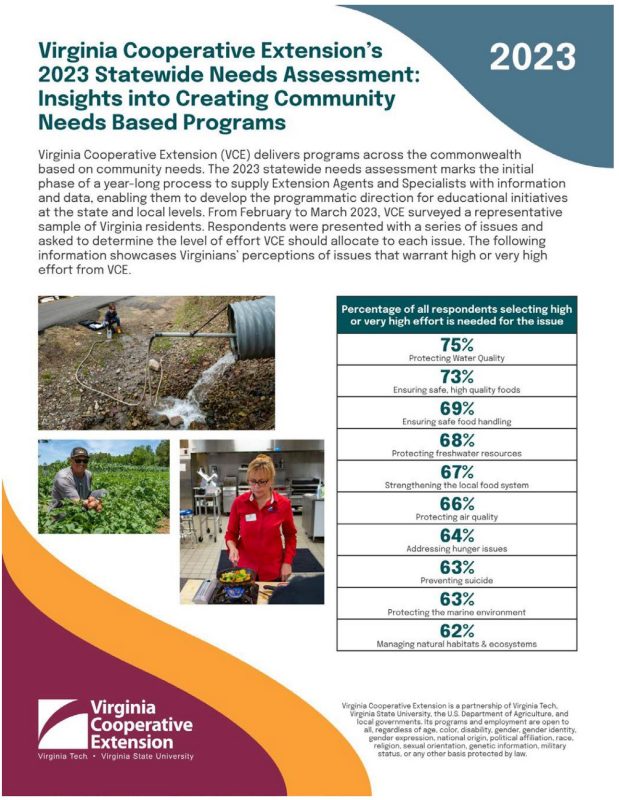
| Protecting water quality | 4.17% | 0.00% | 95.84% |
| Preserving farm and forest land | 0.00% | 16.67% | 83.34% |
| Assisting farmers and forest landowners in production and profitability | 0.00% | 16.67% | 83.33% |
| Helping youth develop leadership, citizenship, and other life skills | 8.33% | 12.50% | 79.17% |
| Strengthening the local food system | 0.00% | 20.83% | 79.16% |
| Ensuring safe, high quality foods | 8.33% | 16.67% | 75.00% |
| Promoting agricultural, natural resources, and environmental literacy | 0.00% | 25.00% | 75.00% |
| Controlling invasive pests (plants, animals, insects) | 0.00% | 29.17% | 70.84% |
| Ensuring safe food handling practices to prevent foodborne illness | 0.00% | 33.33% | 66.67% |
| Getting more adults involved in mentoring youth | 4.17% | 29.17% | 66.67% |
| Protecting freshwater resources (lakes, rivers, springs, wetlands) | 4.17% | 29.17% | 66.67% |
| Building capacity for farm to school programming | 4.17% | 29.17% | 66.66% |
| Protecting air quality | 20.83% | 16.67% | 62.50% |
| Building healthy families | 8.33% | 29.17% | 62.50% |
| Strengthening workforce readiness | 0.00% | 37.50% | 62.50% |
| Reducing misuse and overuse of pesticides and fertilizers | 4.17% | 33.33% | 62.50% |
| Helping consumers make healthy food choices | 12.50% | 29.17% | 58.34% |
| Reducing obesity | 20.84% | 20.83% | 58.33% |
| Teaching youth good money habits | 0.00% | 41.67% | 58.33% |
| Supporting businesses which engage in agritourism | 8.33% | 37.50% | 54.17% |
| Addressing hunger issues | 20.83% | 25.00% | 54.17% |
| Preventing chronic disease | 20.83% | 25.00% | 54.17% |
| Teaching people to manage their money | 12.50% | 33.33% | 54.17% |
| Assisting forest landowners with sustainable management practices | 8.33% | 37.50% | 54.16% |
| Preserving foods for home use (canning, dehydrating, fermenting, freezing) | 12.50% | 33.33% | 54.16% |
| Promoting economic development | 8.34% | 41.67% | 50.00% |
| Assisting local government and businesses with land use decisions | 8.34% | 41.67% | 50.00% |
| Helping communities improve their quality of life | 12.50% | 37.50% | 50.00% |
| Conservation and utilization of forest resources | 16.67% | 33.33% | 50.00% |
| Facilitating civic engagement | 4.17% | 45.83% | 50.00% |
| Teaching healthy relationship skills to teens | 8.33% | 41.67% | 50.00% |
| Protecting the coastal environment | 16.67% | 33.33% | 50.00% |
| Addressing adult and youth mental health | 20.84% | 33.33% | 45.84% |
| Promoting alternative agriculture | 12.50% | 41.67% | 45.84% |
| Promoting small business entrepreneurs | 12.50% | 41.67% | 45.83% |
| Providing physical fitness education | 33.33% | 20.83% | 45.83% |
| Preventing suicide | 33.33% | 25.00% | 41.67% |
| Teaching people to protect themselves from identity theft, frauds, and scams | 12.50% | 45.83% | 41.67% |
| Protecting the marine environment | 8.33% | 50.00% | 41.66% |
| Managing natural habitats and ecosystems | 4.17% | 54.17% | 41.66% |
| Addressing alcohol abuse | 58.34% | 4.17% | 37.50% |
| Helping households reduce water use | 29.17% | 33.33% | 37.50% |
| Composting, reducing, and recycling consumer goods | 20.84% | 41.67% | 37.50% |
| Promoting scientific literacy among youth | 12.50% | 50.00% | 37.50% |
| Strengthening parenting skills | 20.83% | 41.67% | 37.50% |
| Preventing youth violence | 29.16% | 33.33% | 37.50% |
| Helping communities be better prepared for and respond to natural disasters | 29.17% | 37.50% | 33.33% |
| Helping Virginians' become more energy eff. in their homes, farms, and businesses | 16.67% | 50.00% | 33.33% |
| Addressing prescription drug abuse | 54.17% | 12.50% | 33.33% |
| Strengthening couple and/or marital relationships | 33.33% | 33.33% | 33.33% |
| Building the capacity of community nonprofits | 29.17% | 45.83% | 25.00% |
| Strengthening dependent care | 33.34% | 41.67% | 25.00% |
| Addressing poverty | 29.16% | 50.00% | 20.83% |
Virginia Cooperative Extension materials are available for public use, reprint, or citation without further permission, provided the use includes credit to the author and to Virginia Cooperative Extension, Virginia Tech, and Virginia State University.
Virginia Cooperative Extension is a partnership of Virginia Tech, Virginia State University, the U.S. Department of Agriculture (USDA), and local governments, and is an equal opportunity employer. For the full non-discrimination statement, please visit ext.vt.edu/accessibility.
Publication Date
April 5, 2024