Aphids in Virginia Small Grains: Life Cycles, Damage and Control
ID
444-018 (ENTO-584P)
 EXPERT REVIEWED
General Description
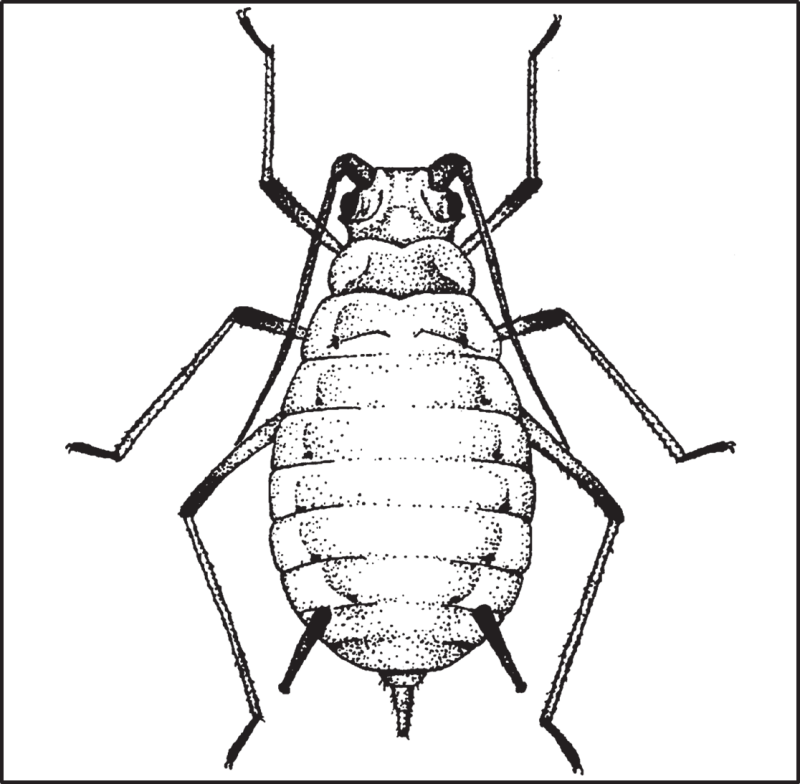
Four species of aphids attack small grains in Virginia greenbug, corn leaf aphid, bird cherry-oat aphid, and English grain aphid. In general, these aphids are small pear-shaped insects (1/16 to 1/8 inch long) that are green to nearly black, or sometimes pinkish in color. Immature aphids look just like adults except smaller. Both winged and wingless forms can occur in the same colony. All grain aphids have a pair of conicles, tailpipe like projections, on the top side of the tail end. Aphids feed singly or in colonies on upper and lower leaf surfaces and stems. They feed near plant bases when plants are young or during cold weather, and on upper-canopy leaves, stems, and even grain heads later in the season.
Life Cycle and Injury
All four aphid species overwinter in small grains in Virginia. Winged adult males and females begin moving into early-planted fields in mid to late October from surrounding wild and cultivated grasses, and can be blown longer distances by wind. After mating, winged females give birth to wingless females (all wingless aphids of these four species are female), which in turn give birth to more wingless females, in as few as seven days after birth. Wingless females reproduce without mating and can give birth to 60 to 80 young during their 20 to 30 day reproductive period. Thus, several generations can occur in one season and enormous populations can develop in a short time.
Maximum reproduction and development occurs between 55° and 75°F, but aphids can feed and successfully reproduce at any above-freezing temperatures. Aphids have been observed giving birth at 48°F in eastern Virginia. Aphid populations are not severely affected by overnight temperatures below 30°F; however, several days of continuous freezing temperatures will dramatically reduce numbers. Aphid populations in Virginia can increase rapidly during periods of warm weather in October through December, are typically very low during January and February, and begin to increase rapidly during warm periods in the spring.
Winged forms can be found throughout the year. The factors that influence the production of winged adult forms are unknown but it is winged adults that leave grain fields after harvest to establish on summer hosts.
Aphids feed by piercing plant tissues with needle-like mouth parts, then sucking fluids. The expression of symptoms after aphid feeding depends on whether plant toxins or pathogens are injected during feeding. The greenbug is the only species of the four known to occur in Virginia grains that injects plant toxins.
Perhaps the biggest aphid-related problem of small grains in Virginia is the potential for transmission or dissemination of barley yellow dwarf virus (BYDV). Greenbug, bird cherry-oat, and English grain aphids are all known BYDV vectors. Some individual aphids carry virus particles in their digestive tracts or saliva.
BYDV causes barley to turn a yellowish color, and infected plants become stunted and nonproductive, whereas, diseased wheat and oat plants turn a reddish color and become stunted.
If BYDV outbreaks occur, they appear as patches of stunted yellowing or reddening plants scattered throughout the field. Yellowing areas that are in strips or that entirely cover the field are most likely not caused by aphid damage or disease, but rather indicate problems associated with fertility, pH, or cold weather. Yield losses due to BYDV are more severe when young plants are infected during the fall or early winter.
Predicting Oubreaks and How To Sample
Aphid population outbreaks are largely dependent on weather and planting date of the grain. Mild temperatures during November and December increase the possibility of serious fall infestations. Wheat and barley planted by October 15 are also more susceptible to aphid attack. These fields should be checked weekly during mild fall weather to determine the presence of economically damaging populations of aphids and BYDV.
To sample, examine all plants in a linear foot of row in at least 5 locations, and estimate the number of aphids per row-foot. The field should also be examined for the presence of small yellowing patches of stunted plants (reddened areas in wheat and oats). When sampling for aphids, be careful not to take samples from the field edges where populations are usually highest. The side of a field that is downwind of a tree line often has more aphids than other parts of the field. Fall insecticide applications are generally needed only when average aphid populations (combining all four aphid species) approach 15 to 25 per row-foot.
Continued mild weather during the winter makes spring outbreaks more likely. The beneficial insects that attack aphids reproduce slowly at temperatures below 65°F, whereas aphids can rapidly increase when temperatures exceed 50°F. Fields should be examined for the presence of aphids just prior to top dressing grain with nitrogen. Many insecticides can be mixed with nitrogen and applied at top-dress; however, this practice should be limited to only those fields where aphid populations approach 15 to 25 per row-foot if top dressing is to be applied before plants have begun rapid spring growth, or 100 to 300 per row-foot if top dressing is to be applied after plants have resumed vigorous growth.
Regular sampling should continue through April and May. If aphids begin to move into the grain heads, examine at least 50 heads from throughout the field, and determine the average number per head. Treatment should be considered if an average of 20 to 25 or more aphids are found per head.
Natural Enemies
There are a number of aphid predators and parasites that, if left untreated, can effectively keep aphid populations below economic thresholds. Among the most common are lady beetles (both adults and larvae), syrphid fly (hover fly) larvae, common lacewing larvae, and a group of small parasitic wasps.
Lady beetle adults are small, oval, hard-shelled, and often brightly colored. Larvae are up to 1/3 inch long, somewhat flattened, bluish-gray with orange markings, and with legs stretched outward on the sides.
Syrphid fly larvae are green or brown maggots that have tapered front and back ends. They have no head capsule or legs and hold their hind ends in place while moving their heads about when searching for aphids. They are commonly found in grain heads and are often mistaken for pests.
Lacewing larvae are light brown, mottled with brownish-red markings, about 1/4 inch long, and resemble tiny alligators. They have relatively large sickle-like mandibles, or jaws, which they use to spear and suck body fluids from aphids and other prey. Adult lacewing females attack small white oval-shaped eggs to tiny upright strands of silk.
Perhaps the most effective natural enemies are the tiny wasps that parasitize aphids. You may not see the wasps, but “mummies,” or aphid remains, can be easily seen when wasps are active. Adult female wasps insert eggs into aphid bodies. Upon hatching from eggs, the tiny wasp larvae eat out aphid bodies and emerge as adults through round hatch-door like exit holes, leaving papery brown empty shells or “mummies.” Parasitic wasps can virtually eliminate aphid infestations, especially when temperatures are warm in early fall or late spring. Fungal diseases may provide some control.
Aphid Identification
Although it is more important to recognize the economic potential of an infestation than to be able to identify the different species, the following are brief descriptions of each species along with information on the injury they do. A survey of eastern Virginia showed that of the four species, English grain and bird cherry-oat aphids were the most abundant during the fall, winter, and early spring. English grain aphid was most abundant in late spring. Corn leaf aphid can be abundant in the fall, but is more commonly found on sorghum (milo). Greenbug can reach high levels, but ecnomic infestations are not common.
Greenbug
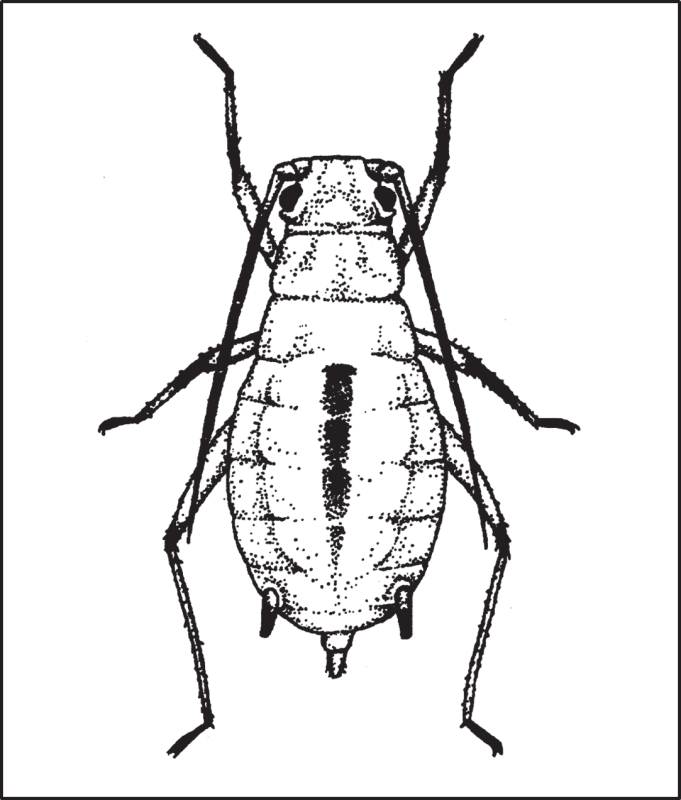
Small grains, primarily wheat and barley, provide the major fall and winter hosts for greenbugs. Oats, sorghum, johnsongrass, and other grasses can serve as summer and interim hosts. Greenbugs are pale green with a darker green stripe running down the middle of the back, but are more readily recognized by the injury they cause to small grain plants. Greenbugs inject a toxic substance when feeding that causes feeding sites, and eventually whole plants, to turn yellow or reddish, then brown if infestations are severe. Seedling plants are very sensitive to injury, which may result in plant loss, stunting, delayed maturity, and reduced kernel size. Field infestations can be detected by the presence of localized areas where leaves have reddish or orange-looking spots (feeding sites), or an overall yellowish appearance. Greenbug injury can be distinguished from moisture or temperature stress, or nitrogen deficiency, by inspecting plants for the presence of aphids. Greenbug is also a known vector of BYDV. The disease is spread as aphids feed, and losses from the disease can be serious if infection occurs in the fall or early winter.
Corn Leaf Aphid
Corn leaf aphids are distinctly blue to dark green in color with a darker area at the base of the cornicles. They feed on small grains, wild grasses, and corn, but are most commonly found in sorghum whorls during vegetative growth stages. Corn leaf aphid feeding is much less injurious to grain than greenbug feeding because toxins are not injected during feeding. Large infestations can cause yellowish mottling of leaves, but injury is seldom economic.
Bird Cherry-Oat Aphid
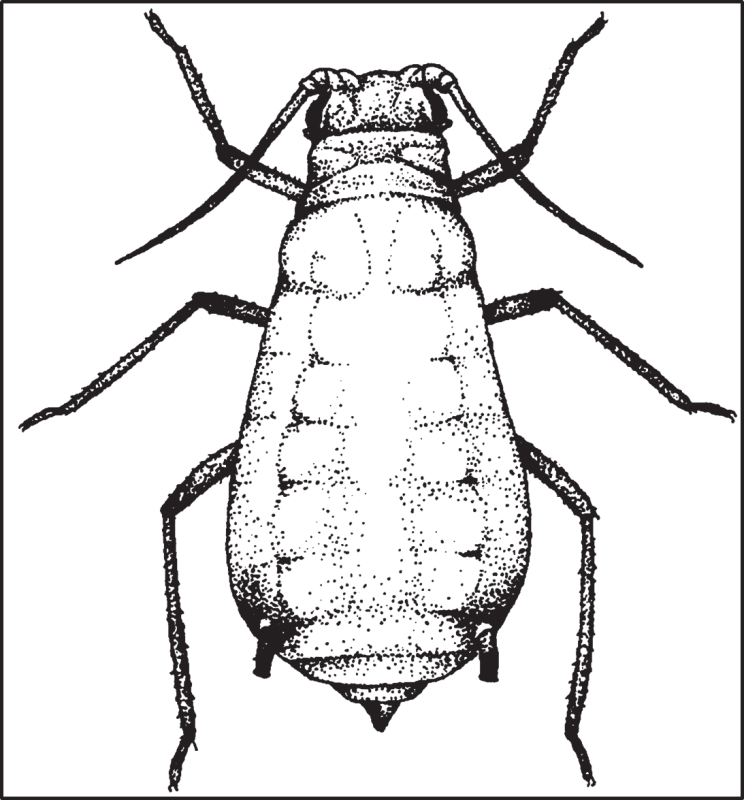
These aphids are olive green to blue-black in color and have reddish patches at the base of the cornicles. Like corn leaf aphids, bird cherry-oat aphids do not inject toxins while feeding, therefore, even though heavy infestations can develop, injury is not readily apparent and plants appear to be able to tolerate large infestations without economic yield losses. However, bird cherry-oat aphid is another known vector of BYDV, and if the virus is present in aphid populations, feeding can vector the disease and yield losses can occur.
English Grain Aphid
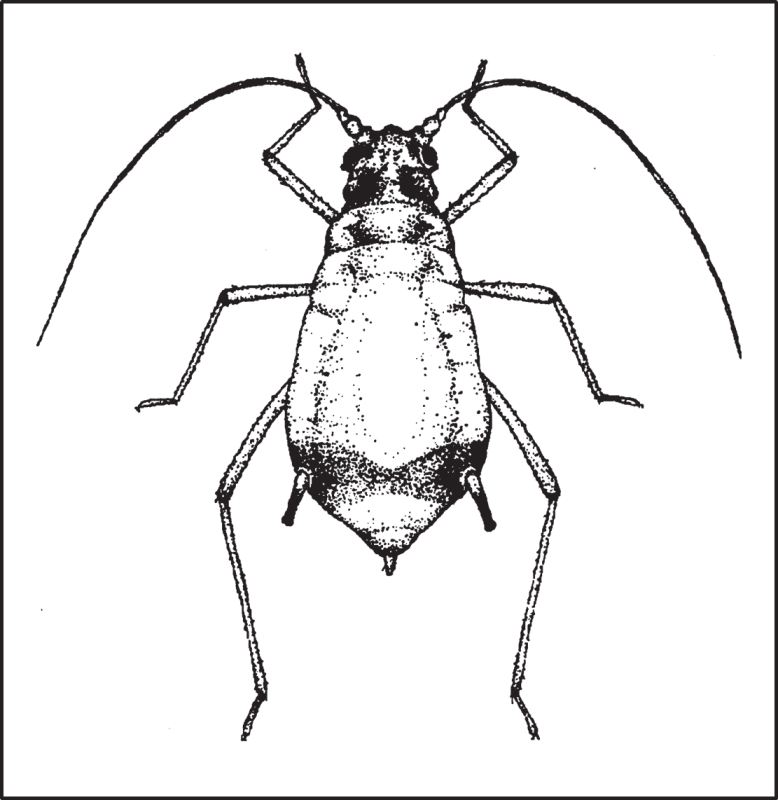
English grain aphids are usually grass-green in color, but can be pinkish, especially in the spring. Their cornicles and antennae are black and longer in relation to their bodies compared with other species. No toxins are injected during feeding, so, like bird cherry-oat aphids, injury is not apparent and usually not economic unless associated with BYDV transmission. It is the most common species in late spring, when it develops and feeds inside the upper leaf sheath (boot) and on the flag leaf. As grain begins to head, the aphids move to the grain head and cluster among bracts and kernels.
Feeding by large numbers causes the growing kernels to discolor and shrivel. Heavy head infestations can reduce yields by 13%. Scouting is especially valuable in predicting problem infestations because English grain aphids have only been found in heads of plants infested in the lower canopy earlier in the season. It appears that they move up plant stalks as grain heads develop, rather than fly in from areas outside the field. English grain aphid can also vector BYDV, and like bird cherry-oat aphids, can cause reduced yields if the virus is present in the populations at the time they are feeding.
When to Treat
The following guidelines should be considered prior to using insecticidal controls for aphids in small grain which will be harvested for the grain:
Insecticide-resistant aphids have been found in other wheat producing areas of the United States. Using insecticides only when actually needed may reduce the likelihood of resistant strains developing. Aphid control is not advised if the crop is approaching the hard dough stage or if there is good predator/parasite activity. For chemical recommendations, review a copy of the most recent issue of the Virginia Cooperative Extension Publication entitled, “Pest Management Guide for Field Crops.” Virginia Tech does not recommend using an insecticide if the crop is to be used for grazing live-stock or is to be cut for hay or silage.
Time of Year |
Suggested Number Needed to Treat |
Fall Planting until spring growth begins |
15-25/row-foot and yellowing areas scattered throughout the field |
Spring After spring growth resumes until hard-dough stage |
100/row-foot, plants 3-6 inches tall 200/row-foot, plants 7-10 inches tall 300/row-foot, plants 11+ inches tall |
Heading |
20-25/grain head |
Virginia Cooperative Extension materials are available for public use, reprint, or citation without further permission, provided the use includes credit to the author and to Virginia Cooperative Extension, Virginia Tech, and Virginia State University.
Virginia Cooperative Extension is a partnership of Virginia Tech, Virginia State University, the U.S. Department of Agriculture, and local governments. Its programs and employment are open to all, regardless of age, color, disability, sex (including pregnancy), gender, gender identity, gender expression, genetic information, ethnicity or national origin, political affiliation, race, religion, sexual orientation, or military status, or any other basis protected by law.
Publication Date
March 20, 2019