Rain Garden Plants
ID
426-043 (SPES-57P)
 EXPERT REVIEWED
A rain garden is a landscaped area specially designed to collect rainfall and manage stormwater runoff. It is a planted shallow depression that temporarily holds runoff from impervious areas until it evaporates, is absorbed by the plants, or infiltrates into the ground. The plants, microorganisms, and soil in the rain garden act as a filter to clean pollutants from the runoff. For more information on rain gardens look at VCE publication SPES-13P. For a rain garden to work, plants must be selected, installed, and maintained properly.
Plant Selection
- Choose plants tolerant of both occasional flooding as well as dry periods.
- Choose noninvasive plants that are adapted to the local environment.
- Choose a mixture of species. A good rule of thumb is one plant species for every 10 to 20 square feet. For example – a 140-square-foot garden would have 7 to 14 different plant species.
- Choose plants based on the amount of sun or shade the garden receives, for interest year-round, to blend with the rest of the landscape, and for any specific design theme like pollinators or natives.
- Choose a mix of woody and herbaceous plants for different root depths and different filtering abilities.
- Choose a mix of evergreen and deciduous plants so there will be visual interest and active filtering in the winter.
- Choose perennials instead of annuals as they come back every year and generally require less maintenance.
- Choose to add a tree (that doesn’t drop a lot of debris) if the garden is large enough. See small and medium tree definitions in the glossary.
- Choose plants for vertical layering – a mix of tall-, medium-, and low-growing species for visual interest and to slow down rainfall.
Plant Installation
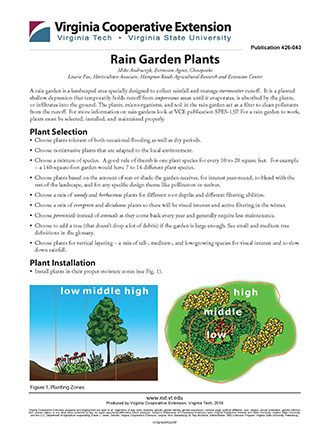
- Install plants in their proper moisture zones (see Fig. 1).
- Plant shrubs and perennials in groups of three to five of the same species. Trees can be planted in groups or individually.
- Plant taller and larger plants in the center, at the back, or at one end of the garden, depending on the views.
- Plant shorter plants where they can be seen easily, around the garden edges, in front of larger plants, or underneath taller plants.
- Space and plant perennials so that their canopies will grow together and cover the ground to minimize weeds.
- Space and plant trees and shrubs according to their mature size. For example – beautyberry shrubs, that grow to six feet wide, should be planted three feet apart.
- Adding plants outside and around the rain garden area helps the garden blend into the overall landscape.
- More information can be found in Tree and Shrub Planting Guidelines, Virginia Cooperative Extension publication 430-295.

Maintenance
- Add two to three inches of organic mulch (like pinebare, pine needles, or shredded hardwood) to the entire newly planted rain garden. Do not cover the crowns of the perennials. Replenish mulch as needed in areas where the plant canopies haven’t filled in or where there is bare ground.
- Be aware that mulch may float when runoff comes into the rain garden.
- Prune or remove any dead, diseased, or damaged plants as soon as the problem is noticed. More information on pruning woody plants can be found in Virginia Cooperative Extension publications 430-455 through 430-462.
- Leave the foliage of perennials and ornamental grasses when they die back and go dormant for the winter. In the spring just before new growth starts, prune the dead foliage and remove from the garden. This leaves the ground bare the shortest amount of time and helps prevent weeds.
- Hand pull or spot treat weeds with an herbicide as necessary.
- Water the garden during its establishment (first growing season) and extended dry periods (more than two weeks). One inch of water per week is recommended.
Plant Lists
Trees, shrubs, and perennials are listed with both their common and scientific names. Research plants including specific cultivars, varieties, and sizes, to see which ones fit the rain garden design best.
Trees
| Common Name | Scientific Name |
|---|---|
| Crape Myrtle | Lagerstroemia spp. |
| Dwarf River Birch | Betula nigra ‘Little King’ |
| Eastern Redbud | Cercis canadensis |
| Fringetree | Chionanthus virginicus or retusus |
| Hazel Alder | Alnus serrulate |
| Serviceberry | Amelanchier arborea/laevis/canadensis |
| Witchhazel | Hamamelis spp. |
| Common Name | Scientific Name |
|---|---|
| Black Alder | Alnus glutinosa |
| Carolina Silverbell | Halesia tetraptera |
| Crape Myrtle | Lagerstroemia spp. |
| Eastern Hophornbeam/ironwood | Ostrya virginiana |
| Eastern Red Cedar | Juniperus virginiana |
| Musclewood/hornbeam | Carpinus caroliniana |
| Sweetbay | Magnolia virginiana |
| White Cedar | Thuja occidentalis |
Shrubs
| Common Name | Scientific Name |
|---|---|
| American Beautyberry | Callicarpa americana |
| Anise | Illicium parvifolium |
| Arrowwood | Viburnum dentatum |
| Bottlebrush Buckeye | Aesculus parviflora |
| Buttonbush | Cephalanthus occidentalis |
| Carolina Allspice | Calycanthus floridus |
| Chokeberry | Aronia spp. |
| Cranberrybushes | Viburnum opulus/trilobum |
| Devilwood | Osmanthus americana |
| Dogwood | Cornus sericea |
| Elderberry | Sambucus canadensis |
| False Indigo | Amorpha fruticosa |
| Fetterbush | Leucothoe racemosa |
| Fothergilla | Fothergilla gardenii |
| Groundsel Bush | Baccharis halimifolia |
| Highbush Blueberry | Vaccinium corymbosum |
| Inkberry | Ilex glabra |
| Leucothoes | Leucothoe axillaris/fontanesiana |
| Oakleaf Hydrangea | Hydrangea quercifolia |
| Possumhaw | Ilex decidua (male and female) |
| Rose of Sharon | Hibiscus syriacus |
| Spicebush | Lindera benzoin |
| Steeplebush | Spiraea tomentosa |
| Summersweet Clethra | Clethra alnifolia |
| Swamp Azalea | Rhododendron viscosum |
| Swamp Rose | Rosa palustris |
| Virginia Sweetspire | Itea virginica |
| Wax Myrtles | Myrica cerifera/pennsylvanicum |
| Willows | Salix caprea/discolor/matsudana sachalinensis/purpurea |
| Winterberry | Ilex verticillata (need both male and female) |
| Yaupon Holly | Ilex Vomitoria |
Perennials
| Common Name | Scientific Name |
|---|---|
| Arrowhead | Sagittaria latifola |
| Asters | Aster spp. |
| Beardtongue | Penstemon digitalis |
| Beebalm | Monarda didyma |
| Blackeyed Susan | Rudbeckia hirta |
| Blue Lobelia | Lobelia siphilitica |
| Bluestar | Amsonia tabernaemontana |
| Calla Lily | Zantedeschia spp. |
| Canna Lily | Canna spp. |
| Cardinal Flower | Lobelia cardinalis |
| Crinum Lily | Crinum spp. |
| Daylilies | Hemerocallis spp. |
| Gingers | Hedychium spp. |
| Goldenrod | Solidago flexicaulis |
| Hardy Begonia | Begonia grandis |
| Hibiscus | Hibiscus coccineus/moscheutos |
| Ironweed | Vernonia noveboracensis |
| Irises | Iris lousiana/versicolor |
| Joe-Pye Weed | Eutrochium (Eupatorium) |
| Leopard Plant | Farugium tussilaginea (Ligularia) |
| Liatris | Liatris spicata |
| Lilyturf | Liriope muscari |
| Lizard Tail | Saururus cernuus |
| Lungwort | Pulmonaria spp. |
| Marsh Marigold | Caltha palustris |
| Monkey Flower | Mimulus ringens |
| Obedient Plant | Physotegia virginiana |
| Pickerelweed | Pontederia cordata |
| Plantain Lily | Hosta spp. |
| Primroses | Primula spp. |
| Rain Lilies | Zephyranthes spp. |
| Red Columbine | Aquilegia canadensis |
| Siberian Bugloss | Brunnera macrophylla |
| Spiderwort | Tradescantia spp. |
| Swamp Milkweed | Asclepias incarnata |
| Swamp Sunflower | Helianthus angustifolius |
| Turtleheads | Chelone lyonii/obliqua |
| Virginia Bluebells | Mertensia virginica |
| Wild Ginger | Asarum canadense |
| Windflowers | Anemone spp. |
Ferns
| Common Name | Scientific Name |
|---|---|
| Autumn Fern | Dryopteris erythrosora |
| Christmas Fern | Polystichum acrostichoides |
| Cinnamon Fern | Osmunda cinnamomea |
| Holly Fern | Cyrtomium falcatum |
| Japanese Painted Fern | Athyrium nipponicum |
| Lady Fern | Athyrium felix-femina |
| Royal Fern | Osmunda regalis |
| Tassel Fern | Polystichum braunii |
| Wood Ferns | Dryopteris spp. |
Grasses and Grass-like
| Common Name | Scientific Name |
|---|---|
| Feather Reed Grass | Calamagrostis acutiflora |
| Little Bluestem | Schizachyrium scoparium |
| Rushes | Juncus spp. |
| Sedges | Carex spp. |
| Sweetflag | Acorus spp. |
| Switchgrass | Panicum virgatum |
Groundcovers
| Common Name | Scientific Name |
|---|---|
| Bugleweed | Ajuga spp. |
| Foamflower | Tiarella cordifolia |
| Green and Gold | Chrysogonum virginianum |
| Lilyturf | Liriope spicata |
| Mazus | Mazus reptans |
| Plumbago | Ceratostigma plumbaginoides |
| St. Johnswort | Hypericum calycinum |
| Strawberry Begonia | Saxifraga stolonifera |
Resources
Chesapeake Bay Program How-To’s and Tips - https://www.chesapeakebay.net/action/howtotips
Chesapeake Stormwater Network Homeowner BMP Guide - http://chesapeakestormwater.net/2013/04/homeowner-bmp-guide/
Low Impact Development Center Rain Garden Design Templates - http://www.lowimpactdevelopment.org/raingarden_design/templates.htm
Natural Resource Conservation Service USDA Rain Garden guide - https://www.nrcs.usda.gov/Internet/FSE_DOCUMENTS/nrcs142p2_011366.pdf
N.C. Cooperative Extension Rain Garden Manual - https://www.ces.ncsu.edu/wp-content/uploads/2016/03/RGmanual2015.pdf
Virginia Cooperative Extension: Stormwater Management for Homeowners Fact Sheet series by L. Fox - http://pubs.ext.vt.edu/
Virginia Cooperative Extension: publications on fertilizer and pesticide use, plant and grass selection and maintenance, and local Extension offices and agents - http://www.ext.vt.edu
Virginia Cooperative Extension: Guides to Successful Pruning publications 430-455 through 430-462 - http://pubs.ext.vt.edu
Virginia Cooperative Extension: Tree and Shrub Planting Guidelines, publication 430-295 - http://pubs.ext.vt.edu/430-295/
Virginia Department of Environmental Quality: Regional Native Plant Guides - www.PlantVirginiaNatives.org
Virginia Department of Forestry Rain Garden Technical Guide - http://www.dof.virginia.gov/infopubs/Rain-Garden-Technical-Guide-2014-05_pub.pdf
Glossary
Annual – any plant that completes its life cycle from seed germination through flowering and seed set in one year
Cultivar – a human crossed plant selection with a unique trait that is maintained by asexually progagation
Deciduous – any woody plant that drops its leaves in winter
Evergreen – any plant that retains foliage throughout all months of the year
Herbaceous – Plants that have no woody stems and generally die back and are dormant over the winter
Impervious surface - Surface that does not allow water to flow through it
Perennial – any plant that lives for longer than 2 years
Stormwater - Water that runs off impervious surfaces during rain events, often associated with urban areas; also called “runoff”
Variety – a naturally occurring plant population with a unique trait like flower or fruit color
Woody – plants that have hard stems like trees and shrubs
Acknowledgments
The authors would like to express appreciation for the reviews and comments provided by the following individuals: Barry Fox, Extension Specialist, Virginia State University, Adria Bordas, Extension Agent, Fairfax County, Karen Carter, Extension Agent, Henrico County, and JoAnne Gordon, Horticulturist, City of Norfolk. This is a revised and updated version of the publication originally authored by Laurie Fox, Mike Andruczyk Traci Gilland, Susan French, and Lynnette Swanson. Reviewed by David Close, Consumer Horticulture and Master Gardener Specialist, Horticulture, Virginia Tech
Virginia Cooperative Extension materials are available for public use, reprint, or citation without further permission, provided the use includes credit to the author and to Virginia Cooperative Extension, Virginia Tech, and Virginia State University.
Virginia Cooperative Extension is a partnership of Virginia Tech, Virginia State University, the U.S. Department of Agriculture (USDA), and local governments, and is an equal opportunity employer. For the full non-discrimination statement, please visit ext.vt.edu/accessibility.
Publication Date
January 2, 2024